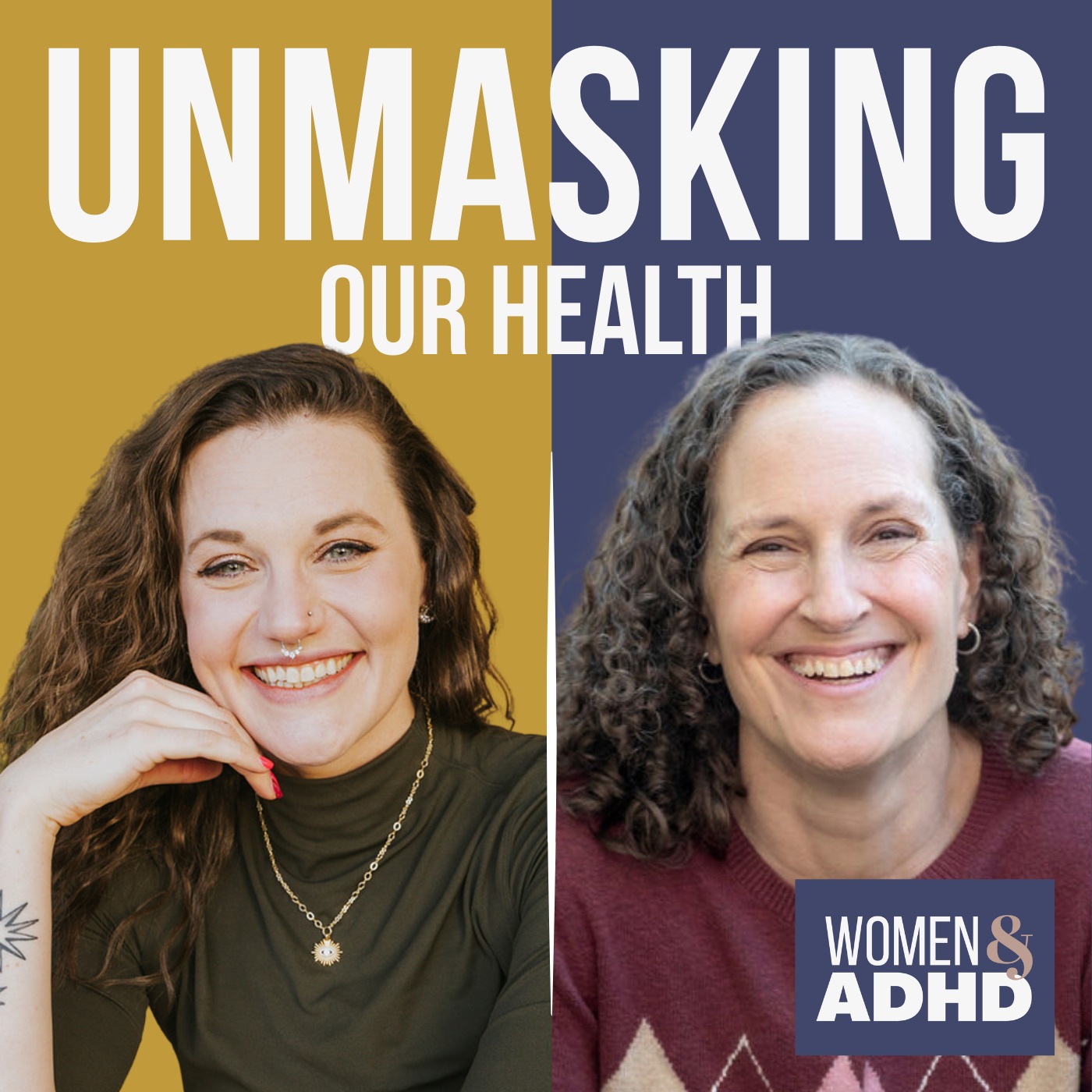
Unmasking Our Health: Hypermobility & hypermobile Ehlers-Danlos syndrome (hEDS), Part 2
About This Episode
Episode 217 with Katy Weber & Kalin Johnson
Welcome back to our new series, “Unmasking Our Health,” in which host Katy Weber teams up with medical expert Dr. Kalin Johnson, PharmD, to look beyond the neurodivergent brain and explore what it means to live in a neurodivergent body.
After years of interviewing late‑diagnosed women and seeing the same patterns — chronic pain, fatigue, autoimmune issues, hormonal chaos, gut problems, “mystery” symptoms — Katy created the Unmasking Our Health series to explore the bigger questions behind neurodivergence: What if ADHD isn’t just about our brains, but about our whole bodies — and how and why is the medical system missing the full picture?
In Part 2 of a 2-part series, we continue the conversation on hypermobility, hypermobile Ehlers-Danlos Syndrome, and the often misunderstood symptoms that can show up alongside ADHD and autism. This episode focuses on the signs people miss, why those symptoms happen, and what kinds of support may help rather than hurt.
Kalin explains the connective tissue and autonomic nervous system connections behind bruising, fatigue, digestive issues, migraines, dizziness, pelvic floor problems, and joint pain, while Katy shares personal examples of how these patterns have shown up in her own life.
In this episode, we cover:
- A recap of Part 1, including hypermobility, hypermobile EDS, the Beighton score, and the connection with neurodivergence
- Why bruising, slow wound healing, nosebleeds, and fragile blood vessels can occur
- Proprioception, balance, spatial awareness, and why “clumsiness” may be more than distraction
- Fear of falling and the increased risk of pain or injury in hypermobile bodies
- Constant bracing, muscle guarding, and why hypermobile people may feel exhausted even while resting
- Digestive symptoms, including constipation, bloating, slow motility, and dysmotility
- Migraines, neck tension, craniocervical instability, POTS, and blood-flow regulation
- Dizziness upon standing, fluid pooling, low blood volume, electrolytes, and compression
- Pelvic floor issues, urinary symptoms, incomplete emptying, and prolapse
- Skin texture, softness, stretchiness, and translucency
- Why aggressive stretching and yoga can sometimes worsen instability and pain
- Strength training, swimming, pacing, and learning to stop before end range
- Estrogen, perimenopause, muscle building, and hypermobility symptoms
- Collagen, creatine, and what supplements can and cannot do
- Exercise intolerance, internalized beliefs about laziness, and body shame
- Finding healthcare providers who are knowledgeable, curious, and willing to listen
Note: Nothing in this episode constitutes medical advice. Always consult with your physician and pharmacist before starting, stopping, or changing any medication.
Kalin’s website: kalinjohnson.com
Instagram: @kalinpharmd
Links & Resources:
- The Beighton Scoring System
- Hypermobility Screening Tool
- Growing Up with Ehlers-Danlos Syndrome: 27 Telltale Signs
- Chronic Pain Partners
- Have a topic you want Katy and Kalin to cover? Contact us
- - - - -
Episode edited by E Podcast Productions
- - - - -
Women & ADHD coaching: www.womenandadhd.com/coaching
- - - - -
Work 1-on-1 with Katy: www.womenandadhd.com/katy
- - - - -
Order the “Hey, it’s ADHD!” course: www.womenandadhd.com/adhdcourse
- - - - -
Did you love this episode? Click here to pledge a one-time donation to the podcast!
- - - - -
If you are a woman who was diagnosed with ADHD and you’d like to apply to be a guest on this podcast, visit womenandadhd.com/podcastguest.
Instagram: @womenandadhdpodcast
Tiktok: @womenandadhdpodcast
Twitter: @womenandadhd
Facebook: @womenandadhd
Advertising Inquiries: https://redcircle.com/brands
Privacy & Opt-Out: https://redcircle.com/privacy
[SPEAKER_01]: little recommendations that really really help us actually be able to exist well in our bodies can be the opposite of these other maybe more commonly diagnosed conditions that it can also look like but the treatment can be the exact opposite and really really really matters to have this diagnosis to have this understanding of your body through this lens if this is what your body is struggling with.
[SPEAKER_00]: Hello and welcome to the women and ADHD podcast. [SPEAKER_00]: I'm your host, Katie Weber. [SPEAKER_00]: I was diagnosed with ADHD at the age of 45, and it completely turned my world upside down. [SPEAKER_00]: I've been looking back at so much of my life. [SPEAKER_00]: School, jobs, my relationships, all of it with this new lens, and it has been nothing short of overwhelming. [SPEAKER_00]: I quickly discovered I was not the only woman to have this experience and now I interview other women who like me discovered in adulthood they have ADHD and are finally feeling like they understand who they are and how to best lean into their strengths both professionally and personally.
[SPEAKER_00]: Welcome back to Women and ADHD. [SPEAKER_00]: Today I am joined once again by medical expert Dr. Kaylin Johnson for another episode of Unmasking Our Health, a recurring series in which we look beyond the neurodivergent brain and explore what it means to live in a neurodivergent body. [SPEAKER_00]: Kailin is a clinical pharmacist, a late diagnosed ADHD and autistic powerhouse, and the ultimate nerd-eversion health advocate. [SPEAKER_00]: You can find out more about Kailin at KailinJonson.com, and that link is in the show notes.
[SPEAKER_00]: Okay, today's episode is part two. [SPEAKER_00]: of a deep dive into hypermobility and hypermobile alers Danlo syndrome. [SPEAKER_00]: If you haven't already listened to part one, I highly recommend you pause and go listen to episode 215 first because we cover a lot of the basics in that episode including why there is such a high prevalence of connective tissue conditions among ADHD and autistic adults. [SPEAKER_00]: In part one, we explore the difference between hypermovility, flexibility, and hypermobile EDS.
[SPEAKER_00]: Kalin explained the connection between neurodivergence and connective tissues, introduced the baton scale and its limitations, and we began unpacking some of the surprising signs of hypermovility, including a resistance to numbing agents, stiffness after car rides, walking on your toes, and pelvic floor fatigue. [SPEAKER_00]: In this episode, part 2, we pick up where we left off and we take a deeper look at every day symptoms and experiences that can be connected to a hypermobile body, including frequent and easy bruising, delayed wound healing, nosebleeds, fear of falling, chronic muscle tension, digestive problems, migraines, pots, dizziness, pelvic floor issues, urinary symptoms, skin texture, and exercise intolerance.
[SPEAKER_00]: We also talk about what it actually looks like to care for hypermobile joints, including why stretching and yoga may sometimes make pain and instability worse, and why building strength, learning your joints, pacing yourself, and avoiding end range movements can be more helpful. [SPEAKER_00]: We also explore the impact of estrogen fluctuations and perimenopause, the role of electrolytes and compression, how ADHD can make pacing especially difficult, and how our own internalized beliefs about laziness, productivity, and weight can affect the way we treat our bodies.
[SPEAKER_00]: Finally, Kalin explains how to find knowledgeable and curious healthcare providers, what types of specialists may be involved, and why getting the right diagnosis can change the way you understand and support your body. [SPEAKER_00]: Okay, without further ado, here is part two of our deep dive into hypermobility and hypermobile EDS. [SPEAKER_01]: Okay, welcome back, Kaelin! [SPEAKER_01]: Hello, and happy to be back! [SPEAKER_00]: I'm so encouraged by all of the positive feedback we've been getting for the unmaskier health series.
[SPEAKER_00]: It seems to be really striking a chord for a lot of listeners. [SPEAKER_00]: So I'm thrilled that that is happening and just wanted to let you know as a listener to reach out. [SPEAKER_00]: If you have any questions or any topics, we have a long list now at this point of topics to talk about in terms of symptoms and traits in neurodivergent bodies that have very,
[SPEAKER_00]: Brains diagnoses. [SPEAKER_01]: So who could have guessed there were unique needs for women with ADHD in the health category? [SPEAKER_01]: Wow, I'm shocked. [SPEAKER_00]: And how surprising it is that they are chronically dismissed by the medical stem. [SPEAKER_01]: What? [SPEAKER_01]: What? [SPEAKER_01]: What? [SPEAKER_01]: No. [SPEAKER_01]: Yeah, that tracks that tracks. [SPEAKER_00]: Okay, so before we get too far into today's topic, do this is also just a reminder if you were a listener that this is part two of a two bird series.
[SPEAKER_00]: So if you haven't already listened to part one of our unmasking our health on the topic of hypermobility and hypermobile ailer stand list, pause, go back and listen to it, part one. [SPEAKER_00]: Before you listen to this episode, because in part one, we get into a lot more depth about the difference between hypermovility and hypermovility. [SPEAKER_00]: Yes, the difference between hypermovility and flexibility. [SPEAKER_00]: Kailin goes on, you know, who Kailin goes into very detailed explanation about why there is this co-occurrence with neurodivergence and hypermovility and just, you know, the brain body connection around connective tissue.
[SPEAKER_00]: symptoms, traits, and neurodivergence. [SPEAKER_00]: So that's good where you're going to find out more about that. [SPEAKER_00]: We're not going to spend much time on that overlap in this episode. [SPEAKER_00]: In part one, we also talked about the bait and score, the nine point bait and test, and how it often misses a lot of the hypermovility, symptoms, and traits, and adults, and how it differs from [SPEAKER_00]: the Bechtel Test in Peter's movies. [SPEAKER_00]: And also we started talking about some of the kind of surprising signs that you had hypermobile EDS or hypermobility growing up.
[SPEAKER_00]: We started talking about some of those signs that are surprising like easy bruising or resistance to light again and numbing agents in dental surgery or just car ride stiffness we talked about in part one. [SPEAKER_00]: and walking on toes, which is a very common trait in kids, especially with autism and ADHD. [SPEAKER_00]: So how that connects to connective tissue, pelvic floor fatigue, and some of the ways in which our body kind of develops trauma from just the like locking and protective guarding around the body.
[SPEAKER_00]: So we got started on that list. [SPEAKER_00]: And I quickly realized this was a long list that I wanted to go into a little board depth. [SPEAKER_00]: So we're going to start there in terms of part two, or at least I guess pick up from where we left off with some of these surprising signs. [SPEAKER_00]: And I wanted to start off with the issue of like blood vessels, minor scrapes and bruises, and sort of bleeding in general. [SPEAKER_00]: Why does it oftentimes with hypermobilidias?
[SPEAKER_00]: You take longer to heal, and your skin has more of a thin texture, and also the nose bleeding, too. [SPEAKER_01]: Yeah. [SPEAKER_01]: Yeah, exactly. [SPEAKER_01]: So again, when you think about connected tissue, I like to think of it a lot about like connected tissues and the scaffolding of the body. [SPEAKER_01]: It's everywhere that basically holds up and supports the body. [SPEAKER_01]: So you're going to find it in different organisms everywhere, including your veins and arteries.
[SPEAKER_01]: So they are also weaker. [SPEAKER_01]: more likely to sustain injury. [SPEAKER_01]: Should you bump your arm, bump your head, any of those things, they're more likely to rupture. [SPEAKER_01]: So you are more likely to have those bruises. [SPEAKER_01]: Let alone one of the things we talked about last time where there's a lot of crossover with ADHD and neurodivergence and hypermobility is the differences in proprioception. [SPEAKER_01]: So we're also a lot more likely to be [SPEAKER_01]: air quo, clumsy, but it's not really clumsiness here.
[SPEAKER_01]: Your body's constantly sending messages back to your brain about where it is in time and space. [SPEAKER_01]: And if the bolts are loose, it's not sending good information back. [SPEAKER_01]: And that's the ligaments. [SPEAKER_01]: So [SPEAKER_01]: if we're not getting good information back, we're not getting great information out to about being able to navigate different spaces with our body. [SPEAKER_01]: So you've got the already weekend vessels and arteries, because that connected to two different, you got the difference in proprioception, and then the delayed wound healing.
[SPEAKER_01]: So we need your immune system, we need your metabolic system, we need all the systems of the body working on point to be able to heal and when you have a body hypermobile body, it is more likely that the body is sending energy elsewhere to deal with other issues and problems we are more likely to have an activated autonomic nervous system for a plethora of reasons and when we're in that state systems that the body deems unnecessary in that moment. [SPEAKER_01]: shut down or stop working as well.
[SPEAKER_01]: So we often don't have as well of a functioning immune system or metabolic system or all these systems that are needed to be able to heal. [SPEAKER_00]: Yeah. [SPEAKER_00]: Right. [SPEAKER_00]: I mean, I remember very early on after I was diagnosed with ADHD sort of making hearing about that connection between bruising and proprioception and ADHD and just being like, oh ADHD, we're clumsy. [SPEAKER_00]: I'm not paying attention because I'm distracted so I bump into things,
[SPEAKER_00]: Why, right? [SPEAKER_00]: Yeah, and I remember you early on when I was first working with you like talking about you had asked me like do I have or I guess we were talking about the fear of heights and how difficult it was for me to like step on a ladder and how I found it strange because I'm not necessarily afraid of heights if I'm on a bridge or something high, but there was this idea of like climbing up onto something that was very, very difficult and you had explained to me why that was.
[SPEAKER_01]: Yeah, there's actually research papers out there. [SPEAKER_01]: There's one that talks about the fear of falling in women with hypermobility and other stainless syndrome. [SPEAKER_01]: Like it is something that's even being researched, which is pretty cool, actually. [SPEAKER_01]: But yeah, that like there seems to be then, if you know and you feel like I can't trust my own bodies, joint system, or where my body is, [SPEAKER_01]: in space. [SPEAKER_01]: One, your body knows if I do fall, it's going to hurt a lot more than it is going to for the average body.
[SPEAKER_01]: I remember as like a really young kid, if I would drop off the monkey bars, like the ankle pain was so severe and I was like 78 years old, but [SPEAKER_01]: If you have, again, those blues bowls, those loose ligaments, loose connected tissue, takes a whole whole lot more impact there than it would for another body. [SPEAKER_01]: And so you've got the pain part, the wanting to avoid that. [SPEAKER_01]: You've got the knowing, like, the the proprioception piece of, like, I'm having a hard time gauging where my body is in space.
[SPEAKER_01]: How far away X thing is and all of a sudden, then you get this fear of falling. [SPEAKER_01]: I've also always had a fear of falling. [SPEAKER_01]: Like, I didn't want to go skiing. [SPEAKER_01]: or like my family did, things like that because I, the idea falling was heck no, no, thank you. [SPEAKER_00]: Yeah, right, my family loves free climbing. [SPEAKER_00]: We have a lot of rock climbing in the area where I live and everybody of my family loves it. [SPEAKER_00]: And I used to like it when I was younger, but now as I'm older, I just, I'm terrified.
[SPEAKER_00]: And it's like, yeah, I'm not terrified of falling. [SPEAKER_00]: I'm terrified of like snapping my cat or, you know, or like, like, I'm terrified of like my kneecap. [SPEAKER_00]: Yes, snapping her. [SPEAKER_00]: So it like it's this very strange fear associated more with like my legs giving out from underneath me than it is about actually falling. [SPEAKER_01]: Right, because again, like something in your brain, though, nose, though, that like those, those bolts are loose. [SPEAKER_01]: Right, like in it, nose, though, that like with impact, there is a greater risk that things are going to go places we don't want them to go.
[SPEAKER_01]: So can your brain smart? [SPEAKER_01]: It was, the body doesn't do things for
[SPEAKER_01]: me that I believe it. [SPEAKER_01]: So firmly actually they get so cool. [SPEAKER_01]: When I'm saying it, you know, on terms to my patients, I'll say it's like pickles, meaning it's like, you know, we talk about how like pregnant women, maybe if they're low on salt, they may create pickles. [SPEAKER_01]: It's not about the pickles, but the brain knows, hey, we're low on salt. [SPEAKER_01]: This is the only way we can send this message out to you to say, hey, get a salt. [SPEAKER_01]: We're like, when I was pregnant, I was dreaming [SPEAKER_01]: like and like um dirt like it sounded so good and I was like oh better check my iron because like that's the way the body sense that message should same thing the body's like I don't want to fall like this is scary to me because again something within you knows though that there are more likely to be injury to these areas should again fall happen of course anybody can be injured but are likely that there's going to be a heck of a lot higher with a lot less [SPEAKER_00]: Yeah, right.
[SPEAKER_00]: And I think it also kind of connects the dots to around like the the exhaustion or the inexplicable exhaustion that you might feel in life and then also the way in which we are constantly just gurgling and holding and and like tensing and [SPEAKER_00]: protecting around those loose joints. [SPEAKER_01]: Just at rest, you're doing work. [SPEAKER_01]: I think that's one of the things too. [SPEAKER_01]: You know, we talk so often and I'm sure if you're scrolling your Instagram feed, you're probably going to see something about like rest and like pressing your nervous system and doing all these things.
[SPEAKER_01]: Of course, I talk about that stuff too. [SPEAKER_01]: But the thing is, for somebody who's hyper mobile, it is so hard to get your body to rest because if you let certain joints
[SPEAKER_01]: sometimes there is risk of injury and it's really hard then like if even if you're laying down it's like oh I better tighten my hips and protect my securely actually oh I better like tighten my shoulders and my neck and protect you know my cranioservical instability and so like trying to get the body to trust that that to be okay to find decisions where it actually is okay to do that is extra difficult so even at rest your body is doing extra work for you [SPEAKER_00]: Yeah. [SPEAKER_01]: Yeah.
[SPEAKER_01]: So you're tired. [SPEAKER_00]: And that makes sense. [SPEAKER_00]: The other really big overlap that I have heard a lot about. [SPEAKER_00]: And one of the, one of the traits that comes up a lot with with EDS that I haven't actually experienced much in recent years. [SPEAKER_00]: I think I did when I was a child more is the digestive problems. [SPEAKER_00]: And [SPEAKER_00]: we should do it a whole episode on IBS and Autism in ADHD. [SPEAKER_00]: But what is the connection there between EDS and digestive problems?
[SPEAKER_00]: And like what kind of digestive problems are we talking about? [SPEAKER_01]: Yeah, so there's a couple of different things that tend to happen here too, because again, it's never one answer, unfortunately. [SPEAKER_01]: But one of the biggest things is we need blood flow going to our gut for our gut to work appropriately, for it to be able to work [SPEAKER_01]: through food, because your GI tract is basically a long tube of smooth muscle that is supported by a connective tissue, and that is all controlled by the autonomic nervous system.
[SPEAKER_01]: So, if our autonomic nervous system is in an activated state, that you guys system isn't working as well. [SPEAKER_01]: I mean, I think a lot of us may be kind of no classically, we term the parasympathetic or that
[SPEAKER_01]: nervous system. [SPEAKER_01]: So right, digestion. [SPEAKER_01]: For in synthetic, digestion goes away. [SPEAKER_01]: Well, hypermobile people because of the body being in the again, this concept kind of like threat response, whether it's from the joints or from the game things like we'll talk more about later, but dehydration, electrolyte and balances, all of the different stuff, the body then goes into, well, you know, there's a bigger threat, we don't need digestion. [SPEAKER_01]: So if you kind of think of it like, [SPEAKER_01]: If you're running from a tiger, the body says, through working through your hamburger, I need that blood flow pump into your muscles so we can get away.
[SPEAKER_01]: And then as soon as you relax, then blood flow rushes back to the gut. [SPEAKER_01]: So you tend to get a lot of slow GI motility and dismotility. [SPEAKER_01]: some patients just like I talked about with the blood flow rushing back and get swings then were then they get increased blood flow and then you get rapid evacuation happening. [SPEAKER_01]: But like chronic constipation is really common in patients with hyperbable allergy and low syndrome. [SPEAKER_01]: So again, if you've got connected to shoe and auto-numbic function, both being altered, digestion is going to be altered too.
[SPEAKER_01]: So, most get this really slow Jedi motilities to you, you're going to get a lot of cramping, bloating, you're then also more likely to get the food, basically stopping and starting to ferment, starting to break down where it's not supposed to, which is when you're then more likely to get a lot of issues with not having the good bacteria we want in the gut or then triggering something called mass-selectivation syndrome or MCAS. [SPEAKER_01]: which is, again, something else we could do it and hold their topic about as well, which is also common in people with hypermobile LSD and low syndrome.
[SPEAKER_01]: So, can I just tissue in the gut? [SPEAKER_01]: Autonomic nervous system, not functioning appropriately, you're gonna get a whole lot of GI issues too. [SPEAKER_00]: Okay. [SPEAKER_00]: All right, so that explains that overlap. [SPEAKER_00]: Now, what about migraines? [SPEAKER_00]: Migraines can also be a sign. [SPEAKER_01]: Yeah, so migraines are something, again, a couple of different things. [SPEAKER_01]: One, we could get migraines often from tension in the jaw, the neck, the shoulders.
[SPEAKER_01]: So one of the common things that we see in hypermole, L.R. [SPEAKER_01]: Sandlow syndrome is something called cranioservical instability, where the neck
[SPEAKER_01]: There's a whole lot of joints, there's a whole lot of muscles, there's a whole lot there happening, and if that's unstable, all that tension around that area trying to keep all of that stable, especially when we tend to have not great posture, which worsens CCI, to tend to be very hunched forward kind of turtle by with our head. [SPEAKER_01]: pointed forward, which was a whole lot of pressure back there at the back of your neck, a lot more likely to get migraines. [SPEAKER_01]: Other reason, likely to get migraines.
[SPEAKER_01]: So, postural or the static tech occurred in syndrome, or pots, is also another condition that is very common in the hypermobile L.S. [SPEAKER_01]: and L.S. [SPEAKER_01]: community. [SPEAKER_01]: and pots then when you get that very blood flow that basically is not able to stabilize when you change body positions. [SPEAKER_01]: So when you go from like laying down to sitting up, to standing, it really constructs. [SPEAKER_01]: And then if you get varying degrees of hydration and electrolyte imbalances, your potty's like constantly struggling to keep enough blood volume and fluid volume to be able to maintain consistent pressures.
[SPEAKER_01]: And the body's not
[SPEAKER_01]: bottoming out and then having to shoot back up really high and having sometimes even things like intercranial hypertension where you get a whole bunch of blood flow up in your head and your vessels are constantly trying to dilate and constrict. [SPEAKER_01]: You're going to get migraines. [SPEAKER_00]: Yeah. [SPEAKER_00]: Also speaking of pots and you know that that notion of standing up and all of the blood rushing to your head and getting really, really dizzy. [SPEAKER_00]: I mean, what does that assign up?
[SPEAKER_00]: Because I've heard everything from, I had somebody tell me that happens to me because I'm tall and so it's just farther, you know, there's just a further distance for the blood to flow, which I was like, okay. [SPEAKER_00]: But I also know it's, you know, it's a symptom of pots. [SPEAKER_00]: What, what is happening there when if you are somebody like me who almost every time I stand up, I get that dizziness? [SPEAKER_01]: Yeah, so again, back to the veins of the arteries. [SPEAKER_01]: So if you have, I remember we'll elders in Los Hidrim, those veins in those arteries are also made of both connected tissue.
[SPEAKER_01]: So I think of it little like, your veins in your arteries should be like a good, good firm straw. [SPEAKER_01]: And like ours are like limbs, beginning noodles. [SPEAKER_01]: Maybe they're like hollow limbs, beginning noodles. [SPEAKER_01]: To my Italian people, whatever kind of, I'm sure there's a name for what kind of noodle that is. [SPEAKER_01]: But I'm gonna make it up here today.
[SPEAKER_01]: It's kind of sloppy, right? [SPEAKER_01]: So if you imagine yourself like trying to suck something up a straw, not so hard, if you're trying to suck something up like a limped noodle straw, that's gonna be a lot harder to do so. [SPEAKER_01]: The body has to work a heck of a lot harder to actually pump that blood where we want it to go. [SPEAKER_01]: So we've got that piece there. [SPEAKER_01]: We've also got this piece here with that because it's hard for us to get blood flow. [SPEAKER_01]: up to the upper half of our body because of this weak and basically pump system, blood flow tends to chill and sit in our pelvis, so tend to get a lot of fluid that will collect there.
[SPEAKER_01]: Well, that's where your kidneys sit. [SPEAKER_01]: So your kidneys can read that then as well we're fluid loaded. [SPEAKER_01]: There's too much here. [SPEAKER_01]: We don't need all of this. [SPEAKER_01]: Let's die or reset. [SPEAKER_01]: Let's pee it out. [SPEAKER_01]: So a lot of my patients will be like, I'm drinking all the time and my pee is clear, but I feel like I'm dehydrated or and my pot's is not good. [SPEAKER_01]: I'm dizzy all the time no matter how much fluid I drink.
[SPEAKER_01]: So that's that's a [SPEAKER_01]: huge mainstay for post treatment is fluids and electrolytes and they're like, I'm doing it, but I still feel this way. [SPEAKER_01]: Yeah, so we end up over diagnosing as people with hypermobile or San Luis syndrome. [SPEAKER_01]: I've read reports that they think that people with HDS are walking around with about anywhere from like 15 to 20% lower fluid and blood volume and they should be at any given time. [SPEAKER_01]: because of this aldosterone paradox, this overdiary thing.
[SPEAKER_01]: Again, and then you have this not-so-great pumping system. [SPEAKER_01]: So again, like I just mentioned, hydration electrolytes are, main say, like pots, the treatment, and then compression gear for that same reason, too, helps the body to be able to work that blood volume up where we needed to go.
[SPEAKER_00]: Electrolites were like mind-blowing to me because as somebody who had been previously diagnosed with miniers and was told by my ENT to limit sodium and to be very careful about sodium, I was always worried about taking electrolytes and it was in fact the opposite was true.
[SPEAKER_00]: And it's been great, like it is, you know, and that's actually when I do have a headache I'm more likely to go for a packet of element than I am for Adville now because it works so much better and so much more quickly. [SPEAKER_00]: But like I think there are probably a lot of treatment protocols out there that say limit your sodium and kind of how do we know if that's correct or if we actually want to go the in the opposite direction. [SPEAKER_00]: or not necessarily in the opposite direction, but like that's not actually going to help you helpful.
[SPEAKER_01]: Yeah, especially for all my women who were, you know, probably like 10 years old, plus in the 90s, feeling in the 90s, it was like, salt is awful, salt is bad, don't use salt, salt is the worst. [SPEAKER_01]: And there's so much nuance to that, where like you said, there are protocols and there are reasons why sometimes limiting salt can be helpful, but that advice is actually very harmful to a body struggling with pots. [SPEAKER_01]: And this is why I know it's something we'll talk about later, but why also the diagnosis is so important because sometimes too these like little recommendations that really really help us actually be able to exist well in our bodies can be the opposite of these other maybe more commonly diagnosed conditions that it can also look like but the treatment can be the exact opposite and really really really matters to have this diagnosis to have this understanding of your body through this lens.
[SPEAKER_00]: Yeah, absolutely. [SPEAKER_00]: I mean, I spent the vast majority of my adult life thinking if I had joint pain, I should be doing yoga more deeper Harder stretch it right like I was like this pain doesn't seem to be going away no matter how often I massage it or no matter how deeply I go into my pigeons You know, my pigeon poses like it doesn't seem to be helping and I just thought well, it's got to be more right like I've never even ever occurred to me [SPEAKER_00]: that that might actually be contributing to the pain and the damage.
[SPEAKER_00]: So I think there are probably a lot of people out there who once they recognize that this is a, you know, a joint and connective tissue is that the source of the pain, there's a completely different way of approaching management, right? [SPEAKER_00]: And that's been life changing for me in terms of which we'll talk a little bit [SPEAKER_00]: I want to get more to kind of what are those preventative measures around, especially around the joint pain. [SPEAKER_00]: Okay, so we talked about the light head and as upon standing bladder issue do we I feel like we did we talk about bladder issues and I feel like I talked about it in the last episode in terms of what we talked about jumping jacks and post and like the fact that I always thought that like Because I had had two kids I was like, oh, I just didn't do enough giggles.
[SPEAKER_00]: I must have missed my window and now I'm doomed to pee when I sneeze kind of and I think a lot of women kind of fall onto that words like, oh well, what are you going to do my pelvic floor is destroyed. [SPEAKER_00]: So we did talk about that a little bit, right? [SPEAKER_00]: Yep. [SPEAKER_00]: Okay, so if Cacos aren't really going to, our Cacos are going to help, like, what do we do in order to help with your anary incontinence, or where we go? [SPEAKER_00]: gel mirror. [SPEAKER_01]: Yes, it still helps.
[SPEAKER_01]: We still want to have good strength in the pelvic floor. [SPEAKER_01]: Like we definitely still want that. [SPEAKER_01]: So doing like all your pelvic floor exercises, doing your k-holes, all of those things, very much do help. [SPEAKER_01]: However, we also need number one, those muscles to turn on and turn off. [SPEAKER_01]: at the time we need them to turn on and turn off. [SPEAKER_01]: I find a lot of my, uh, have normal patients that can be sometimes more of the problem. [SPEAKER_01]: I know it is for my own body, too, because of gripping and guarding all in that area, I tend to just kind of hold it tight all the time, which then keeps [SPEAKER_01]: it exhausted, right?
[SPEAKER_01]: Like it's not going to work necessarily as well. [SPEAKER_01]: But definitely always, this is one of the specialists that can be super helpful, but going and talking to your grind oncologists, to your PT as well. [SPEAKER_01]: But the kind of college is specifically also making sure because we are so more likely to have pro lapses, so whether those be like bladder pro lapses, uterine pro lapses, so everything again, just kind of like [SPEAKER_01]: falls down there. [SPEAKER_01]: So that also is going to worsen that issue.
[SPEAKER_01]: So we also want to make sure that we're not also having then that be a problem as well. [SPEAKER_00]: Well, and I think also the feeling of like needing to empty your bladder, even though there's not much in there, and sometimes can you know, the symptoms, it can mimic symptoms of a UTI, correct? [SPEAKER_00]: Is there a connection there in
[SPEAKER_01]: So yeah, they definitely can, like so UTI's, and with if you have a malfunctioning immune system, her immune system that's not working on point, going to be more likely to if you're chronically dehydrated and your urine is more concentrated, also more likely to, especially if there's high and like sugar, since like that, like that's going to be more likely to cause UTIs as well. [SPEAKER_01]: So that proliferation of that bacteria. [SPEAKER_01]: So yes, all of that, and then yes, [SPEAKER_01]: non-complete voiding because again we're not great at being able to time the on and off of that pelvic floor sometimes um i know like when my her mobility things are really bad i've been really hard time relaxing to pee like i do like the hand on the wall close the eyes like focus to like be able to even do so because everything again is so tight and [SPEAKER_00]: Right, and also like using the squatty party too.
[SPEAKER_00]: Like I was I remember that was a big one too, which was like, do you feel like if you go to the bathroom and then you stop naturally you could then like if you really push you could probably get just as much out again and that was like mind blowing to me too because that was a nothing that happened after I had children that I thought was just sort of a dysfunction that happened in my pelvic floor from having kids, but it was like you really have to like work to empty your bladder. [SPEAKER_01]: Well, it's the same actually for constipation.
[SPEAKER_01]: So that's another reason that constipation can be a big deal for a global EDS people as well. [SPEAKER_01]: If we're not fully relaxing that pelvic floor, when we're trying to pass a bowel movement, then we're also not likely to be able to. [SPEAKER_01]: You have to be able to relax everything down there. [SPEAKER_01]: which again, like if you are your whole life, like a lot of us have, there's a discomfort. [SPEAKER_01]: And again, it's not like it discomfort, like it's the front of your brain, like I'm uncomfortable to relax this, but something in your body just feels like I should keep this tight.
[SPEAKER_01]: I should guard this. [SPEAKER_01]: Something isn't quite right here. [SPEAKER_01]: So again, it's not this like active thinking of this, but it's the body constantly trying to protect itself by doing that farting, but in doing so it causes a whole lot of other problems as well. [SPEAKER_01]: So, constipation, not emptying the bladder fully within that sphere. [SPEAKER_00]: Yeah, right. [SPEAKER_00]: And I think we talked about that in the last episode, too, of that notion of like, if you're just going about your life and then somebody tells you to stop and relax your body, it's amazing that you're kind of like, oh, wow, like I just like fall and to think about how we're just walking through life like that or even I was, you know, talking about chavasana about just how like I feel like I've relaxed and chavasana and then if I actively really focus on relaxing it's like, [SPEAKER_00]: there's so much more to be to let go of than what I think I'm doing when I'm relaxing.
[SPEAKER_01]: I'm the shoulder girl always. [SPEAKER_01]: I think I'm relaxed and my shoulders are up to my ears and I'm on the floor and I'm like taking deep breaths. [SPEAKER_01]: I'm like I'm so relaxed and all of a sudden I'm like checking with my shoulders and I'm like, nope, look like I got shoulder pads on, like I'm
[SPEAKER_01]: So that's one, that's my muscle that I have to work really hard to be able to relax. [SPEAKER_01]: But again, I have a lot of, I get neck pain, often neck issues along with that a career of cervical disability, so it makes sense. [SPEAKER_01]: But that's when I have to like tell my brain, tell my body, like, no, we are in a supported position. [SPEAKER_01]: It is okay. [SPEAKER_01]: You can relax and kind of train it to know when it can relax and how to relax as well. [SPEAKER_01]: And so even that, again, one of the things I think and maybe this will fall into this whole conversation, sometimes it feels like even as I'm talking about this, it's also for warming, living in a hypermobile body, right?
[SPEAKER_01]: Like, here's all the things you need to think about. [SPEAKER_01]: Now you need to think about this. [SPEAKER_01]: Now you need to think about this. [SPEAKER_01]: Now you need to think about how to even relax your body. [SPEAKER_01]: I remember when I got the diagnosis and I was really thinking about existing in this body. [SPEAKER_01]: I was like, do I even know how to walk? [SPEAKER_01]: Do I even know how to breathe? [SPEAKER_01]: And I was like, not actually in the way that would be best for me and like, that's overwhelming.
[SPEAKER_01]: So also, if you're overwhelmed hearing all the things that we're talking about and how to like rethink about your body, it is overwhelming. [SPEAKER_01]: And that's okay. [SPEAKER_01]: We just go one step at a time, though. [SPEAKER_01]: in really thinking about how can we just improve your quality of life? [SPEAKER_01]: Doesn't have to be a complete wipe, but taking this though as the the small tweaks we can um and validated yeah it's really overwhelming to feel like wow I've been you know helping my own body not in the way that was most helpful to it for my whole life.
[SPEAKER_01]: So just sorry in that out there. [SPEAKER_00]: Yeah, no, I'm just thinking about [SPEAKER_00]: sad little Canadian Katie who was told to never be of a figure skater because she had pronated ankles.
[SPEAKER_00]: day. [SPEAKER_01]: I know. [SPEAKER_00]: Um, okay. [SPEAKER_00]: So, and then the last one I wanted to ask about was the translucent skin thin skin appearance. [SPEAKER_00]: What's that about? [SPEAKER_00]: And is that like, is I'm assuming that's Caucasian skin? [SPEAKER_00]: How would you notice that in another color of skin? [SPEAKER_00]: Various, um, what's the word I'm looking for? [SPEAKER_00]: Melonins. [SPEAKER_01]: Yeah, yeah, different melanin. [SPEAKER_01]: So at that point, you more than likely, even more than the translucent, I look for the texture of the skin.
[SPEAKER_01]: So the softs, yes, so the very, very soft. [SPEAKER_00]: So that's all, I know I've heard about that with EDS is at the same with hypermobile EDS, okay? [SPEAKER_01]: Yep, so same thing. [SPEAKER_01]: So that really softs the texture. [SPEAKER_01]: So... [SPEAKER_01]: If you're looking at a lot of the research, it will claim that that is less likely to be seen in hypermobile patients because again, the whole idea of hypermobile L.S.D.L.S. [SPEAKER_01]: is that it's more present in the joints than maybe it is in other systems.
[SPEAKER_01]: And that's kind of again the difference between all those 13 kinds of EDS is where we tend where that's localized. [SPEAKER_01]: right? [SPEAKER_01]: I'll tell you from my experience that I have not found that to be the case, and most of my hyperbubile or San Los Syndrome patients also have that very soft, smooth, silky kind of skin. [SPEAKER_01]: And yes, if they are Caucasians, easier, you can kind of see that that that translucency. [SPEAKER_01]: as well, or maybe you're more likely to see like the veins kind of running under and again that very, very pale kind of skin, but you get this really only going to be more present in people of Caucasian descent, otherwise most of the time really what I'm looking for is that soft and very stretchy as well.
[SPEAKER_01]: So if you guys like watching, being able to pull, yeah, right? [SPEAKER_01]: And, you know, like growing up, that was always the thing my sisters were like, like, oh my god, your arms are so soft and they would just, like, when we would be walking into where they'd just be stroking my arms. [SPEAKER_01]: I think I mentioned this last time too, but then yeah, my wife also. [SPEAKER_01]: She would, like, pre-design those issues. [SPEAKER_01]: Like, kind of, how is your skin so soft all the time?
[SPEAKER_01]: Like, what, what, what lotion are you using? [SPEAKER_01]: And I'm like, [SPEAKER_01]: Just a, you know, like nothing special, like then come to find out, like, yes, this is this is the part of that again because of that that we can connect it to show how it tends to not be able to build up kind of that tough structure. [SPEAKER_01]: So like forming calisess can be harder for us as well. [SPEAKER_01]: So I don't believe I mentioned this last time, but I was on the rowing team. [SPEAKER_01]: at Creighton, it's actually how my wife, Merne and I met.
[SPEAKER_01]: And it's really common that when you're rowing, oh, I think we did maybe I did talk about this, but you'll get calcess on your hands. [SPEAKER_01]: And sometimes so bleed, mine were open wounds. [SPEAKER_01]: I couldn't wash my hair. [SPEAKER_01]: I would just be bleeding like dripping off the or, and my coaches like did not know what to do with me. [SPEAKER_01]: And they were like, at first, they were like, yeah, it happens, it'll heal my dinner. [SPEAKER_01]: And they were like, like, basically, like, what's wrong with you?
[SPEAKER_01]: And so I was the only one ever they let wear gloves to be able to row then, so my hands could actually heal, but again, all of this, again, if you have that, we can connect up to shoot. [SPEAKER_01]: The skin is a huge organ with connect up to shoe in it as well. [SPEAKER_01]: So the soft, the stretchy, the translucency, all part of that. [SPEAKER_00]: Yeah. [SPEAKER_00]: All right, so now I want to move on to kind of, how do we best take care of our bodies? [SPEAKER_00]: It was, you know, because like I was saying earlier, I thought for many years that yoga was going to help with joint elasticity and chronic joint pain and I feel like now looking back.
[SPEAKER_00]: I would probably [SPEAKER_00]: made it worse and, you know, and there were those moments where I was like, I think I just dislocated my shoulder in yoga um yes and I was like that, wait, and you mean that's not normal. [SPEAKER_00]: But I think, you know, for one of the issues with me with yoga was never knowing my limits, right? [SPEAKER_00]: And so I would go to deep into a stretch and then end up injured. [SPEAKER_00]: I think that's probably quite common with open mobility and so even just thinking about joint care, not in terms of
[SPEAKER_00]: proper joint care because I still feel like when you see, you know, mobility exercises on YouTube for like hip pain and stuff like that, it does feel like a lot of it is counterproductive. [SPEAKER_00]: So if you have sort of identified hypermovility, hypermovility, yes, in your joints and you're experiencing joint pain, like what's the first step there? [SPEAKER_01]: Yeah, I think the first kind of conglomeration of things that I think about is learning your joints, stopping to chase your own end range and building strength.
[SPEAKER_01]: Those are the big things that are going to be the most important pieces for the joints. [SPEAKER_01]: So like I said mentioned here with the learning your joints. [SPEAKER_01]: So know though that like yeah, which joints on you are the ones most likely to sublux. [SPEAKER_01]: What positions feel unstable? [SPEAKER_01]: What ones feel more stable? [SPEAKER_01]: What activities do trigger joint pain? [SPEAKER_01]: What ones don't? [SPEAKER_01]: What does instability even feel like? [SPEAKER_01]: What is that?
[SPEAKER_01]: Especially again if it's in joints that like I get one of my most unstable joints,
[SPEAKER_01]: right like that that's not easy one like like an elbow or like a shoulder. [SPEAKER_01]: That's it's easy but like it doesn't feel the same. [SPEAKER_01]: So like I know for me that like what instability feels like often is I start getting a lot of like mid back pain, mid back tenderness. [SPEAKER_01]: I get a lot of shallow breathing. [SPEAKER_01]: I'm not wanting to take a deep breath because it doesn't feel like it's gonna gonna hold up there. [SPEAKER_01]: or if I'm trying to avoid maybe picking things up by completely bending, like allowing my spine to curve, then I'm wanting to like pull that straight.
[SPEAKER_01]: So like those are the first signs that I'm dealing with some instability in that rib. [SPEAKER_01]: So yeah, what does that feel like? [SPEAKER_01]: And then again, like kind of knowing so that next piece is not pushing to your end range, finding normalizing, not chasing that. [SPEAKER_01]: I think so many of my patients too, if there's a feeling of like, [SPEAKER_01]: If I just could pull this apart this far, I would get relief, right? [SPEAKER_01]: If I just pop this, or if I just stretch this at that point, I would get relief and that relief never comes in.
[SPEAKER_01]: In fact, doing that actually makes that worse. [SPEAKER_01]: It causes more inflammation, it causes more instability. [SPEAKER_01]: So it's training your body to stop more at a mid range point.
[SPEAKER_01]: For every patient, I think the words are different. [SPEAKER_01]: I know for me what I say when I just start to feel a pull. [SPEAKER_01]: Like the initial just tingling of some things getting maybe stretched there. [SPEAKER_01]: I know I can go heck of a lot further. [SPEAKER_01]: And it wasn't even gonna feel honestly all that different. [SPEAKER_01]: But I quote, here's the time. [SPEAKER_01]: I don't like the word should, but here's the time I'm gonna use the word should, but I know it's not gonna be best for me, and I really shouldn't push my body to that space.
[SPEAKER_01]: So normalizing, stopping at kind of that mid range, and what helps us stop there too is building strength. [SPEAKER_01]: So, if, again, our ligaments are like the bolts to the muscles, tell those muscles where to stop. [SPEAKER_01]: But we can't really do a whole lot for those bolts. [SPEAKER_01]: What we can do is build strength around those bolts, build up the muscle, and the muscle can help do the job that the ligaments aren't going to be able to do. [SPEAKER_00]: Yeah, yeah, I get like, it doesn't seem like rocket science.
[SPEAKER_00]: Yet it took me until I tore my MCL last year from skiing and also not surprising. [SPEAKER_00]: But then when I was doing PT, you know, the emphasis was on for stability and balance. [SPEAKER_00]: The emphasis was on muscle, you know, building muscle. [SPEAKER_00]: And it was like the first time I ever made that connection. [SPEAKER_00]: you know, embarrassingly, I guess like I didn't realize that like, oh, yeah, if you want to protect your joints, you need to build the muscle around the joints.
[SPEAKER_00]: It's not about stretching and being having playability. [SPEAKER_00]: It's about building strength. [SPEAKER_00]: So like I would imagine weight training in general is just going to be one of the most effective ways to protect your. [SPEAKER_00]: joint health, right? [SPEAKER_01]: Exactly, 1,000% of one of the most effective ways to protect your joint health is also one of the best forms of just exercise like period for people with EDS because anything that puts our nervous systems into like a stress high, high stress state is not going to be helpful for us.
[SPEAKER_01]: So being able to do kind of exercise that is not [SPEAKER_01]: like not like a hit workout right where you're doing the high intensity interval training. [SPEAKER_01]: That's not great for our bodies but building strength building muscle, weight training, swimming, things like that really, really great helpful for our bodies and the best thing you can do. [SPEAKER_00]: That reminds me, what is like, okay, I know that estrogen is a major like lubricant for joints and so in hairy menopause and menopause as estrogen production falls off a cliff like what's happening there?
[SPEAKER_00]: What is the connection there between estrogen and estrogen production production and joint health?
[SPEAKER_00]: I guess HRT is really the best thing to do in this situation or what is first, I guess like let's talk about the hormonal fluctuations for women's and estrogen and hypermucility. [SPEAKER_01]: Yeah hormones play a big role in hypermobile, other St. Louis syndrome. [SPEAKER_01]: It's a big reason why we think that symptoms in women for HDS tend to be more aggressive, more severe than they do in men. [SPEAKER_01]: There's a couple different things here. [SPEAKER_01]: Number one, just the fluctuations itself.
[SPEAKER_01]: is really hard on the hypermobile body. [SPEAKER_01]: Any sort of change and the body has to adapt to that change is really really difficult. [SPEAKER_01]: So why I think I get the most amount of patients I have are people who come to me in perimenopause because of that change that's happening. [SPEAKER_01]: And it really throws all of their HBS symptoms into complete disarray. [SPEAKER_01]: So that fluctuation period causes autonomic disruption, causes inflammation, which is going to cause a lot more joy, pain, and enjoy disfunction itself.
[SPEAKER_01]: So you've got just the transitions. [SPEAKER_01]: we got that part. [SPEAKER_01]: Then you got the estrogen part too where we got estrogen completely falling off. [SPEAKER_01]: So estrogen, like you said, is like lubricant and it also is really paramount in helping the body to build muscle. [SPEAKER_01]: So like I am now into like breastfeeding my daughter. [SPEAKER_01]: So like post-partum women also have a really hard time putting on muscle, maintaining muscle for the same reason, really really low estrogen.
[SPEAKER_01]: So estrogen is [SPEAKER_01]: really, really important in like mobile bodies. [SPEAKER_01]: So yes, starting your conversation with your OBGYN early to see if you are a good candidate for home run replacement therapy or HRT therapy. [SPEAKER_00]: And you don't have to wait until you have entered menopause for HRT. [SPEAKER_00]: That was a big, I always was growing up thinking that like you didn't do, you didn't do a hormone replacement therapy until after you're officially in menopause.
[SPEAKER_00]: And that is not sure. [SPEAKER_00]: I feel like women are
[SPEAKER_01]: I think that's the research now says that for things to be the most protective and lowest actually risk factors is actually just started earlier. [SPEAKER_01]: So we are starting women on that earlier and earlier even like first signs of period menopause. [SPEAKER_01]: So start that conversation early with your provider to see if that's best for you because later after we've lost the window of benefit of the estrogen therapy.
[SPEAKER_00]: And what about, uh, why can't I think of what it's called now? [SPEAKER_00]: The powder supplement. [SPEAKER_01]: That, that put it. [SPEAKER_01]: Creatine? [SPEAKER_00]: Yeah, I'm, I'm, I'm, I'm, I'm, I'm, I'm, I'm, I'm, I'm, I'm, I'm, I'm, I'm, I'm, I'm, I'm, I'm, I'm, I'm, I'm, I'm, I'm, I'm, I'm, I'm, I'm, I'm, I'm, I'm, I'm, I'm, I'm, I'm, I'm, I'm, I'm, I'm, I'm, I'm, I'm, I'm, I'm, I'm, I'm, I'm, I'm, I'm, I'm, I'm, I'm, I'm, I'm, I'm, I'm, I'm, I'm, I'm, I'm, I'm, I'm [SPEAKER_01]: Yeah, that's fine.
[SPEAKER_01]: Again, unfortunately, just like taking collagen isn't going to just increase your body's collagen as some beauty with HDS, that would be awesome. [SPEAKER_01]: Like if that could just treat it. [SPEAKER_01]: But, you know, it's not going to hurt and it will probably help build some, but it's not really like a treatment for HDS, but, you know, [SPEAKER_01]: I think, again, in perimenopausal postmenopausal women, that's something to consider. [SPEAKER_01]: Creatine, I know, is one that some providers will recommend as well, which helps bring a lot of fluid into your muscles, and it helps you build muscle quicker and easier and recover.
[SPEAKER_01]: So, both of those are ones that can be considered for sure. [SPEAKER_01]: I don't think either, like, make it a break it, but I think there are ones that can be talked about [SPEAKER_01]: give you the best advantage to be able to build muscle. [SPEAKER_00]: Well, okay. [SPEAKER_00]: Is there any thing we haven't covered? [SPEAKER_00]: We talked about electrolytes, compression gear, HRT, what else? [SPEAKER_01]: I know this is kind of like a lame one, but pacing. [SPEAKER_01]: like pacing before you crash.
[SPEAKER_01]: I know. [SPEAKER_00]: We all have ADHD, Caleb, and we don't want to be talking about slowing down. [SPEAKER_00]: Hi, you know. [SPEAKER_01]: Is that just like the most cruel thing, too, though, that we have these like this crossover here, so we've got these high-moral bodies that are like, hey guys, like we need to go like super slow and like, you know, have a pace and then our brains are like, [SPEAKER_01]: F that like let's go let's go. [SPEAKER_01]: Let's go. [SPEAKER_01]: So it's yeah, it's really really hard So a lot of my horrible people like, okay, we get them feeling better and then there's just like I feel good Let's do everything and then they flare and then there's days of recovery and then okay Then we finally feel better and then repeat this kind of like Crash cycle happens so really being able to find a sustainable baseline and to learn those limits [SPEAKER_01]: And what are the first things I start with when I'm teaching patients is just to notice when their body is sending them those messages of this is starting to become too much and to respond to it that we want it to be these little up and down curves.
[SPEAKER_01]: of starting to go off of your baseline, not these huge up and downs that cause your body to have these huge, huge swings. [SPEAKER_01]: So you start feeling dizzy, lay down on the floor for even if it's like 60 seconds. [SPEAKER_01]: And that's the coolest thing is like, I promise, if you respond to your body quicker, [SPEAKER_01]: When those things are happening, you will actually be able to do more the things that you actually want to do. [SPEAKER_01]: When you put it off and you put your head down, you push through and you grind through like I know most of us that's what we do.
[SPEAKER_01]: That's actually again the same thing that puts our body into that that flare state into what actually doesn't feel good. [SPEAKER_01]: So retraining yourself to respond and like [SPEAKER_01]: I know again, like this is so also the ADHD demand avoidance thing. [SPEAKER_01]: I know I developed the practice before all of this of doing the exact opposite. [SPEAKER_01]: So if my brain said, I really just want to take the elevator up to my apartment today. [SPEAKER_01]: I'd be like, nope, you're taking the stairs.
[SPEAKER_01]: And, you know, right, and I'd bring the groceries into my house. [SPEAKER_01]: I've got, I really have to pee, like, nope, not until you've got all the groceries away. [SPEAKER_01]: Right? [SPEAKER_01]: But it's the exact opposite thing we want you to do with a hypermobile body. [SPEAKER_00]: Yeah, I just had this like epiphany too because I'm also, you know, like for every year for length, I would give up escalators and elevators and I'm like, like, okay, fine, like fitness great.
[SPEAKER_00]: Yeah, but I'm just had this epiphany about like if you live your life convinced because of executive function that you're an inherently lazy person, there are ways in which physically you are going to punish yourself in ways that I think are kind of very much in line with
[SPEAKER_00]: talk about all the time of the podcast, but just in the ways in which we almost don't give ourselves permission to rest because we, you know, our baseline is lazy and procrastinating and not getting enough done. [SPEAKER_00]: And so it's like even just caring for our body in a way, like you said, like, just paying attention. [SPEAKER_00]: It's not only hard because of the idea of paying attention, it's
[SPEAKER_00]: go easy on ourselves. [SPEAKER_00]: I think that is also just like an emotional and mental hurdle for a lot of adults with ADHD. [SPEAKER_01]: Well, and you mentioned something really interesting there. [SPEAKER_01]: You talked about the executive functioning piece of that inherently lazy. [SPEAKER_01]: I see that as well in my undiagnosed hypermobile patients too because of things like exercise intolerance thinking again that they're also lazy because like I mean like I know as like a kid I would get super dizzy and I'm comfortable doing the bare crawl.
[SPEAKER_01]: And I totally thought it was because I was like a chubby kid, right? [SPEAKER_01]: And I was making this some moral thing about myself and that, like, I was, like, less or less. [SPEAKER_01]: So I need to push myself harder. [SPEAKER_01]: So like, yeah, no, like, you're not going to take that elevator. [SPEAKER_01]: Right? [SPEAKER_01]: Like, all this opposite, when really I was in those moments, likely having pots and dumps because exercise intolerance is a big part of that as well.
[SPEAKER_01]: So again, understanding that. [SPEAKER_01]: So like, now, like, when I'm lifting, [SPEAKER_01]: and I started getting those symptoms of like racing hard, kind of dizzy, like flushed face, maybe I'm feeling kind of itchy, fatigue, brain fog, in between sets, I lay down. [SPEAKER_01]: I get on the floor. [SPEAKER_01]: I allow my pot symptoms to regulate, I drink some electrolytes, I drink some water, I understand that now is a physiological response. [SPEAKER_01]: Not again, something inherently bad about either my brain or my body.
[SPEAKER_01]: And that's a big unpacking to actually be able to help us ourselves care for our bodies, too. [SPEAKER_00]: you just reminded me of like, God, there's so much fucking internalized fat phobia around some of this stuff too. [SPEAKER_00]: Like, I was talking about in the last episode around like the lady, the lady dose for, uh, for litucane at the dentist, but also thinking about like being in the elementary school and middle school and not being able to do pull ups and just thinking, well, it was because I was too fat for pull ups.
[SPEAKER_00]: And nobody told me that, that was just what I told myself, but then also sweating too, right? [SPEAKER_00]: That was another one that was on the list that we didn't really get to, was excessive sweating. [SPEAKER_00]: And like, how I had always lived with that shame as a woman around like, oh, I says, you know, no matter what size I've been over the course of my life, I've always been an excessive sweater. [SPEAKER_00]: And like, [SPEAKER_00]: There's so much fat phobia and laziness wrapped up in my own relationship with sweat.
[SPEAKER_00]: I think that's also a cultural thing for women too, but how dare I have sweat stains in my armpits? [SPEAKER_00]: And what does that say about me as a person? [SPEAKER_01]: Exactly. [SPEAKER_01]: Then again, like we have all these values and morality that attached with it. [SPEAKER_01]: And that's a huge part. [SPEAKER_01]: I think that goes into this and understanding this body. [SPEAKER_01]: And oh, I wanted to mention to, again, even just some of those self-care things to, you know, taking those GI symptoms, you know, seriously.
[SPEAKER_01]: There's a lot of things to GI symptoms are, especially the main say for you, a lot of things to about just like making sure we're getting good blood flow to our gut when we're eating. [SPEAKER_01]: So, you know, that even can be the body [SPEAKER_01]: you eat in. [SPEAKER_01]: So we don't want blood to be pooling, we don't want your body to be in that like higher like threat state, like even like one thing like we changed like in our house, like for eating an issue with HDS bodies is like the dog gets to hang outside while we're eating because his barking he loves to just sit at the window by the table and bark puts us all into a threat response state that's going to pull blood flow away from our gut.
[SPEAKER_01]: She's already more likely to happen for us with HDS. [SPEAKER_01]: that's going to hurt our ability to digest. [SPEAKER_01]: I want to go out to eat, I like to request a booth. [SPEAKER_01]: So I can kind of tuck my legs up. [SPEAKER_01]: So I'm not getting as much blood pulling down in my feet when I am. [SPEAKER_00]: They also add a booth. [SPEAKER_00]: I feel like the booth tables tend to be higher. [SPEAKER_00]: So I can shift my legs more in terms of crossing and uncrossing and cross-legged and stuff.
[SPEAKER_00]: Yeah, I love booths. [SPEAKER_01]: Which is it even about your joints, but about your GI? [SPEAKER_01]: Other two other little things you can do.
[SPEAKER_01]: really well and fine, and things being cooked already really well too. [SPEAKER_01]: Like, rather jeez, yeah, rather jeez, okay, but that's a lot more work for your gut to do, and if you're already having variable flip flow, that can be really really hard on the gut. [SPEAKER_01]: So, like, cooking them all, and like, I'm big fan of like bulls, like, and everything chopped up really small. [SPEAKER_01]: I think of that kind of like, baby bird me, right? [SPEAKER_01]: Like, for the mom, I can choose up the food, like, it's it's it's it's it's it's it's it's it's it's it's [SPEAKER_01]: but like if some of the work's already been done for your guide, that can also just little kind of tips you that can be helpful there too.
[SPEAKER_00]: Well and I imagine also helpful for parents who might have kids who are if they're if you're seeing some of these symptoms in your kids or they're constantly having growing pains as you know and and if they're having got issues that could be helpful too. [SPEAKER_00]: Okay, which brings me then to, um, what do we, who helps you with you? [SPEAKER_00]: Like, because I remember going to my well-meaning douchebag of a GPS or not GPS, uh, uh, who was basically, I only go to him now just to like get my prescription and go home.
[SPEAKER_00]: Yeah. [SPEAKER_00]: I remember when I first talked to him brought up hypermobiliDS. [SPEAKER_00]: He was sort of dumb-founded and was like, no, you would have cardiac issues. [SPEAKER_00]: That's like not a thing. [SPEAKER_00]: So what is the cardiac stuff with EDS? [SPEAKER_00]: That's not necessarily present in hypermobiliDS and also then the bigger question, which is like, who are the specialists out there who would be the first people that you want to go to, [SPEAKER_00]: Because I hear there's like rheumatologist or occupational therapists like who are kind of people who know what they're talking about around this.
[SPEAKER_01]: good question. [SPEAKER_01]: So the cardiac piece of that first. [SPEAKER_01]: So again, cardiac also a muscle also made a full out of connected tissue. [SPEAKER_01]: So if also one of the organs assumes that could not work as well. [SPEAKER_01]: That is one though. [SPEAKER_01]: It can happen. [SPEAKER_01]: We can see history of cardiac issues in patients with hypermobile L.R. [SPEAKER_01]: St. Louis syndrome, but much, much less likely than we are to see it in others. [SPEAKER_01]: And the one that he's probably thinking of and talking about would be the vascular.
[SPEAKER_01]: EDS, which is a specific subtype, where we see it really impact the vascular system. [SPEAKER_01]: And those are the patients where, you know, maybe somebody has sort of EDS where it sounds like they're really, really big scary, where they don't tend to live as long. [SPEAKER_01]: Those are patients with vascular, EDS, because they very, very young, start having very, very significant cardiac issues. [SPEAKER_01]: But that's that specific subtype, not hyperbolic, hyperbolic, [SPEAKER_00]: Okay, so I think also just there are doctors who are thinking when you mention EDS they are thinking of this spectrum and then that's like, you know, one end of the spectrum which are some very significant health conditions and that's what they think of so they just miss it.
[SPEAKER_01]: Yes, exactly. [SPEAKER_01]: So I either hear them dismiss it as that big, scary kind, they're automatically thinking vascular or classic EDS and or they're thinking you would have to have a mobility with just the joints. [SPEAKER_01]: So those are usually the two classic type of responses I see from providers who just don't have a lot of education around these conditions. [SPEAKER_01]: And I will mention with HyperMobile EDS, most providers will still want you to go ahead and see a cardiologist and get an echo just to make sure the heart looks good.
[SPEAKER_01]: And if it does, and that's clear, usually we won't repeat it again for about other five years, so it's still something we check in on, but it's just a lot less likely to be a thing for our type, but yes, that's usually a provider's or thinking. [SPEAKER_01]: So the who diagnosis and how to get help this is one of the hardest things to answer. [SPEAKER_01]: And even when I'm bringing up to somebody that, hey, maybe this is something we should look into. [SPEAKER_01]: I'm always like, oh, good.
[SPEAKER_01]: Having this part of the conversation is so hard. [SPEAKER_01]: because there isn't one specialist who you can go to to get that care. [SPEAKER_01]: We don't have somebody who is an HDS specialist or to that degree is a multi-system specialist, right? [SPEAKER_01]: Like our entire system is about organ systems, right? [SPEAKER_01]: That's how we're all broken down. [SPEAKER_01]: So what you're looking for is somebody who hopefully is knowledgeable, [SPEAKER_01]: about hyperbole, hyperbole, elderly and low-sage and that's the most important.
[SPEAKER_01]: No matter what specialist you go to, you want somebody who has experience in this area and or is open and curious. [SPEAKER_01]: So like my PCP had no experience in this area, but she was very open and very curious. [SPEAKER_01]: And when I brought it up to her, she said, I don't know much about this. [SPEAKER_01]: Let me go do some research. [SPEAKER_01]: I also the nerd that I am, brought a research to some research studies for her.
[SPEAKER_00]: I know it was so great and I still remember she we had to tell the help the appointment after and she was killing this is you and I was like ooooh I hate it right I had my when I had a woman doctor she was always like let's Google that she was so curious and I feel like male doctors and and on this obviously a sweeping generalization but fuck that [SPEAKER_00]: They're always like, you know, I haven't heard about that. [SPEAKER_00]: Sorry. [SPEAKER_00]: It must not exist. [SPEAKER_01]: And I'm like, Jesus.
[SPEAKER_01]: Oh, yeah. [SPEAKER_00]: Anyway. [SPEAKER_01]: So we're looking for that. [SPEAKER_01]: We're looking for that. [SPEAKER_01]: We're looking for the ones who are curious and who are knowledgeable. [SPEAKER_01]: So as far as where you may go, that could be a rheumatologist, which is a doctor who usually helps look at conditions that impact the immunological system and joints and muscles, a lot of autoimmune type disease. [SPEAKER_01]: So they might neurology and very knowledgeable or get a very curious primary care physician.
[SPEAKER_01]: cardiology, especially if maybe you went in for like a pops assessment and then now downstream we're thinking is this secondary to hypermovility in physical therapy, but a lot of them will say, hey, maybe I think this could be a thing, but maybe our or actually comfortable going through the whole diagnostic process and when [SPEAKER_01]: The most perfect place you can probably get sent to be diagnosed with bigenetics. [SPEAKER_01]: So genetics, then what that would basically have to do again is you'd have to get that positive score on the baton scale about having the flexibility and those different joints enjoy areas.
[SPEAKER_01]: But then also having a couple of the additional traits that we would see in those other 12 out of 13 kinds. [SPEAKER_01]: Most geneticists, if you only meet the hypermovility standards, are going to say, no, we're not going to see those patients because they can be diagnosed by another provider. [SPEAKER_01]: We don't need to do that. [SPEAKER_01]: But geneticists, if you do meet those other kinds, they're going to go ahead and run a connected tissue panel on you. [SPEAKER_01]: They're going to test for those other 12 out of 13 kinds of EDS.
[SPEAKER_01]: And it's kind of a process of elimination, and if you're like me and your results came back and you didn't have any of those other clients. [SPEAKER_01]: Then you fall in the group of, hey, but you do have all these symptoms, so your diagnosis now is hypermobile or anything else syndrome. [SPEAKER_00]: So it's the one we don't have the genetic marker for. [SPEAKER_01]: So that's probably the place I think that patients and of going and feeling the most just kind of like validated in that experience.
[SPEAKER_01]: But again, if you don't meet those other kinds, most chances will not see you, which is really difficult. [SPEAKER_01]: So then we're looking for, again, not a perfect specialist, but somebody who has experienced an HDS and or is curious. [SPEAKER_00]: Yeah, you know, I noticed even just looking at the experts, the healthcare professional's directoria on the Aileris Stamlos Society's website. [SPEAKER_00]: Like it's all, it's just everybody from a massage therapy to traditional Chinese medicine to a rheumatology and occupational therapy.
[SPEAKER_00]: Would you recommend the EDS Society or Aileris Stamlos Society's healthcare directory? [SPEAKER_00]: You feel like that's a good, okay. [SPEAKER_00]: So I'll put a link to that in the show notes as well and I'll put the links that I had put in our first episode in terms of the recommended books and websites for people to do some more digging. [SPEAKER_01]: Yeah, check out any link. [SPEAKER_01]: Yeah, chronic pain partners. [SPEAKER_01]: They also have some good directories and then you can even just search for even like, like, [SPEAKER_01]: Facebook groups in your area where people will just like shout out recommendations for like I had this you know provider they were great this one wasn't helpful and it really is kind of like an underground word of mouth.
[SPEAKER_01]: I always love then get a patient and with one provider who's you know got some knowledge then using that then as kind of a big spider web resource like okay [SPEAKER_01]: Now, who's somebody you would recommend in this area? [SPEAKER_01]: Now, who's somebody in this area who has some knowledge on that? [SPEAKER_01]: That's, I mean, the same way I've been able to build my team. [SPEAKER_01]: Like, I always say like, who's the Indianologist who takes the funky weird cases? [SPEAKER_01]: Like, who's the one who's, yeah?
[SPEAKER_01]: that's the one I want. [SPEAKER_01]: But in the end, your PCP, or your GP, is really the one who ends up corner backing a lot of your care, which is really, really difficult because often they're not, they don't have the time, they're not overly trained in it, it can be really difficult, but that's kind of the recommendation out there is that they are, but as far as diagnostic goes, yeah, pretty much all across the board, you just need somebody who's knowledgeable and or curious. [SPEAKER_00]: And of course you, I was going to say like you are the person out there who was connecting the dots around a lot of these siloed professions.
[SPEAKER_00]: So, you know, shout out, go make sure to schedule a colloquial and if you're taking new clients and new patients. [SPEAKER_00]: So awesome. [SPEAKER_00]: All right. [SPEAKER_00]: Well, thank you so much again for this wonderful deep dive into hypermovillity and hypermovillities. [SPEAKER_00]: And yeah, I'll see you next time. [SPEAKER_01]: We'll see ya. [SPEAKER_01]: Bye.
[SPEAKER_00]: There you have it! [SPEAKER_00]: Thank you for listening and I really hope you enjoyed this episode at the Women and ADHD podcast. [SPEAKER_00]: If you'd like to find out more about me and my coaching programs, head over to Women and ADHD.com. [SPEAKER_00]: If you're a woman who was diagnosed with ADHD and you'd like to apply to be a guest on this podcast, visit Women and ADHD.com slash podcast guest and you can find that link in the episode's show. [SPEAKER_00]: Also, you know we ADHD are brave feedback.
[SPEAKER_00]: And I would really appreciate hearing from you, the listener. [SPEAKER_00]: Please take a moment to leave me a review on Apple Podcasts or audible. [SPEAKER_00]: And if that feels like too much and I totally get it, please just take a few seconds right now to give me a five-star rating. [SPEAKER_00]: Or share this episode on your own social media to help reach more women who [SPEAKER_00]: maybe have yet to discover and lean into this gift of neurodivergency and they may be struggling and they don't even know why.
[SPEAKER_00]: I'll see you next time when I interview another amazing woman who discovered she's not lazy or crazy or broken but she has ADHD and she's now on the path to understanding her neurodivergent mind and finally using this gift to her advantage. [SPEAKER_00]: Take care till then!
 Apple Podcasts
 Castbox
 Castro
 Goodpods
 Moon FM
 Overcast
 Pocket Casts
 Podbean
 Podcast Addict
 Podcast Republic
 Spotify