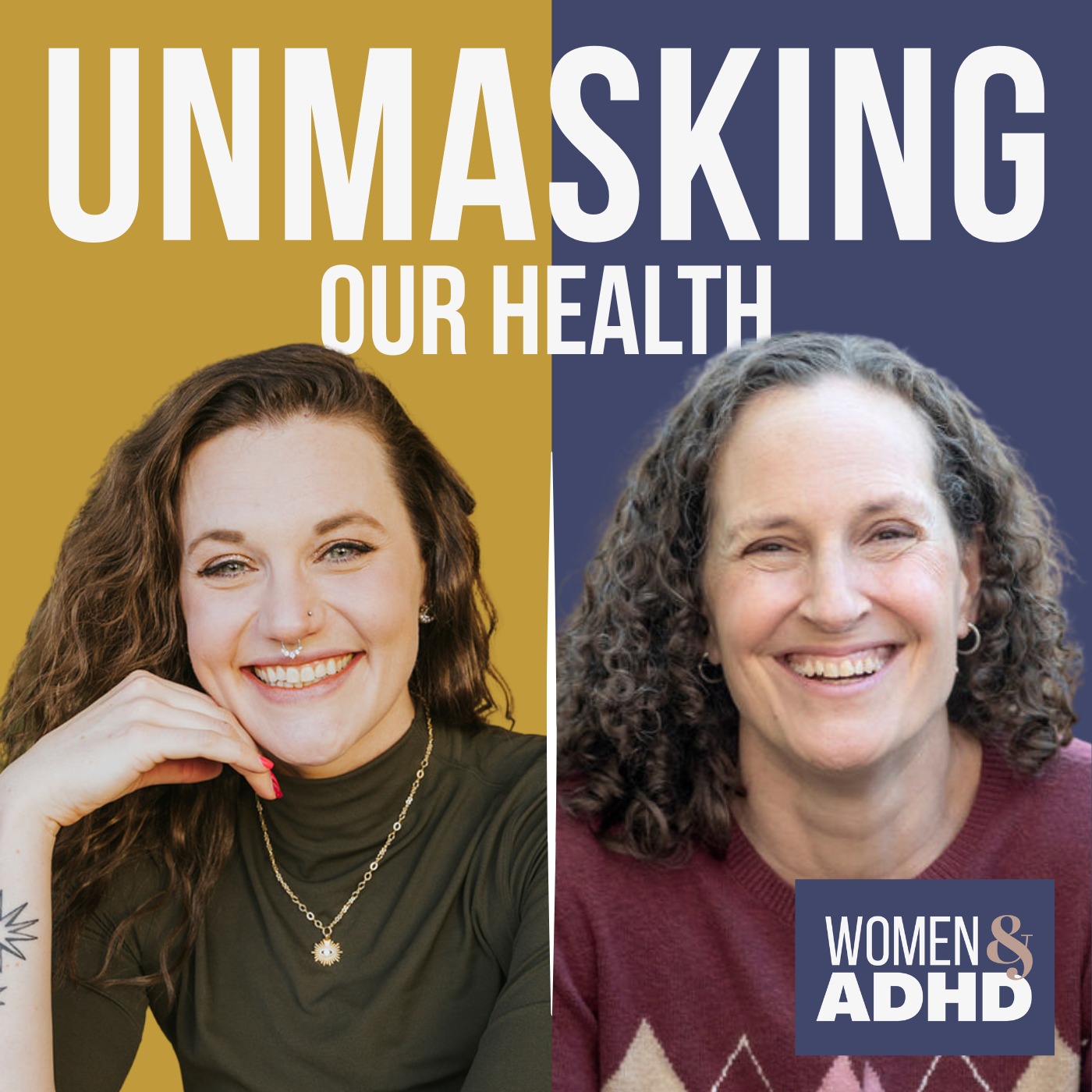
Unmasking Our Health: ADHD, IBS & the gut-brain connection
About This Episode
Episode 219 with Katy Weber & Kalin Johnson
Welcome back to our ongoing series, “Unmasking Our Health,” in which host Katy Weber teams up with medical expert Dr. Kalin Johnson, PharmD, to look beyond the neurodivergent brain and explore what it means to live in a neurodivergent body.
In this episode, we explore the relationship between ADHD and gut health, including IBS, constipation, diarrhea, bloating, and abdominal pain. We discuss how the gut and brain communicate, why ADHD-related behaviors, routines, and medication can all affect digestion, and why a one-size-fits-all approach to gut health can miss what an individual actually needs.
The conversation also looks at what supportive care can involve: listening to your body, making manageable changes, and finding a provider who’s curious about the whole picture — not just one symptom.
In this episode, we cover:
- What IBS is and how it’s diagnosed
- How ADHD and gastrointestinal symptoms may be associated
- The two-way communication between the gut and brain
- How stress, routines, hydration, eating patterns, and body cues can affect digestion
- Potential effects of stimulants, SSRIs, and antibiotics on gut symptoms
- Why fiber, fermented foods, and other common recommendations aren’t right for everyone
- How to look for care that considers ADHD and the whole person
- Why small, sustainable changes may feel more manageable than a complete overhaul
Note: Nothing in this episode constitutes medical advice. Always consult with your physician and pharmacist before starting, stopping, or changing any medication.
Kalin’s website: kalinjohnson.com
Instagram: @kalinpharmd
Links & Resources:
- The Association Between Attention-Deficit Hyperactivity Disorder and Gastrointestinal Symptoms: A Systematic Review and Meta-Analysis
- Have a topic you want Katy and Kalin to cover? Contact us
- - - - -
Episode edited by E Podcast Productions
- - - - -
Women & ADHD coaching: www.womenandadhd.com/coaching
- - - - -
Work 1-on-1 with Katy: www.womenandadhd.com/katy
- - - - -
Order the “Hey, it’s ADHD!” course: www.womenandadhd.com/adhdcourse
- - - - -
Did you love this episode? Click here to pledge a one-time donation to the podcast!
- - - - -
If you are a woman who was diagnosed with ADHD and you’d like to apply to be a guest on this podcast, visit womenandadhd.com/podcastguest.
Instagram: @womenandadhdpodcast
Tiktok: @womenandadhdpodcast
Twitter: @womenandadhd
Facebook: @womenandadhd
Advertising Inquiries: https://redcircle.com/brands
Privacy & Opt-Out: https://redcircle.com/privacy
[SPEAKER_01]: So we've got ADHD, so maybe we've got disrupted routines, which is gonna lead to some GI symptoms, which is going to lead to increased stress and body vigilance, which is gonna lead to more autonomic dysregulation and then worst GI symptoms. [SPEAKER_01]: So we're just trying to put that stick in that wheel somewhere to get that to slow down, to get that to stop.
[SPEAKER_00]: Hello and welcome to the women and ADHD podcast. [SPEAKER_00]: I'm your host, Katie Weber. [SPEAKER_00]: I was diagnosed with ADHD at the age of 45, and it completely turned my world upside down. [SPEAKER_00]: I've been looking back at so much of my life. [SPEAKER_00]: School, jobs, my relationships, all of it with this new lens, and it has been nothing short of overwhelming. [SPEAKER_00]: I quickly discovered I was not the only woman to have this experience and now I interview other women who like me discovered in adulthood they have ADHD and are finally feeling like they understand who they are and how to best lean into their strengths both professionally and personally.
[SPEAKER_00]: Welcome back to Women in ADHD. [SPEAKER_00]: I am joined once again by Medical Expert Dr. Kalin Johnson for another episode of unmasking our health. [SPEAKER_00]: A recurring series in which we look beyond the neurodivergent brain and explore what it means to live in a neurodivergent body. [SPEAKER_00]: Kalin is a clinical pharmacist, a late diagnosed ADHD autistic powerhouse, and the ultimate neurodivergent health advocate. [SPEAKER_00]: You can find out more about
[SPEAKER_00]: Today, we are talking about something many of us have experienced, but may not have connected to our ADHD and that is gut help. [SPEAKER_00]: If you've dealt with IVS, bloating, constipation, diarrhea, or stomach pain that seems to flare up at the worst possible times, this conversation may help you make sense of the connection.
[SPEAKER_00]: We also explore the way ADHD behaviors, traits, stress, eating, and hydration routines and medications can all affect digestion. [SPEAKER_00]: And why advice that may help one person might not work for another? [SPEAKER_00]: Finally, we talk about looking beyond quick fix or patchal diagnosis and why finding a provider who listens, stays curious and understands your ADHD can really make all the difference. [SPEAKER_00]: Our conversation is candid, informative, and contains lots of sexy poop talks, so consider [SPEAKER_00]: Okay, well, welcome back to the Women in ADHD podcast.
[SPEAKER_00]: We have medical expert Kaylin Johnson with us. [SPEAKER_00]: Excited as always. [SPEAKER_00]: Hey, Kaylin, you want your voice to sounding extra sexy today? [SPEAKER_00]: I am. [SPEAKER_00]: I brought this just for the episode on poop. [SPEAKER_01]: That way, if we can make a poop episode sound, just as sexy as it should be. [SPEAKER_01]: So it still needs, still me here. [SPEAKER_00]: about having kids giving you all kinds of weird diseases that I like I've never heard of hand-foot mouth disease before I had kids but like not not that you have that right you just had a kind of a comic called yep exactly I had many stomach problems and stomach bunks thanks to my young kids and like they would get over it in like 12 hours 12 to 24 hours that was the thing that always annoyed me was that then they were bounce back being like all right time to play and
[SPEAKER_01]: girl, indeed took this cold like a champ two days of like runny nose, maybe not feeling kind of great. [SPEAKER_01]: So I'm on day 11 and Marty's on day 10 and we still feel pretty shitty and sound like this. [SPEAKER_01]: So yeah, she gets, she gets a lot of horizontal parenting in the last couple of days. [SPEAKER_01]: But we're doing our best.
[SPEAKER_00]: All right, so let's talk about poop like he said. [SPEAKER_00]: So I'm very excited because at very timely meta analysis just came out on September 10 talking about the association between ADHD and IBS and gastrointestinal symptoms. [SPEAKER_00]: So, that was thrilling for those of us who are thinking about the gut, because this was really high on our list of stuff we wanted to talk about when we decided to come up with on mask-y our health and talk really about living in a neurodivergent body and the prevalence of just gastrointestinal stuff, but especially IBS.
[SPEAKER_00]: So, this is our episode on IBS and all the other tummy stuff that goes with being neurodivergent. [SPEAKER_00]: I feel like we should just start out by talking about, like, what even is IBS? [SPEAKER_00]: Because, like, I could certainly go on and on about all of the stomach issues I've had over the course of my life, but, like, I've never been diagnosed with IVS. [SPEAKER_00]: So, like, how do you go from, like, you know, random stomach pains to irritable bowel syndrome? [SPEAKER_01]: Yeah.
[SPEAKER_01]: Yep. [SPEAKER_01]: Let's talk about it. [SPEAKER_01]: You just named it there. [SPEAKER_01]: So, IVS stands for Irritable bowel syndrome. [SPEAKER_01]: We think of IBS generally as a functional disorder, rather than one that's structural. [SPEAKER_01]: So a lot of times, you may have GI problems, and maybe we're gonna do like a colonoscopy. [SPEAKER_01]: We're gonna look at the structure of the gut itself, and there's a lot of disorders that cannot problem there, where IBS is more about the function itself of the gut.
[SPEAKER_01]: We refer to it as a disorder of the gut brain interaction. [SPEAKER_01]: Really there's communication that happens between the brain and your digestive system a lot of times We you know a lot of people may think, you know, we got the brain and then your gut's just like this tube that just kind of like Possibly does it's thing, but the gut and the brain are constantly communicating to Basically help move through food Effectively and efficiently through your GI tract [SPEAKER_01]: But when we're talking about ABS, the way in which your digestive system is working and happening, that's not happening the way that we want it to.
[SPEAKER_01]: So it's really looking at how sensitive your gut is to things like stretching and movement and normal digestion and how your nervous system, yeah, we're going to be talking about the nervous system again, interprets all of those sensations. [SPEAKER_01]: really the big problem I think that happens with IBS as a diagnosis is it can be really a non-descript catch-all and our providers aren't always thinking about how it kind of connects to the whole mind-body system. [SPEAKER_00]: you don't say.
[SPEAKER_00]: Right? [SPEAKER_00]: Is that shocking?
[SPEAKER_01]: So that's kind of the big kind of issue with it. [SPEAKER_01]: But how do you actually get diagnosed? [SPEAKER_01]: Like, what are the criteria? [SPEAKER_01]: So basically, to me, the standards to actually get the IVS diagnoses, you have to have recurrent belly pain at least one day a week for the last three months. [SPEAKER_01]: And those symptoms have to have started at
[SPEAKER_01]: that part you have to have and then you have to meet at least two of these three factors. [SPEAKER_01]: So one of them being pain linked to having a bowel movement or a change in how often you poop or a change in how your stool looks or feels. [SPEAKER_01]: That's the diagnostic criteria for IBS and then within that we do have subcategories. [SPEAKER_01]: So it's like IBSC, so IBS conservation,
[SPEAKER_01]: Oh, happening. [SPEAKER_01]: So, already. [SPEAKER_00]: What a party, yeah, right? [SPEAKER_00]: Right. [SPEAKER_00]: Okay. [SPEAKER_00]: Yeah. [SPEAKER_00]: And when we talk about stomach pains, are we talking about like, cramping, are we talking about the like, like right under the rib kind of pain? [SPEAKER_00]: Like how do you even know because interception is such a hard point for a lot of us? [SPEAKER_00]: Like how do you even know what they're talking about when they say tummy pain?
[SPEAKER_01]: good question. [SPEAKER_01]: So most commonly we're looking at things like abdominal pain and cramping. [SPEAKER_01]: So just like you said, pain up under the rib, sometimes that pain will be in the lower GI. [SPEAKER_01]: Sometimes even the lower back, constipation can be related to lower back pain. [SPEAKER_01]: Yes. [SPEAKER_01]: I know that one. [SPEAKER_01]: Yeah. [SPEAKER_01]: So, oh yeah, bloating, gas, mucus in the stool, or just changes in bowel habit. [SPEAKER_01]: So, constipation, diarrhea, or both.
[SPEAKER_01]: So, tummy problems, this is kind of frequent tummy problems, this is kind of the catch all diagnosis for that. [SPEAKER_00]: Okay. [SPEAKER_00]: All right. [SPEAKER_00]: And so then the next question is why do people with ADHD especially have such a higher risk like significantly higher like, you know, anywhere from 48 to 63% increased risk for IPS was what I was seeing when I was looking at some of the more recent papers, though. [SPEAKER_00]: This most recent meta analysis said those who are studied with ADHD are 1.25 times more likely to also be diagnosed with intestinal disorders.
[SPEAKER_00]: So we're talking about not causal relationships right now. [SPEAKER_00]: We're talking about correlation, but still like what's what's going on here. [SPEAKER_00]: And I also want you to talk more about the you talked about the gut brain interaction is that the same thing is the gut brain access. [SPEAKER_00]: Right. [SPEAKER_01]: Yes. [SPEAKER_01]: Yes. [SPEAKER_01]: Yes. [SPEAKER_01]: So yeah, I'll help define that a little bit more, too. [SPEAKER_01]: But you're right. [SPEAKER_01]: That was a lot of the the data I was seeing too and just in this recent meta analysis.
[SPEAKER_01]: I've also seen things like double the odds of constipation and then one thing we'll talk about, too, is four times the odds of ankle precess, which is basically were stool leaks out of the rectum. [SPEAKER_01]: And that can happen because of chronic conservation. [SPEAKER_01]: We're basically the the sphincter becomes kind of like lacks and basically little bits of stool can like seeper around the stool that's stuck there and comes out. [SPEAKER_01]: It can also happen because of diarrhea.
[SPEAKER_01]: We're literally then the sphincter just can't. [SPEAKER_01]: do work that much to try to hold that back, or with pelvic floor dysfunction is where you'll get and go pre-says happening. [SPEAKER_01]: But yeah, four times the odds of that has not a fun side effect to have girl knows about it. [SPEAKER_01]: So we're letting it all loose today. [SPEAKER_01]: We're letting it all loose. [SPEAKER_01]: It's all coming out. [SPEAKER_01]: Actually, but not my, my sphinctures working in this moment.
[SPEAKER_01]: Yes. [SPEAKER_01]: Yes. [SPEAKER_01]: Yeah. [SPEAKER_01]: So okay. [SPEAKER_01]: So when we're talking
[SPEAKER_01]: why do we think there may be an increased link between, with got issues in ADHD. [SPEAKER_01]: So there's a couple different theories here. [SPEAKER_01]: Some are behavioral. [SPEAKER_01]: So ADHD, again, we know can make regular eating, hydrating, sleep, exercise, or even responding, or noticing the urge to go to the bathroom surprisingly difficult, which can then cause a whole lot of issues. [SPEAKER_01]: We're dealing with my dog right now. [SPEAKER_01]: He is excited, he doesn't wanna go.
[SPEAKER_01]: to the bathroom in the backyard anymore. [SPEAKER_01]: So he will hold it and he now gets mucus in his stool, all that fun stuff from. [SPEAKER_00]: I talked a similar experience. [SPEAKER_00]: She got usually she started getting UTIs all of a sudden because she was refusing to go outside because she had been or we tried to do one of those invisible fences and it totally traumatized her and she wouldn't go outside anymore. [SPEAKER_01]: Yeah, we had a baby in that traumatized our dogs.
[SPEAKER_01]: So [SPEAKER_01]: Okay. [SPEAKER_01]: And now yeah. [SPEAKER_00]: Anyways. [SPEAKER_00]: But holding back like you said like the idea that we often will wait until we are literally paying our pants before we run to the bathroom and the same goes with the other end too. [SPEAKER_00]: Right. [SPEAKER_01]: Yeah. [SPEAKER_01]: Exactly. [SPEAKER_01]: I know I used to be like, you know what? [SPEAKER_01]: I can carry all my grocery bags. [SPEAKER_01]: Up the fourth floor to my apartment. [SPEAKER_01]: Oh, I know I got a poop.
[SPEAKER_01]: No, I'm gonna put all the groceries away before I even do so Right, so if I if I stop then even do you on this is so relatable Right, then I'm not gonna do it. [SPEAKER_01]: So I might as well just hold it right? [SPEAKER_01]: Yeah, so and then that leads to a whole lot of issues We've got that behavioral component and then I mentioned even to like nutrition whether it's like frequency and eating or sometimes even just having things like [SPEAKER_01]: sensory sensitivities or, and so maybe you eat the same thing.
[SPEAKER_01]: It's the same type of thing often, but maybe you don't have a lot of fiber in the diet. [SPEAKER_01]: Or too much fiber in the diet can also become a problem. [SPEAKER_01]: And all of that, anything we eat to, changes the bacteria in our gut, which is one of the other theories and explanations that is out there as well,
[SPEAKER_01]: different. [SPEAKER_01]: Now there's not like a specific gut microbe that we know causes IPS, but there are some studies that showed that the microbiome and people with ADHD actually similar to those with anxiety and that that gut microbiome when it's not super well and isn't able to digest foods in the way that we want it to, it actually kind of reads similar to kind of like, hey, things aren't okay [SPEAKER_01]: And that communicates that through the vagus nerve, which connects down to your cut up back to your brain, so that when we'll get a little bit more, but it's basically the theory of the gut brain access where that's basically like a two lane highway where your eventual vagal nerve is caring communication from the brain.
[SPEAKER_01]: down to the gut, and then the gut back up to the brain. [SPEAKER_01]: So if the brain is stressed and anxious or dysregulated, there's a stressor upon the nervous system, be it physical or emotional, that's going to be communicated, whether you like it or not, back down to the gut. [SPEAKER_01]: That can change the microbiome of the gut, that can change the function of the gut. [SPEAKER_01]: It could be why, you know, if you want to come to Nebraska, we can go on a tour of all the places my wife pooped before she had a stressful interview or an event because immediately upon, oh my gosh, I'm so nervous.
[SPEAKER_01]: Balls say, okay, we're churn and we're going, or if you're like me, the exact opposite happens. [SPEAKER_01]: But either way, that brain is communicating down the gut and then vice versa, how the gut's doing can actually communicate back to the brain.
[SPEAKER_01]: if the gut microbiomes altered, some people have an increase symptoms of anxiety, executive functioning issues, but it didn't emanate from the brain and emanated from the gut. [SPEAKER_00]: Yeah, you know, I saw some studies that were talking about the possible role of early antibiotics, right? [SPEAKER_00]: You know, in terms of the gut biome. [SPEAKER_00]: And I remember like my son had lots of ear infections when he was a baby. [SPEAKER_00]: He had, I don't know if between the ages of four months and 10 months when we finally got him tubes.
[SPEAKER_00]: he had, I don't know if he either had like eight different ear infections or one just long untreatable ear infection, but he went through eight rounds of antibiotics as an infant under the edge of wow. [SPEAKER_00]: And we finally got him tubes, but I have always kind of had that in the back of my mind in terms of [SPEAKER_00]: like, what did those antibiotics do to his infant gut biome? [SPEAKER_00]: And like, every time he had like skin issues or something, I'd always be like, it was the day of antibiotics, but now of course, my mom brain is like, oh, God, the antibiotics gave him ADHD.
[SPEAKER_00]: Like, so... Yeah.
[SPEAKER_00]: What do you think about that that research there in terms of like early medications because I'm also thinking about like SSRIs and ADHD medications like are what are those doing to the gut microbiome like whatever it is micro biome, you know, and how much control do we have over that. [SPEAKER_01]: completely. [SPEAKER_01]: We can take this even as far as anything that just whites out are got microbiome. [SPEAKER_01]: So you could also be like my daughter who's almost two now. [SPEAKER_01]: She has two gut conditions, just got diagnosed with her second one.
[SPEAKER_01]: So she has a condition called F pies or food protein induced intercalatus where her body basically kind of attacks itself and very strongly omits either out the front and or out the [SPEAKER_01]: If that doesn't agree with her and then she also just got diagnosed with disaccharidase deficiency disorder, where basically her body can't digest certain sugars and carbohydrates founded like natural whole foods like certain veggies and fruits and things like that. [SPEAKER_01]: Her gut is a mess and my mom brain is like, what is going on in her gut?
[SPEAKER_01]: There's no way she probably has a small bowel infection like all these things because there's tools that bend messed up but like even then
[SPEAKER_01]: The thing with the young early antibiotics that we do know of is that really exposure is going to disrupt that infant gut microbiome and it tends to leave certain bacteria behind that reduces the overall diversity of the gut just like [SPEAKER_01]: ecosystem, we want a large diversity different microbes to help us to be able to, again, work through food. [SPEAKER_01]: So what we do see happen, then, long-term health consequences that have been associated with that are immune rewiring.
[SPEAKER_01]: So basically, the immune system rewires itself, and it can permanently alter immune cell function, which can mean that that even extends into
[SPEAKER_01]: infections or illnesses, or GI sensitivities can be hard. [SPEAKER_01]: We have seen links to chronic health conditions, like higher risk of asthma, allergies, and autoimmune diseases, and then just incomplete recovery where the gut microbiome always shows basically lower resilience after that. [SPEAKER_01]: The way I like to think about it is actually ecology in the study of ecosystem has a good understanding of this. [SPEAKER_01]: If you go into a forest and you wipe it out, you tear down all that forest, all of a sudden, then it's not functional.
[SPEAKER_01]: Things will still survive. [SPEAKER_01]: You'll see little weeds or little plants and flowers, growing up here in there, you'll see a little bunny return, but it's not functional for everything that was living there before. [SPEAKER_01]: And we used to think when we would destroy an ecosystem, we could just rebuild it. [SPEAKER_01]: Well, let's replant, right? [SPEAKER_01]: That'll rebuild the ecosystem. [SPEAKER_01]: no girl, that's not how that works. [SPEAKER_01]: Unfortunately, that's not how that happens.
[SPEAKER_01]: But what you can do is return the ecosystem to something that is a new homeostasis that will still be functional for the things in the system, but we'll unlikely to ever be the same again. [SPEAKER_01]: So it's a little bit like [SPEAKER_01]: Again, this is the idea with the guy I'll tell you to with like a lot of this stuff we're still in early research phases. [SPEAKER_01]: We don't fully understand a lot of this, but that's kind of the idea of then a lot of times patients who do go through that they may have lifelong needs done of needing more gut support to help keep that gut functional.
[SPEAKER_01]: Like my daughters, immunologist said, later in life, she'll probably be diagnosed with IBS, because she'll probably always have gut issues and likely need help to support the health of her gut microbiome as it made it her be quite the same. [SPEAKER_00]: And is there anything in terms of like like, you know, I always feel like the answer then is, eat more kimchi and I'm like, I don't like kimchi, it don't like sour crowd. [SPEAKER_00]: What are you doing like proactively? [SPEAKER_00]: Because that was always the thing, you know, when I was giving my son so many antibiotics, when he was younger, I was sort of like, yogurt, yogurt.
[SPEAKER_00]: He didn't want yogurt. [SPEAKER_00]: What is the answer there, prevent it, please? [SPEAKER_01]: Yeah, a really good question. [SPEAKER_01]: So yeah, and notoriously foods that have been fermented are known to have a lot of good gut bacteria in them and can help with that, right?
[SPEAKER_01]: to different things for different reasons, some with IBS don't respond well to those foods. [SPEAKER_01]: So, yeah, the acid in it also, all those foods are high in histamine. [SPEAKER_01]: So, something else, I know we talked a little bit about last week and probably will dig into more, but if you have, um, um, um, um, um, more of a cell activation syndrome, [SPEAKER_01]: those same foods can actually trigger gut problems for you and actually really hurt your gut microbiome because you're more likely to end up with conservation, diarrhea, inflammation in the gut.
[SPEAKER_01]: So, [SPEAKER_01]: There's no broad stroke of something that can be helpful, but those foods are things that you could consider and entertain, otherwise looking at doing probiotics can be helpful as well to kind of help repopulate your gut bacteria, that can be something definitely considered. [SPEAKER_01]: One of the best things you can do, and I know something will dig into more. [SPEAKER_01]: but is to decrease stressors on your autonomic nervous system because we want as little of that stressful communication going back and forth in that Tulane highway between the brain to the gut.
[SPEAKER_00]: Yeah.
[SPEAKER_00]: Knowing we were going to be talking about this. [SPEAKER_00]: I was reflecting on this period of time in my life in university when I had really, really bad stomach pain where it was just double over incapacitating stomach pain. [SPEAKER_00]: I never understood where it would come out of nowhere. [SPEAKER_00]: The only way I could get it to go away was if I would fall asleep. [SPEAKER_00]: And so I sort of assumed it was like, I would just like gas out in my sleep or something because eventually I, you know, if I could fall asleep through the pain [SPEAKER_00]: Now granted, I was in university, I was on a diet of beer, coffee, and cigarettes.
[SPEAKER_00]: That was so, I like always just a serious diet. [SPEAKER_00]: I always just assumed like, okay, I brought this on myself, but actually it ended up being my interest in yoga that I feel like, you know, I've never done a study on this, but like intuitively, I felt like the more I did yoga, the less I suffered from this and eventually it went away and I had, you know, I'll get it very occasionally, but it wasn't like it like it was. [SPEAKER_00]: chronic during those years of stress in university.
[SPEAKER_00]: And so it was kind of like, all right, there's a perfect storm there. [SPEAKER_00]: But yeah, like it comes down to the vagus nerve and just kind of whatever you can do to reduce stress was is a big ask in this day and age. [SPEAKER_01]: It's a huge ask and not really supported by all of our systems, right? [SPEAKER_01]: Like socially, that's not necessarily an easy thing to do. [SPEAKER_01]: Like, none of that is even on ADHD as well. [SPEAKER_01]: Like, you've got the behavioral components, you've got the biological components, you've got the autonomic nervous system, you've got that visceral that gut sensitivity, you've got the vagus nerve, you've got stress physiology, immunology, and the gut microbiome.
[SPEAKER_01]: Whole lot of things happening there. [SPEAKER_01]: And then you've got, again, the making sure you eat, making sure you drink. [SPEAKER_01]: I know for a live ADHD or it's like for something that seems like it should be so simple, pooping, all of a sudden, there's all these things at play here. [SPEAKER_01]: But if the thing I usually tell my patients when I'm working with them, it doesn't have to be perfect. [SPEAKER_01]: It doesn't have to be all there to nothing. [SPEAKER_01]: We are looking to just move the needle a little bit in as many of these areas as we can or also the ones that we can move the needle on that don't add extra stress to you.
[SPEAKER_01]: maybe let's make sure we're getting more insoluble or soluble fiber in your diet. [SPEAKER_01]: But now all of a sudden stressing you out to try to prep your meals and do all of that, well now we're in the same boat for a different reason. [SPEAKER_01]: So I always like one of the things I do, I tend to also get a lot of that crampy, stomach pain, kind of gas and like, constipation is even when just throughout my day, like even talking to you here now, I will try to make sure I'm relaxing my core.
[SPEAKER_01]: that periodically I just relax my core. [SPEAKER_01]: As somebody who's hypermovable, also, I tend to tighten up in guard around my muscles, especially around my ribcage. [SPEAKER_01]: My mid-back area, those joints that tend to be a little more influx, but that little thing, that one thing, has made my cause of vision issues so much better to just put a little bit of body awareness into that relaxation. [SPEAKER_01]: It doesn't have to be all or nothing. [SPEAKER_00]: Yeah, yeah, as you were talking, I just was reminded of our work together in terms of the like intentional diaphragmatic breathing, which is why, you know, I think yoga was so helpful for me too, it's that like moving away from shallow lung breathing to the really like intentional massage of the diaphragm on to my balls and intestines and all of that stuff and giving it like a little internal massage would be really intentional about it.
[SPEAKER_01]: Yeah, it's a little bit of that that love goes back to and which actually you just mentioned something there that can be helpful for some people who lean conservation heavier just some of the functional exercises of diaphragmatic breathing or doing latheimus termed ILU massages which is basically following the path of the GI tract up from like the right hip area up to the right rib over to the left rib and down. [SPEAKER_01]: That's how food and stool move through your colon. [SPEAKER_01]: So if you lean towards
[SPEAKER_01]: laying on the ground and you know doing little light massages sometimes that can be helpful and as I'm saying this you know what I'm thinking about with my own ADHD brain here too is like again it's like something else I have to think about something else I have to do to take care of my body. [SPEAKER_01]: Right, I think that is the thing for ADHD that again can become really overwhelming, but I often feel like ADHD years we tend to leave ourselves out of the story and it does take a little bit of just a little bit little moments of attunement in helping our body to feel.
[SPEAKER_01]: relaxed and safe for lack of a better term I guess to help all of the processes actually work as they should. [SPEAKER_00]: Yeah, right. [SPEAKER_00]: I think there is a tendency, at least on my part, to, you know, there's an urgency when I'm thinking about having to fix something right. [SPEAKER_00]: I need to fix the symptoms. [SPEAKER_00]: I need to fix the symptoms as soon as possible. [SPEAKER_00]: I need to figure out. [SPEAKER_00]: I need to throw everything at the wall right now.
[SPEAKER_00]: I'm going to try and so there's like, you know, I just like my heart rates up like my body is tensing even just talking about the sense of urgency that comes with fixing as opposed to even just thinking in terms of like,
[SPEAKER_00]: cultivating and some of these like more sort of gentler slower words that even just in my own brain I can start to think differently about the urgency of a situation and think more preventively. [SPEAKER_01]: Yeah well and it also actually kind of based back to this that ecosystem analogy is just discussing where when we are you know recreating an ecosystem we're trying to [SPEAKER_01]: where we kind of cross this curve where a bit of a stressor, no longer puts that ecosystem back into a dysfunctional state.
[SPEAKER_01]: That's what we're trying to get with the gut, where we basically put like, [SPEAKER_01]: the a stick in that wheel that's spinning out like crazy enough that it's able to kind of slow down and have some kind of capacity again because it ends up being the very negative biofeedback loop. [SPEAKER_01]: So we've got ADHD. [SPEAKER_01]: So maybe you've got disrupted routines, which is going to lead to some GI symptoms, which is going to lead to increased stress and body vigilance, which
[SPEAKER_01]: So we're just trying to put that stick in that wheel somewhere to get that to slow it down, to get that to stop. [SPEAKER_01]: And with a little bit of those preventative kind of things, exercise is even just like am I holding my core really tight all the time, am I holding my pelvic floor tight all the time? [SPEAKER_01]: Have I taken a deep breath? [SPEAKER_01]: Have I drank water that just, you know, one or two of those things can actually be the difference between, you know,
[SPEAKER_00]: Yeah, well, and I also feel like this speaks to a larger theme that has been running through our episodes on a mess here health, but also just like the general way we talk about the medical field right in terms of how siloed expertise is but also this notion of like when you are. [SPEAKER_00]: Like, I find often physicians are focused on fixing, right? [SPEAKER_00]: So there's this like, hey, here's your diagnosis. [SPEAKER_00]: Here's your medication. [SPEAKER_00]: See a good luck.
[SPEAKER_00]: And that's kind of where it ends. [SPEAKER_00]: There's that, like, tends to be, understandably, given how many patients they see in a day, et cetera, et cetera. [SPEAKER_00]: Like, there seems to be a lack of curiosity. [SPEAKER_00]: But then that is combined with a kind of feeling of, like, [SPEAKER_00]: threatened in some way when you've done your own research that it threatens their expertise, which is also, you know, put into the mix, which is like, if you're the only person who's paying attention and connecting the dots, you then get shamed by the various experts who are like, I don't know what you're talking about.
[SPEAKER_00]: I don't think that's true. [SPEAKER_00]: And so I think, you know, [SPEAKER_00]: just the way in which we treat this and look at this in the way in which the medical field looks at this and treats this as something to be fixed, contributes in a lot of ways to what we are struggling with and then ending up with a lot of this symptoms, right? [SPEAKER_00]: Like it feels like it's doing more harm than good a lot of the time. [SPEAKER_01]: Completely and honestly, let's call it like it is.
[SPEAKER_01]: I think a lot of the medical community also
[SPEAKER_01]: Like you're just stressed out, like that's it, right? [SPEAKER_01]: And it's so much more than that. [SPEAKER_01]: And it's not, I straight up, I BS is not biological, psychological, but it can be related to the function of our autonomic nervous system. [SPEAKER_01]: And psychological stress can play a part in that, but it is not the only part. [SPEAKER_01]: And again, just like we talked about, [SPEAKER_01]: It's a two-lane highway between the brain and the client. [SPEAKER_01]: And there are also so many other things that can stress out the autonomic nervous system.
[SPEAKER_01]: So like when I'm working with patients, I always say at the very beginning of our first sessions and meeting together, I take a stress inventory. [SPEAKER_01]: So I'm looking for, [SPEAKER_01]: every single thing I can think of in that person's life externally and internally that could be stressing and putting stress on their body. [SPEAKER_01]: I mean, that could even be something like anemia, iron deficiency, right? [SPEAKER_01]: Low vitamin D. That's a stress on the body. [SPEAKER_01]: That's going to be a stress on the autonomic nervous system too.
[SPEAKER_01]: So I think of it in two buckets. [SPEAKER_01]: So a bucket of things that maybe we're going to have to bake as impact on your health. [SPEAKER_01]: Maybe your IBS symptoms. [SPEAKER_01]: But then
[SPEAKER_01]: you're most willing to maybe attack and change or maybe alter or the ones that we can maybe most simply do and really focusing in there to get those improvements but again it's not psychological but it is related to the autonomic nervous system and [SPEAKER_01]: You're going to see that theme throughout all of this because the autonomic nervous system is what controls everything single passive system in our body. [SPEAKER_01]: Our immune system, our metabolic system, our GI system, everything.
[SPEAKER_01]: Our health is dependent on the state of our autonomic nervous system. [SPEAKER_01]: What really sucks with ADHD is our nervous systems because of how we operate in the world
[SPEAKER_01]: tend to live in this higher stress-related state, which, again, is what brings us back to that a big part of that connection. [SPEAKER_01]: And why a lot of, you know, ADHD women, some may report when I treated my ADHD, my G.A.S. [SPEAKER_01]: and some Scott Better. [SPEAKER_01]: So for that patient, again, that's not everybody, but for some people, [SPEAKER_01]: where maybe the stress of their executive functioning issues or impulsivity or inability to focus may have been a big part of that autonomic nervous system dysregulation, they may see their symptoms improve.
[SPEAKER_00]: Yeah, you know, in terms of how much your body is physically holding around your anxiety, yeah, I saw a reddit thread, which is not really rigorous research, sort of being that anecdotal, you know, women talking about the fact that once they were actually diagnosed with ADHD and sort of felt like they were on the right path, their anxiety reduced and their IVS symptoms reduced too, which I thought was interesting. [SPEAKER_01]: Exactly, when our body goes into that fight flight stress state and if the stress was coming from the ADHD symptoms or wherever your body releases cortisol and cortisol actually impacts your GI's contraction it disrupts that normal contraction again for some people I know for me I'm I'm a mixed girlly so there are times where something stressful happens like [SPEAKER_01]: I had a rejection sensitivity moment a couple weeks ago and I got an email and immediately when I read it I just felt my stomach dropped literally within like 50 minutes.
[SPEAKER_01]: I was like [SPEAKER_01]: got to go to the bathroom, right? [SPEAKER_01]: Like, as immediately, my body starts producing cortisol and then that starts actually contracting more and more and more and again, sometimes the opposite happens where when my gosh I got that email, I was perceived or I was misunderstood or something like that and my make-to-less trigger and my flight flight response is triggered and blood flow is averted away from the gut, even if cortisol is something and then nothing's coming out there then too.
[SPEAKER_01]: The other thing that it also releases is a hormone, a neurotransmitter, yeah, hormone called vasopressin. [SPEAKER_01]: And vasopressin also actually alters how our body stores fluid. [SPEAKER_01]: So in stressful times, stressful events, we are also more likely to retain fluid and often retaining fluid in third spaces. [SPEAKER_01]: So you may see, feel like you're retaining fluid around like your gut, like your lower belly, your hips, your ankles, your hands, or I'll get it my face sometimes.
[SPEAKER_01]: We also need fluid for stool to be able to pass. [SPEAKER_01]: And so if we're retaining fluid, but not retaining it where we actually want it to go, again, more constipation as even a big part of our treatment, which can be helpful for at least a bandage for IBS symptoms around constipation or osmotic laxatives, like mirror lax or probably like all, which basically helps to draw what into the bowel to get things moving. [SPEAKER_00]: Yeah, fascinating. [SPEAKER_00]: Okay, so just to recap, there is the genetic predisposition element, mostly around the gut brain access and also a lot of the stuff we've been talking about around in terms of connective tissue and just the way in which we move through space that there's a correlation there.
[SPEAKER_00]: And then there is these sort of more behavioral side of ADHD that might be leading to
[SPEAKER_00]: holding on to long eating disruptions, arphid, you know, like all of the ways in which we don't feed ourselves very well. [SPEAKER_00]: I'm thinking about my, you know, cheese on hand sandwich I had for lunch today and just like, or even just like the rushed ways that we eat or the way that we go until we are starving before we eat. [SPEAKER_00]: I mean, I could go on and on about like the behavioral stuff that could be leading to some of the gut [SPEAKER_00]: And then there's also the medication side, which I want to get back to.
[SPEAKER_00]: So we talked about the possible link with antibiotics, but also I want to talk more about ADHD medication, like stimuli medications because they tend to dehydrate, right? [SPEAKER_00]: But also like what are those sort of GI side effects of specific ADHD medications that might be causing this correlation? [SPEAKER_01]: Yeah, so specifically for talking like stimulants so stimulants, again, like you said. [SPEAKER_01]: can they can dry things up. [SPEAKER_01]: They can also cause appetite suppression.
[SPEAKER_01]: So we may not be eating as much as often again as much fiber than binging at night. [SPEAKER_01]: Exactly. [SPEAKER_01]: Yep, probably not on fibers. [SPEAKER_01]: Get me like foods. [SPEAKER_01]: I've heard more than likely something that gives us a good dopamine. [SPEAKER_00]: It's the fiber content of entire sleeve of Oreos just as you prefer, friend.
[SPEAKER_01]: Conservation tends to be the big GI related side effect with stimulants. [SPEAKER_01]: So if somebody is already on a stimulant, they're eating less, they're drinking less and becoming constipated again, that's definitely a very real medication effect that we would down you to consider where some patients then, unfortunately, we just talked about some people having improvements and their symptoms, some people can see them worsened. [SPEAKER_01]: or just be different and change then, which actually, sorry, Marnie, I'm talking about your poop here for a hot second.
[SPEAKER_01]: She went mind, she was talking about poop. [SPEAKER_01]: Yep, said that too.
[SPEAKER_00]: So many great soundvites for Marty this week. [SPEAKER_01]: I know, I know, we're going, yes, yes, do her and I, because now we're both conservation ladies, trade pictures back and forth sometimes. [SPEAKER_01]: We're like, look, look, I did good today. [SPEAKER_00]: Oh, I know, if that's not true love, right? [SPEAKER_00]: But I was going to say, five years of somebody who gets as excited about your food photos as you do. [SPEAKER_01]: Yeah, it's exactly. [SPEAKER_01]: So, [SPEAKER_01]: Um, she was somebody who leaned, IBS, uh, D, diarrhea, but then post after starting a simulate now leans towards constipation.
[SPEAKER_01]: So her problem is just kind of swung to the other side, unfortunately. [SPEAKER_01]: So for those patients, when that happens, obviously we're going to look at, you know, is this something that we can still maintain on the medication if we want to see on the medication. [SPEAKER_01]: Then we're going to look at kind of getting some of those other supports around there, a little bit better, so making sure we are eating regularly, that we're eating breakfast, that we're drinking good amounts of water, that we're not ignoring body signals all day, that we're not doing that push through to do so, and that sometimes too, getting a little bit of help for maybe like a stool softener.
[SPEAKER_01]: like a doc you say or again from something like a mirror lax which the osmotic type laxatives that bring water to the soil generally are safe to use more frequently versus your stimulant laxatives which actually cause your gut to do the contraction itself or not. [SPEAKER_01]: necessarily a safe to take long-term overtime. [SPEAKER_01]: Any of these meds definitely talk to your doctor about, but Osmotic Lachsatives and stool softener sometimes can be helpful to kind of combat some of those symptoms as well.
[SPEAKER_00]: Can a electrolyte help, too? [SPEAKER_00]: Because I know we talked about electrolytes with hypermobility. [SPEAKER_00]: I feel like do the extra like magnesium, then sodium, what are they doing for another region? [SPEAKER_01]: So, especially the magnesium, that is another region as I love that. [SPEAKER_01]: Yes, the magnesium especially is known to also be an asmodic laxative of soar into kind of help speed along bowel movements. [SPEAKER_01]: Certain types of magnesium have more GI side effects than others.
[SPEAKER_01]: Often for some people that can be a very unwanted side effect. [SPEAKER_01]: If you struggle with conservation, it can be a very nice side effect to have. [SPEAKER_01]: Again, I find that that actually helps me, but I have to be careful in the morning. [SPEAKER_01]: where I can be a little potsy in the morning, so I wanna drink my electrolytes, but if I don't eat soon enough after drinking my electrolytes, then we're swimming in the other way too. [SPEAKER_01]: But yes, my museum, especially that component in electrolytes can be very helpful too.
[SPEAKER_00]: are hemorrhides involved in any of this conversation because I think if we have never really struggled with that, but I know like I have family members who have had chronic struggles with hemorrhides over the years and just like that feels like hemorrhides are connected to constipation, though, or kind of like overpushing and frequent straining. [SPEAKER_01]: Frequent straining, okay. [SPEAKER_01]: Frequent straining. [SPEAKER_00]: That could also be a nice tidy side effect for somebody
[SPEAKER_01]: Exactly. [SPEAKER_01]: Yeah. [SPEAKER_00]: And then my other question was that I mentioned earlier was the SSRIs because I know that like there's been a lot of recent discovery and research about serotonin in the gut. [SPEAKER_00]: And I know so many of us are on SSRIs either from ADHD or prior to ADHD diagnosis. [SPEAKER_00]: So like what what's the connection there? [SPEAKER_00]: Should we is that directly contributing? [SPEAKER_00]: I don't feel like I've seen much. [SPEAKER_00]: I don't feel like I got a lot of warnings when I went on an SSRI about the gut.
[SPEAKER_01]: No, so the same thing there where we can see either happen. [SPEAKER_01]: It's not one of those things where it's written in the stars with SSRIs where like, oh, I know you're gonna have got issues. [SPEAKER_01]: Some people don't have any side effects of the medication. [SPEAKER_01]: Some people will have some classification. [SPEAKER_01]: Some people will have some diarrhea as well. [SPEAKER_01]: Obviously, would take any medication. [SPEAKER_01]: It can irritate the gut period, which can then also cause those.
[SPEAKER_01]: medications themselves just can be the problem, but also the impact of serotonin. [SPEAKER_01]: On the gut, if we were maybe not having our gut was certainly to produce enough serotonin, again, you may see things kind of even out. [SPEAKER_01]: If we have excess, we may see diarrhea. [SPEAKER_01]: Again, exercise, sometimes can cause some drying effect as well to, so then you may see
[SPEAKER_01]: And the SSRI may help that, you also then, again, could see some of those GI symptoms that negate, which is actually, maybe I even said this last week, but it ties in here too, where one of the really interesting I've seen a couple of weeks ago with my patients and like GLP1, so GLP1s come with a big risk factor around slowed gut motility and therefore, constipation. [SPEAKER_01]: Obviously, a big concern for patients who already maybe have constipation, [SPEAKER_01]: But if the constipation with a lot of my patients was related to the hypermovility and metabolic health, related downstream to the hypermovility, a lot of my patients, not everybody, but a lot of them have actually had better bowel movements than they've ever had being on this medication.
[SPEAKER_01]: So nothing's exactly right. [SPEAKER_01]: It kind of depends on the individual, the individual's gut, the individual's gut microbiome, and the individual's autonomic nervous system to know what we're going to get. [SPEAKER_00]: So what do you feel like medical professionals need to get better at or understand better when it comes to this correlation? [SPEAKER_01]: I think they need to understand and really think about the autonomic nervous system, truly. [SPEAKER_01]: I think it really comes back down to understanding too that there's a difference between stress and stressors.
[SPEAKER_01]: And both of those impact the autonomic nervous system. [SPEAKER_01]: I think even providers, when you say stress, they have a bias towards emotional stress and behavior that there's just something about you, [SPEAKER_01]: that you need to do and you need to fix, and this is all on you. [SPEAKER_01]: And that's not the case. [SPEAKER_01]: I think they really need to really understand and think bigger mind body about what all could be playing into this. [SPEAKER_01]: And also, you know, I have a lot of patients when they get their ADHD diagnosis.
[SPEAKER_01]: It's like, okay, you have ADHD. [SPEAKER_01]: Here's a med. [SPEAKER_01]: Bye. [SPEAKER_01]: Good luck. [SPEAKER_01]: But no really information again about [SPEAKER_01]: the impact that other diagnoses or other systems, other things that happen in the body can impact everything else in the body, including the guy. [SPEAKER_00]: Yeah, you know, as you were saying, you were just reminding me of a topic that comes up a lot with many of my ADHD coaching clients, ironically, or maybe not, but like the difference between stress and overwhelm, right?
[SPEAKER_00]: Because I'm like,
[SPEAKER_00]: But like overwhelm is when you don't feel like you're driving anymore, right? [SPEAKER_00]: You don't feel like you're at the wheel and that's when you start to get overwhelmed and then you become burnt out. [SPEAKER_00]: And so it's like, there is a, there is a real difference between having, you know, something that you have a goal to work toward and you see that it's far ahead and you see that there's hard work and you're willing to put that work in and you like have the goal. [SPEAKER_00]: But I think for so many of us, we feel overwhelmed by the question marks.
[SPEAKER_00]: We feel overwhelmed by the lack of understanding. [SPEAKER_00]: We feel overwhelmed by the dismissals and the gas lighting and everything else. [SPEAKER_00]: And I'm like, that just feels like the perfect storm for when we talk about IVS. [SPEAKER_00]: And the gut, like, that's what I meant earlier about, like, is this oftentimes, it feels like it's causing more harm than good when we are seeking out treatments for this, like, you know, the feeling [SPEAKER_00]: sort of hopelessness or helplessness that comes with a feeling of overwhelmed and that compounds a lot of that stress and anxiety that so many of us in neurodivergent buddies feel a lot of the time.
[SPEAKER_01]: Completely, just like you said, even we're going to get help, so that's the, you know, the complete RC more on of like all of this really is that like, you know, yourself, our struggling and maybe stress, if something, a stresser or overwhelmed is playing a factor [SPEAKER_01]: You go to the system, the health care system that's supposed to help you. [SPEAKER_01]: and actually creates just as much if not more stress on your system therefore worsening symptoms. [SPEAKER_01]: And I wanna say too, you know, I was talking a lot because obviously, you know, people who are listening to this, you are the ADHD, and I'm speaking a lot to you about, you know, maybe having ADHD and IBS and not wanting you to think of those of like, I have a bad brain and a bad gut or something that happened to coexist, that you have one interconnected body, but that's actually my message to the providers too.
[SPEAKER_01]: We need to be looking at patients like that. [SPEAKER_01]: It's not these again siloed issues of ADHD and IBS. [SPEAKER_01]: Like once we start looking at the nervous system, we look at the gut, we look at hormones, we look at the immune system, we look at behavior and environment, and all of that is parts of the same system, then the pattern starts to actually make a lot more sense. [SPEAKER_00]: Right, and that's why I feel like, you know, if for a provider, if they see somebody coming to them with IBS, they shouldn't be thinking just like, all right, well, take some of the musical good luck to you.
[SPEAKER_00]: They should be like, are you okay? [SPEAKER_00]: Like, what are what are the stressors like in your life? [SPEAKER_00]: What is happening? [SPEAKER_00]: who is in your home, all of those really important questions around support that not to make this a political, not to get like, too political, but I think it really talks about the swell of support for Lizzie Clancy, the Lizzie Clancy case was this highlighting when somebody is screaming for help and nobody is helping, right? [SPEAKER_00]: The worst case scenario, but just this idea that like, [SPEAKER_00]: There should be a little bit more curiosity about like what is causing this as opposed to just saying like oh, that sounds awful here here's your here's your solution.
[SPEAKER_00]: Yeah. [SPEAKER_01]: Exactly. [SPEAKER_01]: I had a vision the other day. [SPEAKER_00]: I can't believe I just got I just went for a little declancy in one sentence. [SPEAKER_01]: I'm actually a little proud of myself, but you should that was on my bingo card bingo. [SPEAKER_01]: Yeah, I had a piece of the other day who was talking about, you know, seeing their primary care provider and [SPEAKER_01]: She wasn't feeling very good, she was having some GI issues, she was feeling kind of dizzy, her pots was acting up and so.
[SPEAKER_01]: was the office and she kind of laid back in her chair and closed her eyes and the provider came in and she was like, oh, are you really sleepy? [SPEAKER_01]: And my vision was like, no, I was really, really potsy and dizzy and the provider goes, oh, well, I will be long, I'll be really quick and get on your hair. [SPEAKER_01]: I know I don't like being talked to when I don't feel good. [SPEAKER_01]: There was no curiosity about her symptoms. [SPEAKER_01]: There was no curiosity about what was going on.
[SPEAKER_01]: There was no curiosity about it being managed.
[SPEAKER_01]: And I have a colleague her and I talk about this within the healthcare system a lot and I think that's the piece that tends to be missing from a lot of providers once they're in the system is they lose their curiosity and to really be able to treat a patient well. [SPEAKER_01]: and to really connect things that when a patient is struggling, especially because of the state of their autonomic nervous system, you have to be willing to get curious because there's just so many pieces out there that you have to try to connect and there can be hundreds of hundreds of hundreds of stressors that it is our job as providers to help identify and help our patients account for and treat.
[SPEAKER_01]: And not just our job to put a bandaid on the outside solution that we saw or the outside problem that we saw, like here take a five or supplement. [SPEAKER_01]: Okay, but why does this person have I BS because I'll say to one of the big things that we have to make sure when we're treating IBM said this really on, but it becomes a catch all a very non-descript catch all that can sometimes I think it's really thrown out. [SPEAKER_01]: Well, you know, oh, you've got regular got problems.
[SPEAKER_01]: Okay, I BS. [SPEAKER_01]: But could it be celiac disease? [SPEAKER_01]: It could it be inflammatory bowel disease? [SPEAKER_01]: Is it a medication side effect? [SPEAKER_01]: Are there pelvic floor problems? [SPEAKER_01]: Do we have endometriosis, MCAS, a disaccharinase deficiency, hypermobility? [SPEAKER_01]: Because all of those things give us also a better picture of the Y, which also better help us tailor the treatment and not just put a bandaid on this very outside problem we're looking at.
[SPEAKER_00]: Preach, I love that. [SPEAKER_00]: OK, thank you for that was beautiful. [SPEAKER_01]: Yeah, I try. [SPEAKER_00]: Well, because there was a part of me that feels like a little worried that somebody might come away from this episode while also being an incredible amounts of pain. [SPEAKER_00]: And here in episode that we're basically saying, like, yeah, this really sucks. [SPEAKER_00]: Take some deep breaths and some minimal and like I don't want that to be the case, but I also kind of feel like.
[SPEAKER_00]: What else do you say, right? [SPEAKER_00]: Like what, yeah, I mean, really it's like, do your, I guess sort of find somebody who is willing to go a little bit deeper with you and that this isn't just a physical issue, that this could be really an environmental issue, this could be genetic, but like, don't just stop at the diagnosis. [SPEAKER_01]: No, and again, the deep breaths, all those things, those things are all helpful. [SPEAKER_01]: I think those things are mentioned because they're not gonna hurt.
[SPEAKER_01]: And they're likely to help. [SPEAKER_01]: They're not going to fix the overarching problem more than likely. [SPEAKER_01]: That is going to take somebody getting more curious about that. [SPEAKER_01]: But I'll put a little note there too is trying to find somebody who's curious, but also who is curious about and understands your ADHD. [SPEAKER_01]: That was the one that I think I was going to say about, you know, what you're looking for at a provider.
[SPEAKER_01]: beliefs, your subjective experience, and all parts of that. [SPEAKER_01]: So the ADHD component too, because I have also had patients who've come to me with gut issues that is often one of the primary reasons people do, who maybe saw another provider or a nutritionist or somebody who gave them like a 27 step GI protocol where it required them to take [SPEAKER_01]: 14 supplements every day at different times a day and they had to prepare six different meals from scratch at home and they had to track every bowel movement for three months and then you just created a treatment plan that is fundamentally incompatible with your brain.
[SPEAKER_01]: So there's that swinging side of that too. [SPEAKER_01]: So what I like to do is simplify it. [SPEAKER_01]: So we want to get down to regular meals, adequate hydration, pay attention to fiber, soluble fiber, generally is the one that causes bulking, which is the one that you'll see recommended, but I will tell you if you link on to patient for some patient, soluble fiber isn't helpful. [SPEAKER_01]: So watch that in food. [SPEAKER_01]: girl, it's either that, it's soluble fiber and protein that are the hot things right now that are added into everything.
[SPEAKER_01]: So watch your labels for those to move it, sleep, those when we didn't mention behavioral wise. [SPEAKER_01]: And then like just doing what you can to just move the needle a little bit on all of those things. [SPEAKER_01]: Then if we can, we can start trying to just pay attention to how your body maybe does respond to certain foods you eat. [SPEAKER_01]: People with IBS also, [SPEAKER_01]: often will struggle with high fat meals, spicy foods, foods that can create a lot of bloating in gas.
[SPEAKER_01]: So those are often known as fod map foods, which I mentioned earlier, they give my daughter struggles with those, which are fermentable, oligosaccharides, disaccharides, mono-saccharides and polyoles, which are basically the short chain carbs found or like sugar up the hulls that tend to sit in the small intestine and they are absorbed well. [SPEAKER_01]: and can cause a lot of gas and bloating. [SPEAKER_01]: So can like look at like little shifts in the diet for that. [SPEAKER_01]: And then we look at really trying to fix that gut brain connection itself alongside this at the same time.
[SPEAKER_00]: I'm calling out by Oreos, aren't you? [SPEAKER_01]: I am.
[SPEAKER_01]: No, Oreos, hey, you know what? [SPEAKER_01]: So the funny, actually, let's actually [SPEAKER_01]: Well, I had on that for a hot set because I started having my IBS symptoms, mine got severe when I actually started eating an anti-inflammatory diet. [SPEAKER_01]: It was after my wife, Marnie, was diagnosed with multiple sclerosis and I would laugh that. [SPEAKER_01]: So we left going to the Disney parks that when I would go to all Disney World and all I would eat was like bread, making rice crispy treats and like macaroni and cheese and corn dogs.
[SPEAKER_01]: I was like an amazing [SPEAKER_01]: So what I end up discovering after learning more about my own ADHD autism, my autonomic nervous system and my hyper mobility is I actually really struggle with fiber. [SPEAKER_01]: So I have to be really careful about how much fiber I ingest that actually causes me to have more problems. [SPEAKER_01]: So like fiber supplements for me, not helpful. [SPEAKER_01]: And I have to be very, very careful about how much fiber and what kind of fiber I'm taking
[SPEAKER_01]: So don't take, again, your body makes sense. [SPEAKER_01]: Like your body doesn't do things for shits and giggles. [SPEAKER_01]: Something in your body is saying, this is helpful where this isn't helpful. [SPEAKER_01]: You get to be the researcher of that. [SPEAKER_01]: So pay attention and also don't take, you know, the overarching recommendations may not be right for you. [SPEAKER_01]: Notice and see how your body responds to all these different factors. [SPEAKER_00]: Right, and then my coach brain is also like just pick one, just pick one thing for this week pick one thing just just focus on water because oftentimes it's that feeling of like when you reduce the overwhelm and you feel like you are a little bit more in the driver seat, a lot of it starts to help you know it has a ripple effect.
[SPEAKER_00]: So rather than being like, I got to increase my fiber, I got to go with water, I got to move more, I got to do this, right? [SPEAKER_00]: Which is my ADHD tendency all the time. [SPEAKER_00]: It's like, I have to say like, nope, I am only going to put all of that aggressive focus into one thing and just pick one and then just be like, huh, interesting. [SPEAKER_00]: Okay, once that is established, then I can bring in one more thing. [SPEAKER_00]: And I feel like that just like behaviorally is helpful for me.
[SPEAKER_01]: in terms of being really intentional about like it doesn't matter which thing doesn't matter what it is just one thing one I love that I think that's perfect and then again they can swap out so I remember again one time Marnie got in the car and she was like about in tears and she was like I don't want to think about drinking water today like I'm so tired I was having to like think about drinking water and I was like okay then forget it let's not but what's something else [SPEAKER_01]: that we can focus on today, that feels like we'll be helpful for your autonomic nervous system.
[SPEAKER_01]: And she was like, I just want to have fun today. [SPEAKER_01]: And I was like, the let's go have fun. [SPEAKER_01]: Let's go play Puppet. [SPEAKER_01]: Like, let's go bowling, let's go do whatever. [SPEAKER_01]: It's also going to be helpful for your tools. [SPEAKER_01]: It's also going to be helpful for your IVS, because it's what's helpful for the autonomic nervous system is what's helpful for your gut. [SPEAKER_00]: Yeah, and there's the intentionality piece too, right? [SPEAKER_00]: Totally.
[SPEAKER_00]: Thank you, Marty, for being our invisible guest host today.
[SPEAKER_00]: I don't feel like she needs a credit.
[SPEAKER_00]: Oh, Marnie. [SPEAKER_00]: Yeah. [SPEAKER_00]: Okay. [SPEAKER_00]: Well, thank you so much. [SPEAKER_00]: This has been really informative. [SPEAKER_00]: I feel like I need to make some sort of poop button right now. [SPEAKER_00]: That's not coming to mind, but I'm sure we'll afterwards. [SPEAKER_00]: This float nicely, a very smooth, I don't know what I want to say, but yeah, seriously, I feel like this has been very helpful for me and hopefully for you guys listening. [SPEAKER_00]: So, thank you again, Caleb.
[SPEAKER_00]: It's always a pleasure and I can't wait to see what we talk about next. [SPEAKER_00]: You're so welcome. [SPEAKER_01]: Me too. [SPEAKER_01]: I don't know if anything will top food, but we're gonna try.
[SPEAKER_00]: There you have it! [SPEAKER_00]: Thank you for listening and I really hope you enjoyed this episode of the Women and ADHD podcast. [SPEAKER_00]: If you'd like to find out more about me and my coaching programs, head over to women and ADHD.com. [SPEAKER_00]: If you're a woman who was diagnosed with ADHD and you'd like to apply to be a guest on this podcast, visit women and ADHD.com slash podcast guest and you can find that link in the episode's show notes. [SPEAKER_00]: Also you know we ADHD are great feedback.
[SPEAKER_00]: And I would really appreciate hearing from you, the listener. [SPEAKER_00]: Please take a moment to leave me a review on Apple Podcasts or audible. [SPEAKER_00]: And if that feels like too much and I totally get it, please just take a few seconds right now to give me a five-star rating. [SPEAKER_00]: Or share this episode on your own social media to help reach more women who maybe have yet to discover and lean into this gift of neurodivergency. [SPEAKER_00]: And they may be struggling and they don't even know why.
[SPEAKER_00]: I'll see you next time when I interview another amazing woman who discovered she's not lazy, or crazy, or broken, but she has ADHD. [SPEAKER_00]: And she's now on the path to understanding her neurodivergent mind and finally using this gift to her advantage. [SPEAKER_00]: Take care until then!
 Apple Podcasts
 Castbox
 Castro
 Goodpods
 Moon FM
 Overcast
 Pocket Casts
 Podbean
 Podcast Addict
 Podcast Republic
 Spotify