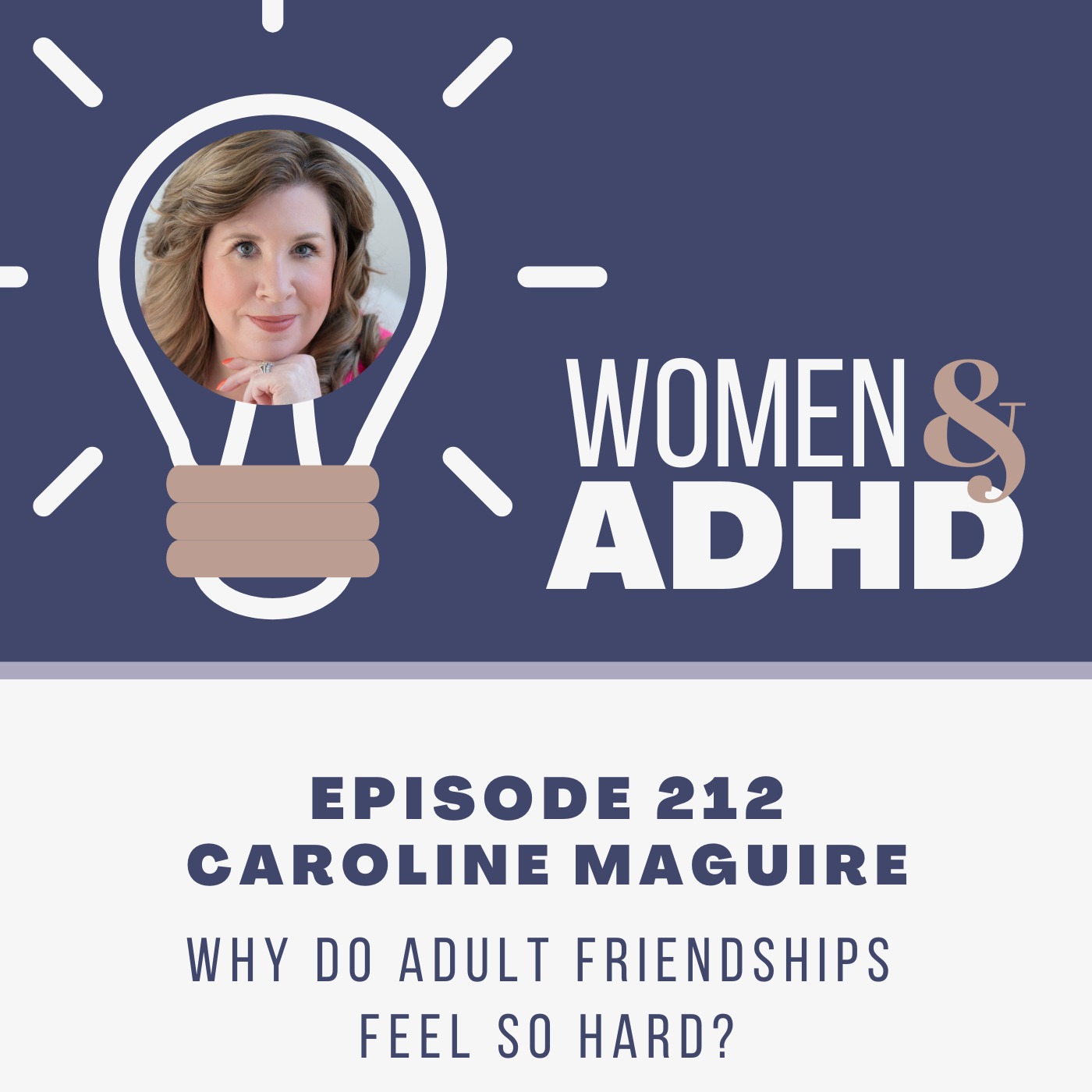
Caroline Maguire: Why do adult friendships feel so hard?
About This Episode
Episode 212 with Caroline Maguire
“All the kids I worked with were like, 'I would love to have a friend.' All the adults were like, 'Something's wrong with me, I don't have friends.' And I was like — no, no, no. Nothing's wrong with you.”
Caroline Maguire is an ADHD coach, friendship expert, and author of the new book, “Friendship Skills for Neurodivergent Adults: A Guide for the Anxious, Uniquely Wired, and Easily Distracted.” If you’ve ever felt like you missed the “how to be a friend” manual — or that you can do intense one‑on‑one connection but still don’t feel like you truly belong anywhere — this conversation is for you.
We dig into why neurodivergent wiring affects the way we show up in friendships, and what it actually looks like to build connection on our own terms. Caroline offers a deeply neuroaffirming roadmap to adult friendship, with language for patterns many of us have felt but never named, plus practical tools that don’t ask you to mask or be “less” of yourself.
Key topics discussed:
- Caroline’s journey into ADHD coaching and why friendship became her niche
- The difference between connection vs. belonging for neurodivergent adults
- Key friendship mindsets: scarcity thinking, all‑or‑nothing, anxious over‑correcting, and the impulsive friendship cycle
- Fortressing: what it is, why we do it, and how it protects and isolates us
- The five levels of friendship and how mismatched expectations create pain
- Communirelating: explaining how your brain works without apologizing for it
- Practical strategies for structured socializing and automating check‑ins
Website: carolinemaguireauthor.com
Instagram: @authorcarolinem
Links & Resources:
- Friendship Skills for Neurodivergent Adults by Caroline Maguire
- Caroline’s Youtube channel
- - - - -
Episode edited by E Podcast Productions
- - - - -
Women & ADHD coaching: www.womenandadhd.com/coaching
- - - - -
Work 1-on-1 with Katy: www.womenandadhd.com/katy
- - - - -
Order the “Hey, it’s ADHD!” course: www.womenandadhd.com/adhdcourse
- - - - -
Did you love this episode? Click here to pledge a one-time donation to the podcast!
- - - - -
If you are a woman who was diagnosed with ADHD and you’d like to apply to be a guest on this podcast, visit womenandadhd.com/podcastguest.
Instagram: @womenandadhdpodcast
Tiktok: @womenandadhdpodcast
Twitter: @womenandadhd
Facebook: @womenandadhd
Advertising Inquiries: https://redcircle.com/brands
Privacy & Opt-Out: https://redcircle.com/privacy
[SPEAKER_00]: I don't really give like three chances that little girl in me that you really abused she's not giving you three chances so I have a castle the walls are pretty high also so that sometimes so impossibly high that no one could ever meet the standards and then there's a drawbridge and the minute you do something that I think is suspicious or something I pull that drawbridge up.
[SPEAKER_01]: Hello and welcome to the women and ADHD podcast. [SPEAKER_01]: I'm your host, Katie Weber. [SPEAKER_01]: I was diagnosed with ADHD at the age of 45, and it completely turned my world upside down. [SPEAKER_01]: I've been looking back at so much of my life. [SPEAKER_01]: School, jobs, my relationships, all of it with this new lens, and it has been nothing short of overwhelming. [SPEAKER_01]: I quickly discovered I was not the only woman to have this experience and now I interview other women who like me discovered in adulthood they have ADHD and are finally feeling like they understand who they are and how to best lean into their strengths both professionally and personally.
[SPEAKER_01]: Hello, hello, and welcome. [SPEAKER_01]: Here we are at episode 200 and 12 in which I interview Caroline McGuire. [SPEAKER_01]: Caroline is a certified ADHD coach and a word-winning author and one of the most thoughtful, compassionate voices we have when it comes to friendship and social skills for neurodivergent children and adults. [SPEAKER_01]: Caroline's first book was Why Will No One Play With Me, a practical guide for parents to help children with social and executive functioning challenges, build friendships.
[SPEAKER_01]: It won multiple awards, including a Best Book Award from American Book Fest, and has been named by Book Authority as one of the best ADHD books of all time. [SPEAKER_01]: But today we are talking about her brand new book, Friendship Skills for neurodivergent adults, a guide for the anxious, uniquely wired and easily distracted. [SPEAKER_01]: This is the first comprehensive truly neuroaffirming roadmap to adult friendship for ADHD and autistic adults. [SPEAKER_01]: And I cannot overstate how patient, kind, and practical this book is.
[SPEAKER_01]: I found it to be full of real world strategies
[SPEAKER_01]: In today's conversation, Caroline and I dig into why friendship is so difficult for neurodivergent adults, and why this topic has become her niche. [SPEAKER_01]: We also talk about the difference between connection and belonging, and we talk through the friendship mindset that so many of us fall into without even realizing it, like scarcity mindset, fortracing, the impulsive friendship cycle. [SPEAKER_01]: Anxious overcorrecting. [SPEAKER_01]: And how simply having a language for these patterns can be genuinely life-changing.
[SPEAKER_01]: Caroline's book is both emotionally validating an incredibly actionable. [SPEAKER_01]: I found myself seeing my entire friendship history through a new, much kinder lens. [SPEAKER_01]: So, I really hope you enjoy this conversation as much as I did. [SPEAKER_01]: Without further ado, here is my interview with Caroline McGuire. [SPEAKER_01]: Oh, Caroline, thank you so much for being here. [SPEAKER_01]: Last time I spoke to you was in October of 2024, and you were just starting to write the adult version of your book that you wrote several years ago, why will nobody play with me?
[SPEAKER_01]: And congratulations, it's finally out in, it's called Friendship Skills for Nerd of Urgent Adults, a guide for the anxious, uniquely wired and easily distracted. [SPEAKER_01]: Before we even get started, I just want to thank you wholeheartedly for putting this book into the world. [SPEAKER_01]: It is funny, credible, resource, it is so helpful, it is so like, [SPEAKER_01]: I don't know what I was reading and I was thinking like it is so patient and kind and thorough and I think that that is like one of those things as a person who was in order to version like I really appreciate how much detail you go into and how just like productive it felt to read that book like it's really chockful of skills in a way that I think is not overwhelming and just it's just was really comforting and so bravo like it's an amazing book and I'm so glad [SPEAKER_01]: Like how was it for you to write it?
[SPEAKER_00]: Well, thank you first for having me, and thank you so much for your compliments of the book. [SPEAKER_00]: I'm so glad I really thought about it for a long time before I wrote it, and I think that's part of it. [SPEAKER_00]: I also consulted with a lot of people. [SPEAKER_00]: Some people are mentioned in the book, some people are like, love you, don't wanna be mentioned, but I think for me writing it, it was actually so much more empowering than writing what I will know and play with me.
[SPEAKER_00]: I knew so much more, I really had such a clear vision, [SPEAKER_00]: I had a clear enough vision that when other people would weigh in and I knew it wasn't the right thing. [SPEAKER_00]: I didn't go along. [SPEAKER_00]: Whereas I feel like with why I don't know and play with me, I had like literary agents and people sort of pushing me in a direction. [SPEAKER_00]: And I'm not saying it's not a great book, but this time I was like, no, I've spoken to so many people and like that's not their directions we need to go.
[SPEAKER_00]: So I also have a new literary age and who's amazing and sweet and wonderful and would never push me on anything. [SPEAKER_00]: But I think like I just felt like I knew what I was doing a little more and so that really helped because I knew what to expect. [SPEAKER_00]: but also I've read like every friendship book that comes out right and I always read them and I'm like this is nice like if I could do that I don't totally do that right like if I could like drop a little note to people every day letting them know how I feel or what I like you know advice and people give them like I can't remember to do that like I don't always remember my friend Dorco people like I can be able to do some of these things so I really felt empowered about [SPEAKER_00]: These are the things that people want and are asking for and that there's no one size fits all and like here's the different ways you could friend and the different skills and strategies you might need.
[SPEAKER_00]: Maybe not you personally, Katie, right? [SPEAKER_00]: But maybe someone else, right? [SPEAKER_00]: And so I felt empowered. [SPEAKER_01]: Yeah, that's so interesting. [SPEAKER_01]: And what did interesting parallel to this version of this book as opposed to the first book?
[SPEAKER_01]: in your books, which is like it's not about trying to fit in, right? [SPEAKER_01]: It's not about trying to fit in. [SPEAKER_01]: It's trying to like find connection on your own terms, and by finding it on your own terms, and a lot of us I think with an adult diagnosis relate to the feeling that a diagnosis gives us is this it opens this opportunity to be who we are and to not feel shame about that, and then also [SPEAKER_01]: to like improve our skills around communication, emotional regulation, whatever it is, but it comes from a place of acceptance and validation, and it sounds like this book mirrors that idea that you were like, okay, I'm in a grounded place where I feel really good about my what I'm writing about and what I need this book to be, and you know, so I'm not going to like fall prey to a lot of the pressures that might exist around me.
[SPEAKER_00]: I love that you brought this up to because I think it really drives with like women in ADHD, right? [SPEAKER_00]: So I think we were socialized a certain way. [SPEAKER_00]: I think we were told certain things. [SPEAKER_00]: And I was like super aware of that when I was writing the book and I was super aware of that just as [SPEAKER_00]: so many people are coming into this late diagnosis, right? [SPEAKER_00]: And I really was aware that there's going to be just like thousands and thousands of people, right?
[SPEAKER_00]: Getting a diagnosis and then saying, okay, how do I live with this diagnosis? [SPEAKER_00]: How do I thrive? [SPEAKER_00]: How do I take this information and have this be a new day? [SPEAKER_00]: And then, oh, PS, I've never had friends or I've never had the friends I wanted, and like, what is this new diagnosis do for me in that context too? [SPEAKER_00]: Like, I just was so aware of that because I am one of those people who loves the explosion of the numbers. [SPEAKER_00]: I'm like Halleluja, the day is coming.
[SPEAKER_00]: It's always been there, right? [SPEAKER_00]: Like it's just been this undercurrent. [SPEAKER_00]: It's been the people you chat with in the nail salon or the supermarket or at a dinner party and they say like I think I might have ADHD now coming and getting that. [SPEAKER_00]: That diagnosis. [SPEAKER_00]: So that was also so on my mind. [SPEAKER_00]: Like there's all these people who didn't know their brain and now they have this diagnosis. [SPEAKER_00]: as adults right different from children and then like what do we do with that information.
[SPEAKER_00]: So it's so good that you brought that up because that was like so omnipresent on my mind. [SPEAKER_00]: I was like writing to those people too.
[SPEAKER_01]: We've talked a lot about a lot of our ADHD experience and a lot of what gets us to our diagnosis and adulthood, especially as women, has nothing to do with the DSM and has nothing to do with a lot of the diagnostic criteria and so much of it is relational, so much of it is emotional. [SPEAKER_01]: And there is a lot of the executive functioning element, but a lot of it is rooted in how we feel around other people and the shame that we feel. [SPEAKER_01]: And that starts at a really young age, right?
[SPEAKER_01]: I guess I'm curious, like, how did friendship and friendship skills become your niche? [SPEAKER_00]: So, you know, I had a really hard time as a kid and I didn't have friends and then I sort of figured out how to make friends and then I got my diagnosis when I was 25 and then I really, really started to figure things out. [SPEAKER_00]: And I would definitely say Caroline that that age is different from Caroline now on my friendships are different, right? [SPEAKER_00]: So I always knew that, right?
[SPEAKER_00]: It was like present in my life. [SPEAKER_00]: That I just knew I was more empowered as I came along as I got more ADHD support and knowledge. [SPEAKER_00]: And when I trained to be an ADHD coach, when I came into ADHD coaching 21 years ago, [SPEAKER_00]: Friendship was not discussed. [SPEAKER_00]: As a matter of fact, this is, you know, the internet was not as it is now. [SPEAKER_00]: There weren't podcasts, there weren't, you know, everything was different. [SPEAKER_00]: And so there were sort of gatekeepers.
[SPEAKER_00]: And the magazines and the media and the gatekeepers, I would bring up. [SPEAKER_00]: Like none of my clients have friends at any age, right? [SPEAKER_00]: And it was such a hot topic. [SPEAKER_00]: I worked at the Hollywood Center at the time, and it was such a hot topic of like, oh yeah, none of our clients are happy socially. [SPEAKER_00]: And when I would bring it up to the gatekeepers who got to decide what you spoke about and wrote about, they were like, oh, you know, Caroline, people need to get to work.
[SPEAKER_00]: People need to be on time. [SPEAKER_00]: Like this is not as important. [SPEAKER_00]: And I was like, no, this is the reason you get up in the morning, right? [SPEAKER_00]: Like, it's not just to be on time to go slog it out in some job. [SPEAKER_00]: You get up so that you have connection and happiness and joy. [SPEAKER_00]: And so I was lucky in that, um, Ned Howell was really, really supportive. [SPEAKER_00]: I think his book connection had came, had come out by then. [SPEAKER_00]: And he was just like, yeah, no kidding, right?
[SPEAKER_00]: And he basically endorsed me starting to run groups and starting to do things. [SPEAKER_00]: And then I just became like it became a hyper focus and I went and I got a master's debris so that I would have the knowledge to teach executive functions, social, emotional learning skills. [SPEAKER_00]: at a level that other people didn't, because I was just like, no, we're talking about this. [SPEAKER_00]: It kind of worked to me. [SPEAKER_00]: It was like that ADHD thing where you're just like, you telling me no bothers me, right?
[SPEAKER_00]: I was like, you don't get to tell. [SPEAKER_00]: It was like pre us taking charge as a community kind of, but me going, you don't get to tell us what's important. [SPEAKER_00]: we get to figure out what's important to us and we get to tell you what we need, right? [SPEAKER_00]: Like, I just thought that that was so irritating. [SPEAKER_00]: You know, because all the kids I worked with were like, I would love to have a friend, all the adults that I saw. [SPEAKER_00]: We're like, something's wrong with me.
[SPEAKER_00]: I don't want my friends. [SPEAKER_00]: And I was just like, no, no, no, nothing's wrong with you. [SPEAKER_00]: You know, like, I just felt so annoyed that it was the topic we were not discussing. [SPEAKER_01]: Yeah. [SPEAKER_01]: Well, and I think that's the same notion as I mentioned earlier, this notion of fitting in, right? [SPEAKER_01]: And I think a lot of like in terms of apparent, you know, when my kids were little, that was a core concern for me was like, I wanted them to fit in, I wanted them to be accepted.
[SPEAKER_01]: And [SPEAKER_01]: I also knew that like you had to validate them in terms of who they were, right? [SPEAKER_01]: And so I think you know a lot of the time when we talk about skill building, it's this notion of notion of like, okay, these are the rules you need to follow in order to fit in. [SPEAKER_01]: And as somebody who is a neurodivergent kid would think like, [SPEAKER_01]: Okay, this feels an authentic, and then it becomes masking, and then it becomes exhaustion, and then it becomes burnout and isolation, et cetera.
[SPEAKER_01]: So I think a lot of the time, like as I was reading your book, I was thinking about that real distinction that you have throughout the book implicitly of this notion of like, [SPEAKER_01]: you're not changing yourself, right? [SPEAKER_01]: You're not trying to fit in. [SPEAKER_01]: You're not trying to like squeeze yourself into a mold. [SPEAKER_01]: And you want to be able to communicate and you want to be able to find connection. [SPEAKER_01]: And the answer is not to just like hide or say like, I tried, that's it.
[SPEAKER_01]: I'm just going to live out the rest of my life in isolation. [SPEAKER_01]: You know, that is really is about the importance of connection and how do we find that in a way that works for us? [SPEAKER_00]: And Katie, I'm so glad you got that theme and like you're bringing this up because it's so important, like, there's this thing to of like, so if you're fitting in, you're going to a place you're not really into, which goes against interest, which is the fuel of our brain, right, to be with people who don't really know you and they don't accept you and they, they maybe they're even tolerating you the absolute worst feeling in the world is being tolerated, right, and so you're like, [SPEAKER_00]: Going to be with people, you're not so keen on.
[SPEAKER_00]: Going to a place, maybe you don't want to be to do an activity that probably isn't what fills your cup. [SPEAKER_00]: And that, and that's the masking thing. [SPEAKER_00]: And I think so many of us were socialized. [SPEAKER_00]: Like you said, when your kids were little, I want my kids to have the skills to make friends. [SPEAKER_00]: I want my clients to have the skills to make friends. [SPEAKER_00]: But I want them to be able to be authentic and have their values and their humor and their personality show.
[SPEAKER_00]: And I also think there's like new research that's come forward that helps us with this. [SPEAKER_00]: which in the past five or six years, there's a bunch of research that shows that the problem for us in socialization isn't like you have to follow all these rules and like become a robot and mask it's that there's miscommunication, mismatched expectations and so typical people are expecting us to do certain things behavior in some ways and when we don't they're kind of baffled they're like why are you not [SPEAKER_00]: responding to my 8,000 texts, right?
[SPEAKER_00]: And then if we explain, oh, I have ADHD, or even just I'm a person who loses track of people, or you give them that context, that actually, you know, I'm not saying everyone, because there's always, [SPEAKER_00]: mean people, right, but that that actually people will be accepting, but it's really just the fair kind of baffled by like what we're doing, right? [SPEAKER_00]: So if we say I'm a person who tells you a story that seems like a side quest, but really it's going to loop back around and tell you something that's really important, they'll follow us, right?
[SPEAKER_00]: And if they don't, here's my
[SPEAKER_00]: You know, a person who does forget to text you back, irks them so much, then maybe we're not a match, right? [SPEAKER_00]: Because I can do a lot of things, but short of becoming super hyper vigilant, I can't have the executive function management and organization of a typical person. [SPEAKER_00]: Unless that's the only thing I do, which by the way in college, I think that is the only thing I did. [SPEAKER_00]: I think in college, Caroline, like all I focused on was like being social and making sure everything ran smoothly.
[SPEAKER_00]: But that's not life, right? [SPEAKER_00]: Like we have kids to raise and mortgages to pay and like groceries to buy. [SPEAKER_00]: You know, like I can't spend all my life doing that. [SPEAKER_01]: Yeah, you know, one of the things you, uh, had a, like a YouTube video on your channel about the longing. [SPEAKER_01]: And this was something I was thinking about a lot with the book, the difference between connection and belonging. [SPEAKER_01]: Because I feel like often times, you know, I always hear that fact of like, you know, the, the, the most important part to health and, and longevity is connection, right?
[SPEAKER_01]: It's the most important part of the human experience. [SPEAKER_01]: And like I feel connected to my spouse, I feel connected to my children. [SPEAKER_01]: I feel connected to like a handful of my BFFs that are my writer die, level of friendship, which we'll get into the friendship flavors. [SPEAKER_01]: But I was like, [SPEAKER_01]: Do I feel a sense of belonging, no? [SPEAKER_01]: And I wonder if there's something unique to the neurodivergent experience around this outsider, this is like general outsider, because I was thinking a lot about like, am I lonely?
[SPEAKER_01]: Like I have people in my life who keep you know, I'm not a lonely person, but I have had this overall sense of lack of belonging. [SPEAKER_01]: And I'm curious, how do you distinguish between connection and belonging? [SPEAKER_00]: You know, it's so interesting that you save us because I find that that is the truth, right? [SPEAKER_00]: I find it for myself too. [SPEAKER_00]: I think that we can feel belonging. [SPEAKER_00]: I feel belonging when I'm at the International Conference on ADHD.
[SPEAKER_00]: I feel belonging when I'm in my little true crime. [SPEAKER_00]: I am obsessed with true crime as most people know and like I do these patriots and stuff and like it's like crazy and the amount per month that I'm paying by the way like I should have my head examined. [SPEAKER_00]: But like when I'm in those groups and we're kind of all speaking to same language even though a lot of the people are typical I do feel belonging because we have this [SPEAKER_00]: We have this beyond connection like they're happy to see me they're happy to hear for me as a matter of fact Like sometimes I'll be like oh well, I think that person doesn't read the room and they'll be like tell me about this reading the room thing like how do you know someone is reading the room right so like my expertise like actually plays a role So I think that a lot of times we do feel like outsiders.
[SPEAKER_00]: I mean a lot of times I am in groups especially with [SPEAKER_00]: sort of mean girl moms. [SPEAKER_00]: And I'm like, how are we on the same planet? [SPEAKER_00]: Like, I do not understand like excluding two children in a class of 15 because you say you can't get enough tickets to a farm birthday party. [SPEAKER_00]: Like, I would never do that. [SPEAKER_00]: I'd be like, we can't have the birthday party there, right? [SPEAKER_00]: Like, I just feel like, are we the same planet? [SPEAKER_00]: Like, [SPEAKER_00]: And I think that sometimes I also feel like that, and I know a lot of my clients, especially new diagnosis, right?
[SPEAKER_00]: Especially if they don't know their brain, they feel sort of other. [SPEAKER_00]: And I think connection is that moment where you're using with someone or you, you feel a kinship with them, or like you said, you have this history, right? [SPEAKER_00]: Like I have a history with someone so I don't have to explain everything to them. [SPEAKER_00]: But I think belonging is when you feel that comfort and development and like you are part of the community. [SPEAKER_00]: And I think we can feel that.
[SPEAKER_00]: But I think a lot of times we have not found it yet or we've found it in a way that is like a one particular place or environment. [SPEAKER_00]: And I never know because the people writing about belonging and stuff and doing the research, they're typical. [SPEAKER_00]: So they, I mean, the way they talk about it is like, almost blase, like, you'll just find belonging. [SPEAKER_00]: Like, it's not that simple for us. [SPEAKER_00]: And that's why I wrote it as like a goal, but understanding that it is something that it's a journey because also, [SPEAKER_00]: If you're masking all the time, people who are high masking always tell me that they just feel like a fish out of water, you know, whenever they're in those high masking situations.
[SPEAKER_01]: Yeah, you know, like I always joke to the past about like having really intense conversations and really being more comfortable about one on one conversations, right? [SPEAKER_01]: I mean, this is like I love the podcast because I have these intense one of our conversations with people and then we go off and we're sort of like maybe I'll see you again, maybe I won't but like [SPEAKER_01]: You know, and like I, you know, at parties in university, I was always the one, you know, everybody else was socializing in the kitchen and I'd be like having this intense conversation about the time space continuum with somebody on a couch.
[SPEAKER_01]: And so it's like, I always thought that that there was this neurodivergent element to wanting to have one-on-one intense conversation, so that maybe then contributed to this lack of like community. [SPEAKER_01]: element, right? [SPEAKER_01]: Like the belonging aspect is much more of like a group, a community, a feeling of being welcomed. [SPEAKER_01]: And they do exist. [SPEAKER_01]: I'm not saying that like I also have my like niche communities, but I think there's something about this like [SPEAKER_01]: preferable friendships like I've just never been like a one of the girls kind of person I've never I didn't have bright maids I've never been a bright it's made all of my friends are like one friend They don't know each other and I spend time with each one individually and I don't think that's I feel like that's a pretty typical experience for a lot of neurodivergent people [SPEAKER_00]: I love that you're touching on this because I think it normalizes some things, right?
[SPEAKER_00]: So first of all, there are people who have those, those girl groups. [SPEAKER_00]: I think it also depends on the person. [SPEAKER_00]: I'm married like my best friend from college. [SPEAKER_00]: So I do admit that I'm sure there are people who don't have that and who are seeking that in a, in a female friend. [SPEAKER_00]: And I have female friends, but I'm seeking other things for them. [SPEAKER_00]: Right, I have a best friend. [SPEAKER_00]: I have someone who's like built in here in the house, whether he likes it or not, who I tell everything to, right?
[SPEAKER_00]: And I always think that that might be part of my thing, but I also think like we do want that intense connection. [SPEAKER_00]: Like, I get DMs. [SPEAKER_00]: I'm not kidding you. [SPEAKER_00]: Regularly, I get emails. [SPEAKER_00]: I get Facebook comments, my YouTube channel, and they're like this. [SPEAKER_00]: I don't want a bunch of friends. [SPEAKER_00]: I have acquaintances. [SPEAKER_00]: I want a best friend, or I want a close friend. [SPEAKER_00]: And I totally think, I think I was very different in college.
[SPEAKER_00]: I wasn't sitting on the couch like you were having the space time continuing. [SPEAKER_00]: But I also think I was probably masking, probably trying to fit in more. [SPEAKER_00]: But I do find that I'm that person now. [SPEAKER_00]: Like I will talk in a group. [SPEAKER_00]: But my husband always jokes to me, always. [SPEAKER_00]: Like, can we go anywhere without talking about ADHD? [SPEAKER_00]: And part of it is, when I say what I do, people are immediately like, oh my God. [SPEAKER_00]: So I have this sister-in-law and like, she is constantly struggling, what do I do?
[SPEAKER_00]: My child, my this, my that. [SPEAKER_00]: I'm a professor, none of my ADHD students turn in their work, like, what's that about? [SPEAKER_00]: You know what I mean? [SPEAKER_00]: Like, it's always happening. [SPEAKER_00]: But I think you're right, and I think that just the way in our community reacts, where they're writing me, and they're like, like, get out of here with your acquaintances, right? [SPEAKER_00]: Like, if you're proposing acquaintances, I don't want it. [SPEAKER_00]: And that's why I'm very much into, there's no one's size fits all.
[SPEAKER_00]: Right? [SPEAKER_00]: Because what you want, what fills your social cup and what makes you walk away from an evening or an afternoon and say, wow. [SPEAKER_00]: I really feel good and that's how you should feel is different than someone else, right? [SPEAKER_00]: But yeah, I think it is a thing and I can't really figure out, and of course they do no research on us, right? [SPEAKER_00]: Like they don't research adults with ADHD, like it's just, it's barely done. [SPEAKER_00]: But they do research autism, not just not as much adults, I just think part of it is that we want deep talk.
[SPEAKER_00]: right, and we don't want that like superficial thing. [SPEAKER_00]: And Katie, see if this resonates with you, the other thing I was thinking of when you were speaking about us, I also think we don't like fakeness. [SPEAKER_00]: And part of what I struggle with in a group of women, especially, is I'm with you, and maybe you're not my bosom friend, but you're my friends friend. [SPEAKER_00]: And I know that you did leave those two kids off on the birthday. [SPEAKER_00]: I have a really hard time even being civil to you.
[SPEAKER_00]: You know what I mean? [SPEAKER_00]: So that's also part of it is that women are socialized in a certain way, hopefully it's changing, right, and like I have a really hard time in certain groups not all, but where there's a lot of hypocrisy or there's caddiness or there's meanness or people are making little comments that I'm supposed to ignore. [SPEAKER_00]: in order to be part of this larger group. [SPEAKER_00]: And the comments that are mean or whatever. [SPEAKER_00]: And I'm like, I don't really need this.
[SPEAKER_00]: So I don't know. [SPEAKER_00]: I always think about that, Katie. [SPEAKER_00]: Always. [SPEAKER_00]: I'm like, is there something different about us that I can't just tolerate you saying little, caddy things and me just going along to get along? [SPEAKER_01]: Well, I feel like there's so many elements that are all wrapped up in that, and I, and it's one of the reasons why I called your book patient because I feel like you really do explore so many elements and like what is it, you know, that constant curiosity about like what is it about my brain wiring that leads me to these different mindsets around friendship right and as you were talking to, it was reminding me of the fortress mindset.
[SPEAKER_01]: which was the part of your book that made me cry like I fully cut, but just from seeing that protective person and you know really having to think about like what am I protecting in myself when I do that fortress saying and I feel like we should get into like okay what [SPEAKER_01]: There's so much about this book, I got overwhelmed there for a minute. [SPEAKER_01]: Okay, let's talk about the friendship mindsets because I feel like this was this was definitely the most emotional part of the book for me in general thinking about like, you know, going over all of these ways in which [SPEAKER_01]: I come into hot, you know, or then I'm cold and then I forget about people like all of those ways that you know just brought up a lot of those feelings of shame that so many of us have a way around like not being able to do friendship correctly and and feeling like everybody got the manual but us so so you break it down you break it down friendship mindsets into a bunch of different categories can we just like go through them.
[SPEAKER_01]: The first one is scarcity mindset, which I think a lot of us will relate to. [SPEAKER_01]: Can you just describe quickly what that is? [SPEAKER_00]: Yeah, so the mindset thing I wanted to talk about because it affects how you interact with people, right? [SPEAKER_00]: If you think, um, scarcity mindset, there's not that many people in the world. [SPEAKER_00]: There's so few who accept me. [SPEAKER_00]: I have to hold on to people because I'm going to be alone otherwise. [SPEAKER_00]: And you have that scarcity mindset then you go through life with interactions, feeling that way.
[SPEAKER_00]: And instead of saying, wow, you're not treating me very well or, wow, I end up people pleasing around you or, wow, I don't really have a good time here. [SPEAKER_00]: you feel like I have to take it because there's just not that many people in the world or people who will, I'm gonna use this word again, tolerate me, which I think tolerate is like the worst feeling in the world. [SPEAKER_00]: And so that's, you know, I wanted to talk about the mind sets. [SPEAKER_00]: I didn't know it would be that emotional.
[SPEAKER_00]: I wanted to talk about them because I fully admit that I've gone through a bunch of these different iterations, right? [SPEAKER_00]: Like I've been through this and my clients will often [SPEAKER_00]: they'll reframe things based on the mindset, right? [SPEAKER_00]: So, you know, they come in and they say I had this great time, I did this great experience and then they'll say like, um, very all or nothing thinking is one of the mindset. [SPEAKER_00]: It's like a black and white thinking, like, oh, like it was a great time or it was a disaster, right?
[SPEAKER_00]: I was well accepted loved and, you know,
[SPEAKER_00]: That's probably not the case, right? [SPEAKER_00]: We tend to have a lot of black in my thinking, a lot of all or nothing thinking. [SPEAKER_00]: And the thing is, a lot of times my clients reframe things. [SPEAKER_00]: Like they start out telling me how great it was. [SPEAKER_00]: And then the shame and the baggage and the rejection, sensitivity and all that stuff makes them continually reframe to whereby the end of the session, they're like, it was a disaster. [SPEAKER_00]: Or one social faux pas makes us, instead of looking at, I was with this person for five hours, we had a great time, except the one comment I made, that makes us feel such shame and such anxiety.
[SPEAKER_00]: And so that, I mean, I thought the minds that were important to sort of have us know so that we can catch ourselves and say, like, oh, Caroline, this is you, [SPEAKER_00]: anxiously overcorrecting is one where you make that phopa that no one noticed and then be gruminate about it and then we send 45 texts to people explaining ourselves and now it becomes this like sort of cringy thing and we kind of overcorrect or and it locks into people pleasing. [SPEAKER_00]: And so I wanted people to be aware I wasn't anxious overcorrecter in college.
[SPEAKER_00]: I was totally an anxious overcorrecter. [SPEAKER_00]: And I think it was confidence and practice and me addressing that and saying like do not explain this because it wasn't a big deal so I wanted to address those things because I think they affect how how we approach friendships and relationships. [SPEAKER_01]: Yeah, right, exactly. [SPEAKER_01]: And yeah, I love what you said about just like having the language to be able to be mindful of our own behaviors and sort of stop ourselves and say like, what are the facts here?
[SPEAKER_01]: Like is this a mindset that I'm falling into or is this, you know, can I take a moment to really take a step back and take a bit of a, you know, a macro look at like what actually happened and and what is what is the truth here? [SPEAKER_01]: And so there's the scarcity mindset, there's the rushing in mindset, which I feel like I did a lot more when I was younger than I do now, although, you know, my husband and I basically met and we were like, oh, we're going to get married. [SPEAKER_01]: So let's not waste any time.
[SPEAKER_01]: He's and he's, you know, we've been inseparable for the last 25 years. [SPEAKER_01]: So I'm glad it worked out. [SPEAKER_01]: But, you know, you look back and you're sort of like, oh, maybe we should have taken a little bit slower, but that's how my friendships have always been like, [SPEAKER_01]: And I think it's connected to this scarcity mindset a little bit in that way of like, oh, here is this person. [SPEAKER_01]: This is this connection I'm feeling is rare. [SPEAKER_01]: And I don't want to lose this.
[SPEAKER_01]: Like, I'm going to go all in on this person because this person might be my soulmate. [SPEAKER_01]: And we skip from the acquaintance level to like the year might best be level so quickly that it ends up kind of being problematic, which you talk about in the book. [SPEAKER_00]: Yeah, the impulsive friendship cycle I talk about in the book and I totally used to be an impulsive friendship cycle person and and you know then I would get into trouble like I joke about this all the time but like it's the truth like I was once at breakfast with someone and I was like oh you're racist and you're like a terrible person and I've rushed into this relationship with you you know and and people actually since they've been reading the book have been writing me their like stories right like people have come up to me when I've given speeches and stuff and then and like sometimes they're like [SPEAKER_00]: I'm trapped, sent help.
[SPEAKER_00]: I don't know what to do. [SPEAKER_00]: I got myself into this relationship way too fast. [SPEAKER_00]: And it's like I get it. [SPEAKER_00]: We feel that saying it's akin to falling in love. [SPEAKER_00]: The chemicals come. [SPEAKER_00]: We don't always feel that connection. [SPEAKER_00]: I would argue a lot of the things I offer in the book are how to increase [SPEAKER_00]: The number of people we meet and the kinds of people who are our people so that we feel that connection more, you know, in areas of high interest and high connection, but I do get how it happens because I wasn't impulsive friendship person and I think the problem too is sometimes the people were meeting.
[SPEAKER_00]: don't want to be an impulsive friendship person, right? [SPEAKER_00]: So we take it so personally, we're like, oh my God, I asked them to get married and they don't want to and I'm so rejected. [SPEAKER_00]: And when my clients tell me the story or other people, I'm like, well, no, I think they're just taking it at a pace where they're moving through the stages of friendship and you skipped all the stages and they might even be a little bit [SPEAKER_00]: weirded out or they might be like me where I'm a former impulsive person so I put in place pauses so that I don't end up in a situation where I'm in a relationship that doesn't work for me in any way because I rushed in.
[SPEAKER_00]: And I've had relationships that did work, but I also
[SPEAKER_01]: Right, and I think also like that's where the fortressing part comes from for me, which is like I think we're a lot closer than we probably are and then all of a sudden you don't text me in what I feel is an appropriate amount of time to text me back and then I get personally offended and feel rejection and then the wall goes up so let's talk about fortressing because like I said that was probably the biggest like gut punch for me in terms of some of the [SPEAKER_01]: some of the patterns and trends I could look back over my life and see with friendships.
[SPEAKER_00]: Yeah, I heard about fruit fortressing on the internet and it resonated with me so much and I totally know that I do it. [SPEAKER_00]: And I would love to hear from people do other people who were bullied and stuff do this. [SPEAKER_00]: I bet they do. [SPEAKER_00]: I did consult researchers and stuff about it and was like, is this just to me thing? [SPEAKER_00]: And they were like, no, I think this is what it is. [SPEAKER_00]: And what it basically is is that I don't really give like three chances, right?
[SPEAKER_00]: That little girl in me that you really abused, she's not giving you three chances. [SPEAKER_00]: So I have a castle.
[SPEAKER_00]: Sometimes so impossibly high that no one could ever meet the standards, right? [SPEAKER_00]: And then there's a drawbridge and the minute you do something that I think is suspicious or something, I pull that drawbridge up. [SPEAKER_00]: And I think that it's good to know about ourselves because sometimes there is a simple explanation for why someone didn't text back or why they canceled or why they aren't [SPEAKER_00]: You know, maybe moving through the stages of friendship as fast as you are, sometimes they are there are red flags and I have a whole chapter on how do you know someone be a good friend and please don't say I'm not saying pay attention to red flags pay attention, but I think if you're a fortresser you have to know it.
[SPEAKER_00]: Because you have to know that I am less likely to give second chances. [SPEAKER_00]: I am less likely to allow for things like as much as I do this for a living. [SPEAKER_00]: I have to guard against fortracing because that's a self-protective instinct that developed at some point. [SPEAKER_00]: Right? [SPEAKER_00]: At some point, I developed a self-protective instinct that said, hey, I'm an incredibly loyal, dedicated person.
[SPEAKER_00]: I'm pulling my drop-ritch up. [SPEAKER_00]: And so I think it's just good to know so that if you are that person, you can figure out how much do I wanna be this person and where does this whole me back? [SPEAKER_00]: And where am I also maybe overreacting a little bit and like human beings make mistakes? [SPEAKER_00]: Is it a red flag or is it just like a faded text back and I've decided it's a red flag, right? [SPEAKER_01]: Right, and I think that a lot of it is about vulnerability like how ready it might be vulnerable with this person and if I'm in a moment where I have to show vulnerability and say like my feelings are hurt because you didn't text me back like that's a lot easier to do with my writer diversity than it is with somebody I haven't known so long and so that's what I really loved about the flavors of friendship that you that you break down in the book to the five levels of friendship because I think it's super helpful to then say like okay where is this person in these friendship levels [SPEAKER_01]: And do I have too many expectations right now, like it's so practical, and I love how you use like the ice cream scoop analogy of like buildings building friendships slower even if they feel more intense and like why it's important for us just just in terms of like emotional clarity right about some of this, some of those emotional reactions and some of the rejection sensitivity like.
[SPEAKER_01]: I find it's really helpful to then have this like, you talk about GPS, right? [SPEAKER_01]: It's like this map of our friendships in terms of like, okay, is this is my emotional reaction relative to the level of this acquaintance right now and so it's so practical. [SPEAKER_01]: So thank you for that and thank you for taking the time to break that down. [SPEAKER_01]: So we have the level one, which is like the friendly strangers right or friendly acquaintances.
[SPEAKER_01]: It's a strange beast, right, in terms of where people fall. [SPEAKER_00]: It is a strange beast and I'm so I'm contradicting myself a little bit because it is a strange beast, right? [SPEAKER_00]: So like I put it into that friendly stranger. [SPEAKER_00]: I want people to be aware of you know some of those true crime people. [SPEAKER_00]: I know everything about them as podcasters, but they don't know me, right? [SPEAKER_00]: But I also want to say that I'm also saying if you are anxious or you feel socially awkward or you feel like I don't know if I have the guts to try again.
[SPEAKER_00]: This is really hard. [SPEAKER_00]: you could join an online group and you can find kinship and connection there. [SPEAKER_00]: And so, it's not that I'm saying you can't have a close, close friend that you meet online. [SPEAKER_00]: But I think we just have to remember that sometimes, you know, we follow someone we watch their videos, we feel that connection, just like the person, you know, you see at the coffee shop every day and you wave to is not a friend, right, they're in a quaintant, and they're a person you say hello to.
[SPEAKER_00]: And then the biggest pitfall I see us having is more acquaintances. [SPEAKER_00]: that we have acquaintances or maybe they're even activity buddies, you know, someone you see at yoga, someone you talk to, maybe they're even moving into the emerging friends category where you're becoming friends. [SPEAKER_00]: But we start to have expectations of them of a friend, of a rider guy friend, and we start to lead on them in that way. [SPEAKER_00]: And [SPEAKER_00]: This is not me saying that we're too much and that we should curb our personality.
[SPEAKER_00]: This is me though saying that if you lean on someone who's an acquaintance and they disappoint you, that's because they are treating you like an acquaintance, right? [SPEAKER_00]: It doesn't mean that they're a bad person or that the relationship is doomed. [SPEAKER_00]: And that's, I think, a big thing for us. [SPEAKER_00]: A lot of people, I think, because they move really quickly through the stages of friendship, [SPEAKER_00]: and they go to sort of close friend with someone or they expect things of them.
[SPEAKER_00]: I think we have to remember the other person is part of this and they don't always move so fast and they may not reciprocally be feeling like we're a close friend. [SPEAKER_00]: They might be like, oh, this is an acquaintance or this is the next level which is an emerging friend. [SPEAKER_00]: Someone I'm getting to know rather than a friend. [SPEAKER_00]: And I think that moving through so fast, [SPEAKER_00]: It makes it harder for us to build the kind of trust and closeness and build that foundation.
[SPEAKER_00]: And I know that we like to move fast a lot of times and I get that, but I think that slowing down a little bit gives us actually the ability to build a better friendship that is more reciprocal. [SPEAKER_01]: Right, and I think also just there's a roadmap that if you feel like things have gone wrong, if you feel like you're no longer in this wonderful dopamine heavy situation, there is a way to for you to kind of look at this autopsy like okay what what's happening here with a lot more clarity, I think then most of the time where we're like what's wrong with me it must be be I'm terrible end of story right to look at like okay what what happened here.
[SPEAKER_01]: So there was the emerging friend level, and then there was the like moving into close friend your writer die in her circle, which you sort of felt like usually about two or three. [SPEAKER_01]: Does that include spouse? [SPEAKER_00]: No, I don't think that includes spouse, right? [SPEAKER_00]: But I think that, um, I think we really want those close friends. [SPEAKER_00]: I think we want those writer die friends. [SPEAKER_00]: I think some people have never had them and that's why they want them.
[SPEAKER_00]: Um, I think also sometimes we're looking for someone, you know, and it's, it's Hollywood. [SPEAKER_00]: I blame Hollywood because they make it seem like you're going to have this friend who's writer die who functions like a spouse. [SPEAKER_00]: This is where it sort of depends on the person. [SPEAKER_00]: If someone's looking from that for me, they're not going to get it because I have a spouse who is my sort of that person. [SPEAKER_00]: I can be your close friend, but I'm not going to function like a spouse for you.
[SPEAKER_00]: I just don't have the bandwidth and I don't have that need. [SPEAKER_00]: And that's the piece I'm trying to talk about in here. [SPEAKER_00]: The other person you're in reciprocity with, they have certain needs. [SPEAKER_00]: And I think sometimes we forget we have these needs and they feel so big that we forget that the other person has needs. [SPEAKER_00]: And the other person has things they want or don't want. [SPEAKER_00]: And so I think we could have those close friends. [SPEAKER_00]: I think we build toward them.
[SPEAKER_00]: Someone who is our people, and I think those... [SPEAKER_00]: those friendships build over time and you only get two or three, you know, in a lifetime. [SPEAKER_00]: And sometimes we do have and I have a lot on this friendship breakups, ghosting friendships that we no longer, you know, maybe you're newly diagnosed and the person you thought would support you most doesn't support you at all. [SPEAKER_00]: And I tell stories about stuff like that in the book for me personally where someone used to be what I thought I needed and then they're not anymore.
[SPEAKER_00]: And then I have a chapter on trouble shooting. [SPEAKER_00]: So if you are finding like, oh, I'm not feeling the same reciprocity or my friendship to feel stock, you can look at what's going on and what are the different moving pieces. [SPEAKER_00]: And maybe it is just it's taking time, we don't expect it to. [SPEAKER_00]: Maybe it is something that a skill we need to build or putting more time into it. [SPEAKER_00]: But I know that that's so hard. [SPEAKER_00]: We get stuck and we don't we don't have anyone to talk to about it.
[SPEAKER_00]: We don't know what to do.
[SPEAKER_01]: you talk about your friendship with Jessica McCabe a lot in the book and her desire to kind of get some IRL friends in her neighborhood. [SPEAKER_01]: She felt like a lot of her friends were online and this desire to have like a plop friend which I love that term. [SPEAKER_01]: Just just somebody to like sit down with, right? [SPEAKER_01]: Somebody, well, okay, what is a plop friend? [SPEAKER_00]: So plop front is someone like you pick up the mail from the mailbox on the way in to the door that's open because you you're allowed to open the door and you go and you sit on the couch, you know, maybe you take off your shoes and you sit on the couch and you talk about your day or you talk about something that's happened and you sort of plop onto that couch with them and you know, there is the in real life in person element to it.
[SPEAKER_00]: And there is that intimacy to it right like they know about your life. [SPEAKER_00]: They know about the people in your life and you can you know you can just launch in to like okay, you know my [SPEAKER_00]: You know, I know one point when I was working in a corporation, I had like six different bosses, right? [SPEAKER_00]: So you can be like, boss number five said this today. [SPEAKER_00]: And they are not like, wait, you have five bosses. [SPEAKER_00]: Right? [SPEAKER_00]: They're like, they're up on it.
[SPEAKER_00]: And it was something that Jessica expressed to me that she wanted during this whole process of her writing her book and me helping her and me writing my book. [SPEAKER_00]: And I wanted to include it with her permission because I felt like it's something that a lot of ADHD people really want. [SPEAKER_00]: I also thought it was sort of a magical story in the sense of like, it's a journey to get to plop. [SPEAKER_00]: And you might find other things along the way and don't discount all those things, right?
[SPEAKER_00]: You might find a me who is a virtual plop and when you're together, it's great. [SPEAKER_00]: It's not that you give up on that other plop. [SPEAKER_00]: It's just like you might find other things along the way and you're trying to get to that. [SPEAKER_01]: dream that you have of, of plop, beautiful quotes, which reminds me like, do you feel like there are unique benefits to having, IRL friends? [SPEAKER_01]: I mean, if you're somebody who is more inclined to have online friends, should you be looking for some real-life friends?
[SPEAKER_01]: Like, is
[SPEAKER_00]: I mean, of course, there are. [SPEAKER_00]: Here's the thing, no. [SPEAKER_00]: I feel like the online friends were really discounted in the past, like people acted like they weren't real friends. [SPEAKER_00]: You know, David Gwork had a the ADD coach academy who I've known for 25 years is my real friend, right? [SPEAKER_00]: He knows everything about me. [SPEAKER_00]: We don't see each other in person except maybe once or twice a year. [SPEAKER_00]: You might be, I met tons of people, even podcasters as I'm doing this who are like, you know, this person I podcast with, I met in a group or they're part of a group or part of Alan on or part of an online roleplay group and they are really, really close.
[SPEAKER_00]: I just think it's about what do you want, right? [SPEAKER_00]: So there are people who. [SPEAKER_00]: really find that their social cup is filled up with these online relationships. [SPEAKER_00]: They also can be a jumping off point. [SPEAKER_00]: I get confidence in this group. [SPEAKER_00]: I get confidence by having a really good online friendship. [SPEAKER_00]: And then that confidence means I can go out and do in person things that I couldn't do before because I didn't feel confident about it.
[SPEAKER_00]: Are there benefits? [SPEAKER_00]: Yeah. [SPEAKER_00]: I mean, an in-person friend can come over to my house and give me a hug, right?
[SPEAKER_00]: an online friend can't do. [SPEAKER_00]: But I also just want to say, like, I don't, I think in the past, people would only online friends were really maligned. [SPEAKER_00]: And I told, I tell a story in the book where, you know, I was part of this group. [SPEAKER_00]: I was going in every month helping people make friends, adults, and one of the women just hadn't met anyone she liked. [SPEAKER_00]: And then she met someone through a group. [SPEAKER_00]: And it was like an hour and a half away in person.
[SPEAKER_00]: And I just said, it's your choice. [SPEAKER_00]: But would you rather be with people in your hometown who you just don't really click with, or travel an hour and a half once a month and then have the rest of the relationship beyond line? [SPEAKER_00]: And without hesitation, she said, [SPEAKER_00]: I want that because that was like the best experience I've had in years and so I just want people to think about it like sort of out of the box and realize that like I'm not saying you can't have plough or you can't have in person but if you just don't feel that connection and then you feel it online maybe that's good for you right it's about choice which we didn't have as kids we
[SPEAKER_00]: and not to think about this in a more strategic choice-based way. [SPEAKER_01]: Right. [SPEAKER_01]: Yeah. [SPEAKER_01]: It reminds me of one of my favorite quotes from Glenn and Doyle. [SPEAKER_01]: I have it on a t-shirt that says, you'll be too much for some people. [SPEAKER_01]: Those are not your people. [SPEAKER_01]: And that's a idea. [SPEAKER_01]: Just like it's not about trying to fit in. [SPEAKER_01]: It's not about trying to make do with the best. [SPEAKER_01]: It's really about finding your people.
[SPEAKER_01]: And that sense of belonging. [SPEAKER_01]: And how do we find it? [SPEAKER_01]: And it's going to look different for everybody. [SPEAKER_00]: Yes, absolutely. [SPEAKER_00]: That's absolutely what I'm saying. [SPEAKER_00]: I don't have that t-shirt, but I feel like I need to get that t-shirt. [SPEAKER_01]: Well, and I think it's this idea of just doing things without shame, and I think that's something you were talking about with like choosing where you find your belonging, it doesn't matter, right?
[SPEAKER_01]: There isn't a writer wrong. [SPEAKER_01]: It's really about like how you feel and also not feeling like there's a right way in a wrong way. [SPEAKER_01]: And I think that that's tied into a lot of the way that we think, I mean, even when I was talking about like this book is so helpful because it gives me a roadmap and I can check
[SPEAKER_01]: To me like make me laugh because I'm like this is not neurodivergent at all for I'm like I'll say like how many how many exactly how many acquaintances is an acceptable amount of acquaintances I'm how many acceptable emerging French like I'm constantly want to be doing things right and I know that that is You know that's that's something I'm always striving for and so again like recognizing that that's [SPEAKER_01]: something I do and not feeling shame about it is so helpful. [SPEAKER_01]: And you talk about like communication and you talked about that in your earlier book too with this notion of like explaining our needs and explaining who we are to other people in a way that is not an apology but just really like an explanation.
[SPEAKER_01]: How do we get other people to do that for us? [SPEAKER_00]: He means they explain us or they anticipate our needs. [SPEAKER_01]: Well, no, I think it's like you were talking earlier about like, you know, sometimes we have to be a tune to friendships and their needs. [SPEAKER_01]: And that's not something I'm necessarily very good at, right? [SPEAKER_01]: So I'm really good at communicating myself, but I'm not always going to notice some of those nuances in an early friendship that I might miss happen.
[SPEAKER_01]: And then like, is there a way to encourage other people to communicate and explain to us rather than just sort of like ghosting us? [SPEAKER_00]: Oh my god, absolutely. [SPEAKER_00]: Like I think that's part of the community's plan. [SPEAKER_00]: Like I'm not a person who always notice his things. [SPEAKER_00]: I have a family friend, Janet, I'll call her out. [SPEAKER_00]: I don't wanna say her last name, but Janet always used to say when I was growing up. [SPEAKER_00]: She was like, my mom's, one of my mom's close friends.
[SPEAKER_00]: She would say, I'm not an observant person, right? [SPEAKER_00]: And I loved that because she would just say to people, like I'm not an observant person, like you have to tell me stuff. [SPEAKER_00]: And, you know, I think to say like, I might miss stuff. [SPEAKER_00]: You know, and I think busy people do this, right? [SPEAKER_00]: Busy people say, you know, I had a friend who was in the middle of a divorce. [SPEAKER_00]: And she said to me, like, I'm so busy that the day is over before it begins.
[SPEAKER_00]: But like, if you need something, you raise your hand and say, I need you and like shake me a little bit and I'll be there, right? [SPEAKER_00]: I don't mean to be in this like vortex where I don't communicate and I'm just whatever, but like her life was really busy. [SPEAKER_00]: I think we can say to people, you know, I sometimes don't notice or I sometimes miss stuff, but like let me know. [SPEAKER_00]: And I think it's not as aberrant as we fear it is, right? [SPEAKER_00]: And I think that the more we say, even if something happens, instead of coming from a place of shame, saying, like, wow, I missed that.
[SPEAKER_00]: Like I didn't know that was going on for you or I didn't realize that party was so horrible [SPEAKER_00]: Next time, say to me, and I leave with you, and I think that is about like sort of uping our communication game, which I don't think is masking. [SPEAKER_00]: I think it's a skill. [SPEAKER_00]: I mean, how many hundreds of thousands of books are built about business communication? [SPEAKER_00]: Some of them are really about that, right? [SPEAKER_00]: So I do think there is a way, and I do think
[SPEAKER_00]: I think it shows the kindness and the compassion that we really feel and are, right? [SPEAKER_00]: I also think there is, you know, skills around perspective taking and like thinking about what might be going on in someone's life that we can build, but I really truly think we're going to miss stuff and that's okay. [SPEAKER_00]: We just have to ask people to let us know or take that
[SPEAKER_01]: Yeah, I appreciate that. [SPEAKER_01]: Also like the more we communists play in this more we're creating a safe space within that relationship for that sort of reciprocal Honesty and vulnerability and again like without without a sense of shame or judgment. [SPEAKER_00]: Yeah, I mean, whenever I've communesplained, okay, and I use this with my clients and people are now using it all over the world, right, the reception is pretty positive, right, am I promising everyone's going to know I think it's akin to allergies, right, like are there people who have dinners at a place.
[SPEAKER_00]: where a person who's allergic to garlic can't eat and invite them and know their allergic to garlic? [SPEAKER_00]: Yes, are they your people? [SPEAKER_00]: Absolutely not, because that's rude, right? [SPEAKER_00]: And so I think like are there people who aren't going to take in the community's place? [SPEAKER_00]: Yes. [SPEAKER_00]: But the vast majority, I think akin to sort of the allergy discussion will go, oh, I didn't know that. [SPEAKER_00]: Thank you for telling me. [SPEAKER_01]: Yeah, I like that analogy.
[SPEAKER_01]: Now, one of the things you talk about in the book, the like, automating friendships for those of us who struggle with memory and executive functioning. [SPEAKER_01]: And the page I've taken in my own friendships. [SPEAKER_01]: So two of my closest friends, who are my writer dies, one of them is virtual. [SPEAKER_01]: We have not lived in the same city for 25 years at this point. [SPEAKER_01]: So we meet on Zoom and then the other one is local, but we forget like to keep in touch, right?
[SPEAKER_01]: So we have this rule which I took from the page of like dentist office, which is you don't leave the other person without scheduling in your calendar the next time you're going to meet. [SPEAKER_01]: absolutely so helpful like we just absolutely it's like I we have to have something in the calendar and we meet because we're like in person intense coffee conversations and then okay let's do this again in two weeks let's do this again in a month um what are some of the what's like your number one structured socializing or automation tip for for friendships.
[SPEAKER_00]: I think pick stuff that has an automatic, it's every Thursday kind of thing, or ask people to make it that. [SPEAKER_00]: Right, like I can't, like I know I was a member of a book club and it was like, what, every Wednesday, forever. [SPEAKER_00]: I mean, for 10 years. [SPEAKER_00]: And then people move, people went away, and then it became like scheduling every month. [SPEAKER_00]: And I just said, I can't do this, right? [SPEAKER_00]: My schedule is sometimes set two years in advance.
[SPEAKER_00]: I can't move the time around. [SPEAKER_00]: And that gives people choice. [SPEAKER_00]: People can say, [SPEAKER_00]: to bad Caroline, we love you, but bye. [SPEAKER_00]: Or if you say like, I love this group, I love coming to this, I love when we meet for coffee, I love when we go to the farmers market together. [SPEAKER_00]: Can we make this like an automatic scheduled thing or scheduled the end of each time, like you said? [SPEAKER_00]: It gives people the opportunity, but I think making it automatic is part of the key and there are groups and there are social things that are very automatic.
[SPEAKER_00]: I think that's key and then I have something in about asking yourself questions before you cancel because a lot of us will cancel a lot, even if it's on autopilot, even if it is once a month every Thursday and I think we have to look at that and sort of I'm not saying we're going to become perfect, I'm not looking for that, but I do think we have to look at that and say how much do I cancel and what's the price on friendships for canceling
[SPEAKER_01]: Well, gosh, I mean, this, this is one of those books where again, I was like, I want everybody to read this book, especially like, anyone who has ever felt awkward or like, they didn't belong or felt like they just are not doing friendship correctly. [SPEAKER_01]: This book was so helpful, it's so,
[SPEAKER_01]: like, productive. [SPEAKER_01]: I don't know what the word is. [SPEAKER_00]: What am I, what am I, sticky, that's what my editor says. [SPEAKER_00]: She's like, everything's very snackable and sticky. [SPEAKER_00]: I don't know if that's the right word, but that's the thing she always says. [SPEAKER_00]: Like if I turned in a chapter and it wasn't snackable and sticky, we would like rework it so that it was more like here's strategies and here's ideas and like one of the things I say in the book is take what you want and leave the rest.
[SPEAKER_00]: Right, it's not prescriptive. [SPEAKER_00]: It's not like, oh, Katie, I'm going to tell you how to do this and it's my way or the highway. [SPEAKER_00]: Really isn't that. [SPEAKER_00]: It's like, if you don't resonate with this or it won't work for you, don't do it. [SPEAKER_00]: You know, but if you're looking for solutions in different areas, the tendo effect friendship for neurodversion adults, it's here, right? [SPEAKER_00]: You can pick from it. [SPEAKER_01]: yeah right but i think there's like there's a fine line like sometimes a book can be two vague in terms of like you know just put yourself out there and you're like what does that mean what is that involved i need a roadbap and there are like so many roadmaps in this book that i find really helpful and also there's this is that sense of like [SPEAKER_01]: you're doing okay and here are some skills that are going to work for you if you feel like something hasn't been working and so it's just an incredibly like curious validating book in and so thank you for writing it.
[SPEAKER_01]: I know it's we've been all have been excited for this to come out and here it is and do you have another like [SPEAKER_01]: I know you're still kind of in the relax or I guess you're in the promotion stage and taking your breather phase, but I can't help but ask Carolinas what's next on the horizon for you. [SPEAKER_00]: I do have ideas for other books. [SPEAKER_00]: My goal is to just really get this out there so that the publishing world will let me do what I want. [SPEAKER_00]: Which is a thing, right?
[SPEAKER_00]: Just so people know in terms of
[SPEAKER_00]: quickly. [SPEAKER_00]: It is a thing in the publishing world. [SPEAKER_00]: Jessica McCabe's book being successful helped others of us have the publishing world say, oh, okay, you ADHD people are a thing. [SPEAKER_00]: I might let you write a book. [SPEAKER_00]: It really is. [SPEAKER_00]: When I wrote while no one played with me, they would not let me put diagnostic labels in. [SPEAKER_00]: They were like, you can't, it won't sell. [SPEAKER_00]: That's a niche book. [SPEAKER_00]: And there's nothing wrong with niche books, but they don't get national attention, and they don't get NPR, and they don't get the things that help us spread this to everyone, right?
[SPEAKER_00]: And so I was really lucky that some successes made them say, oh, you know, like they have an entire imprint at how shut now about inclusion and diversity, and we're part of that, and there's many other books coming out. [SPEAKER_00]: from that imprint. [SPEAKER_00]: So that I'm just trying to let people know that friendship skills for neurodivergent adults is out there and then, you know, January, February, I'll pause and think about what's next, but I really want people to have this because we need to end the shame cycle.
[SPEAKER_00]: we haven't done anything wrong. [SPEAKER_00]: We need to stop feeling ashamed. [SPEAKER_00]: Yeah, and it's never too late, right? [SPEAKER_01]: Let's never think too. [SPEAKER_01]: Like I'm 51 and I was so appreciative of this book to feel like I just came away from it with so many, like good answers and also like some feeling like I was equipped to meet some of those more emotional hurdles. [SPEAKER_01]: And I'm not yet ready to like climb into my hermit dead for the rest of my life.
[SPEAKER_01]: So, [SPEAKER_01]: Yeah, no don't climb in the den, don't go in the den, but just that a notion of like, you know, friendship skills aren't just for kids. [SPEAKER_00]: No, no, and honestly as parents, the more we learn, the more we can help our kids in the happier we are. [SPEAKER_00]: Like our kids want us to be happy, right? [SPEAKER_00]: And so yeah, no, it's not over. [SPEAKER_00]: And it's, and as we have all these late diagnosis folks,
[SPEAKER_00]: is before you knew your brain, you know, I know it's easier said than done to let go of it. [SPEAKER_00]: I'm not delusional, but I also would love to just say, please let go of it. [SPEAKER_00]: You didn't know. [SPEAKER_00]: Don't beat yourself up for it anymore. [SPEAKER_00]: You know, you didn't understand how your brain worked and that's a journey. [SPEAKER_01]: Oh, beautifully said. [SPEAKER_01]: Okay, so quickly, where is the best place to find you Caroline and where should people buy your book?
[SPEAKER_01]: Do you want them to buy it from your website or Amazon or all of the above? [SPEAKER_00]: You can buy the book anywhere books are sold. [SPEAKER_01]: Okay. [SPEAKER_00]: And if you can't afford a book, please go to a library and request it. [SPEAKER_00]: That really, really helps it helps other people then within the library network get it. [SPEAKER_00]: So anywhere books are sold, it is on audio book. [SPEAKER_00]: And you can use your audible points and it's been doing very very well and audible because we like audiobooks.
[SPEAKER_00]: I love audiobooks and you can reach me at at author Caroline M is my Instagram and my YouTube channel and everything flows from there. [SPEAKER_00]: And please let me know, but you know, I would love people to read and then to let me know how you feel and any questions you have.
[SPEAKER_00]: which I have to get back to, but I haven't been recording because I've been doing all this. [SPEAKER_01]: Well, I hope you do. [SPEAKER_01]: It's some wonderful conversations there too. [SPEAKER_01]: So I'll have links to all of that in the show notes, but thank you so much, Caroline. [SPEAKER_01]: This is a great, and I really appreciate all the work you do with this field. [SPEAKER_00]: Thank you, YouTube. [SPEAKER_00]: I appreciate you having me on. [SPEAKER_00]: I'm so happy we got to get together again.
[SPEAKER_01]: There you have it! [SPEAKER_01]: Thank you for listening and I really hope you enjoyed this episode of The Women and ADHD Podcast. [SPEAKER_01]: If you'd like to find out more about me and my coaching programs, head over to women and ADHD.com. [SPEAKER_01]: If you're a woman who is diagnosed with ADHD and you'd like to apply to be a guest on this podcast, visit women and ADHD.com slash podcast guest and you can find that link in the episode's showdowns. [SPEAKER_01]: Also, you know we ADHD are great feedback.
[SPEAKER_01]: And I would really appreciate hearing from you, the listener. [SPEAKER_01]: Please take a moment to leave me a review on Apple Podcasts or audible. [SPEAKER_01]: And if that feels like too much and I totally get it, please just take a few seconds right now to give me a five-star rating. [SPEAKER_01]: Or share this episode on your own social media to help reach more women who [SPEAKER_01]: maybe have yet to discover and lean into this gift of neurodivergency and they may be struggling and they don't even know why.
[SPEAKER_01]: I'll see you next time when I interview another amazing woman who discovered she's not lazy or crazy or broken but she has ADHD and she's now on the path to understanding her neurodivergent mind and finally using this gift to her advantage. [SPEAKER_01]: Take care till then!
 Apple Podcasts
 Castbox
 Castro
 Goodpods
 Moon FM
 Overcast
 Pocket Casts
 Podbean
 Podcast Addict
 Podcast Republic
 Spotify