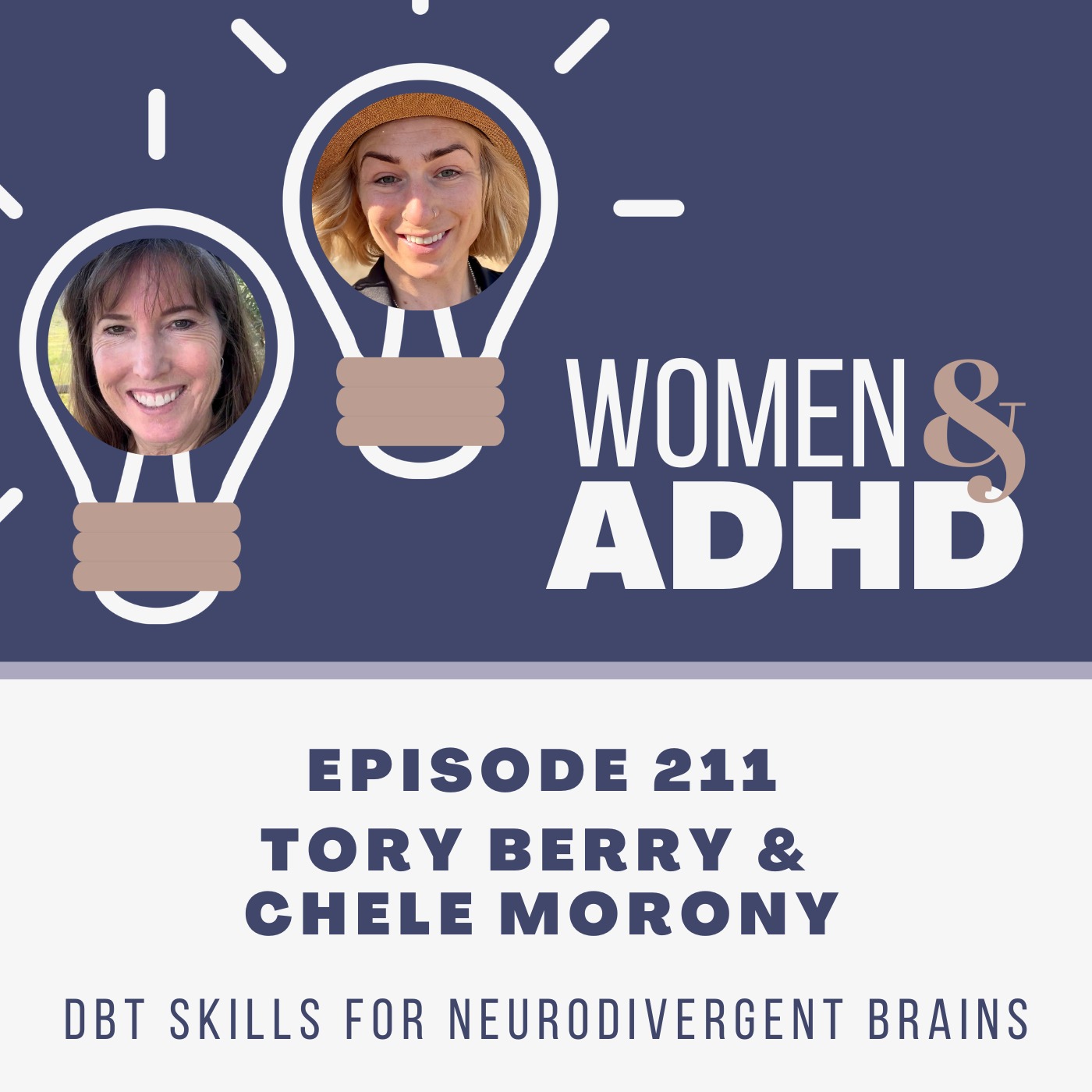
Tory Berry & Chele Morony: DBT skills for neurodivergent brains
About This Episode
Episode 211 with Tory Berry & Chele Morony
“People say DBT is for borderline personality disorder. I’m like, what are you talking about? DBT is for everyone. One of the most common refrains that we hear in the group is ‘Where has this been? I needed this in high school!’”
This episode combines two of my favorite topics: ADHD coaching and Dialectical Behavior Therapy (DBT)!
Tory and Chele are a mother-daughter duo from Southern California who have created something really special in the neurodivergent support space.
Tory is the founder of ADHD Works Now, and she is also one of our amazing ADHD coaches at Women & ADHD.
Tory was diagnosed with both ADHD and autism in adulthood, and she’s channeled her own lived experience into helping other neurodivergent adults through 1-on-1 coaching and specially adapted DBT groups.
Chele is a Licensed Clinical Social Worker with over 35 years of experience. She is also Tory’s business partner, bringing a clinical perspective to their work together.
We talk about Tory’s adult diagnosis and how Chele missed her ADHD and autism in childhood, despite her own clinical training.
We also talk about the fundamentals of DBT, and how the focus on validation, acceptance, and practical skill development makes it particularly powerful for neurodivergent clients who've spent years asking, “What’s wrong with me?” And Tory & Chele share about their collaborative group approach and how they’re making DBT skills applicable to the neurodivergent experience.
Tory & Chele’s DBT groups fill up quickly. The June cohort is already full, but you can sign up at the link below for the next cohort waitlist.
Key topics discussed:
- Tori's journey from adult ADHD/autism diagnosis to becoming an ADHD coach
- The missed signs of ADHD in girls and women
- How DBT skills can be adapted for neurodivergent brains
- The importance of validation vs. invalidating environments
- Masking vs. authenticity — when and how to be "legible”
- The intersection of coaching and therapy
- Running neurodivergent-friendly DBT groups
Website: adhdworksnow.com
Links & Resources:
- - - - -
Episode edited by E Podcast Productions
- - - - -
Women & ADHD coaching: www.womenandadhd.com/coaching
- - - - -
Work 1-on-1 with Katy: www.womenandadhd.com/katy
- - - - -
Order the “Hey, it’s ADHD!” course: www.womenandadhd.com/adhdcourse
- - - - -
Did you love this episode? Click here to pledge a one-time donation to the podcast!
- - - - -
If you are a woman who was diagnosed with ADHD and you’d like to apply to be a guest on this podcast, visit womenandadhd.com/podcastguest.
Instagram: @womenandadhdpodcast
Tiktok: @womenandadhdpodcast
Twitter: @womenandadhd
Facebook: @womenandadhd
Advertising Inquiries: https://redcircle.com/brands
Privacy & Opt-Out: https://redcircle.com/privacy
[SPEAKER_01]: If we're trying to fit ourselves into the textbook, we're going to miss a step and it's going to feel like, quote unquote, once again, we have failed. [SPEAKER_01]: When really we can adjust those steps to meet our own needs. [SPEAKER_01]: That's the reality of ADHD.
[SPEAKER_00]: Hello and welcome to the women and ADHD podcast. [SPEAKER_00]: I'm your host, Katie Weber. [SPEAKER_00]: I was diagnosed with ADHD at the age of 45, and it completely turned my world upside down. [SPEAKER_00]: I've been looking back at so much of my life. [SPEAKER_00]: School, jobs, my relationships, all of it with this new lens, and it has been nothing short of overwhelming. [SPEAKER_00]: I quickly discovered I was not the only woman to have this experience, and now I interview other women who like me discovered in adulthood they have ADHD, and are finally feeling like they understand who they are and how to best lean into their strengths, both professionally and personally.
[SPEAKER_00]: Hello and welcome back here we are at episode 211, in which I interview Tori
[SPEAKER_00]: Now today's episode combines two of my favorite topics, ADHD coaching and dialectical behavioral therapy, DBT. [SPEAKER_00]: Tori and Shell are a mother, daughter duo from Southern California, who have created something really special in the Nerd of Urgent Support Space. [SPEAKER_00]: Tori is an ADHD coach and the founder of ADHD works now. [SPEAKER_00]: She also happens to be one of the amazing team of coaches we have at women and [SPEAKER_00]: Now Tory was diagnosed with both ADHD and then autism in adulthood, and she has channeled her own lived experience into helping other neurodivergen adults through one-on-one coaching and specially adapted DBT groups.
[SPEAKER_00]: Shell is a licensed clinical social worker with over 35 years of experience, and she is also Tori's mother and business partner who brings the clinical perspective to their work together. [SPEAKER_00]: The three of us talk about Tori's adult diagnoses and how Shell missed the ADHD and autism in Tori's childhood, despite her own clinical training. [SPEAKER_00]: We also talk about the fundamentals of DBT, and how the focus on validation, acceptance, and practical skill development makes it particularly powerful for neurodivergent clients who have spent years asking the question, what is wrong with me.
[SPEAKER_00]: And Tori and Shell share about their collaborative group approach, and how they are making DBT skills applicable to the neurodivergent experience. [SPEAKER_00]: Tori and Shell's DBT groups fill up quickly. [SPEAKER_00]: I've heard that June cohort is already full, but there is a link in the show notes where you can sign up for the next cohort weight list. [SPEAKER_00]: Okay, without further ado, here is my interview with Tori and Shell. [SPEAKER_00]: Well, welcome, Tori and Shell. [SPEAKER_00]: I am so excited to have you on the podcast today.
[SPEAKER_00]: Thank you so much for being here. [SPEAKER_01]: Yeah. [SPEAKER_01]: Thank you for having us. [SPEAKER_01]: Yeah. [SPEAKER_00]: Thank you. [SPEAKER_00]: This is exciting. [SPEAKER_00]: Okay. [SPEAKER_00]: I know, right? [SPEAKER_00]: Okay. [SPEAKER_00]: So let's start out a Tory. [SPEAKER_00]: I want to ask you about your adult diagnosis. [SPEAKER_00]: You're diagnosed with both autism and ADHD. [SPEAKER_00]: So I want to hear from you. [SPEAKER_00]: And when that happened, what were some of the signs that you noticed where you thought I should probably look into this?
[SPEAKER_00]: Were they simultaneous diagnoses or [SPEAKER_00]: Did one happen first? [SPEAKER_00]: I want to hear all the things. [SPEAKER_00]: So what are you starting? [SPEAKER_01]: I was born January 13.
[SPEAKER_00]: It was a rainy day. [SPEAKER_01]: Yeah. [SPEAKER_01]: Yeah. [SPEAKER_01]: So my diagnosis was ADHD first. [SPEAKER_01]: And that's kind of what got me looking into all of the neurodivergent traits and tendencies, but I was just really struggling in life in general. [SPEAKER_01]: A lot of the struggles that I had were definitely in school and in college I was the type that would zone out. [SPEAKER_01]: I would find like a little like pile of pieces of like cuticles on my desk by the end of the end of the class because I just couldn't sit still.
[SPEAKER_01]: And so I would go through systematically and perfecting, you know, my like bare nails are picking off all of my nail polish if I had it on.
[SPEAKER_01]: And then, you know, one of the big ones too with school was I would copy math problems down wrong. [SPEAKER_01]: So I would think that I was doing really well. [SPEAKER_01]: I was like, I remember this formula. [SPEAKER_01]: I've studied really hard for this. [SPEAKER_01]: This is awesome. [SPEAKER_01]: Then I would go and I would turn in my test and I would get it back and I would get like a D. And I was like shocked. [SPEAKER_01]: And when I looked over my work, it was because I did the entire problem right.
[SPEAKER_01]: But I switched like a one and a two. [SPEAKER_01]: And so instead of like two 13, it would be three one two and it was honestly like devastating because I would work so hard and then for such a you know quote unquote stupid mistake I would get everything wrong and it kind of shattered my confidence so as a student you know I think I was a good student. [SPEAKER_01]: was a very talented athlete, I guess not was, still an athlete, but that's really got me through and got me into college.
[SPEAKER_01]: It was a field hockey player, I went to school in the East Coast, and that's when the personality kind of problems also started to come into play. [SPEAKER_01]: It had really hard time with friendships with the team dynamic. [SPEAKER_01]: I, you know, was told a lot that I cared more about my sport than I did about my teammates, and that was true because my sport was my special interest. [SPEAKER_01]: I should have played tennis. [SPEAKER_01]: So it was painful. [SPEAKER_01]: Yeah, it was definitely painful.
[SPEAKER_01]: And after I graduated, I was just trying to make sense of everything. [SPEAKER_01]: And why I was, you know, chronically misinterpreted and seen as someone that I
[SPEAKER_01]: So, that's when, you know, we explored a lot of what was going on with the mental health and ended up having a solid psychiatrist and a therapist who really helped me through the diagnosis and the medications and also getting me into DVT group, which is a passion project for me for sure. [SPEAKER_00]: Oh, that's amazing. [SPEAKER_00]: Okay, so now when you said we started looking into it, was that you and Shell? [SPEAKER_02]: Yes. [SPEAKER_02]: Yeah. [SPEAKER_02]: Yes. [SPEAKER_02]: Can I chime in on the, yeah, the background a little bit.
[SPEAKER_02]: So I'm shallow. [SPEAKER_02]: I'm Tori's mom. [SPEAKER_02]: We are business partners and very close in our relationship as well. [SPEAKER_02]: And I am an LCSW. [SPEAKER_02]: I want to say that I missed Tori's diagnosis completely. [SPEAKER_02]: And I think it's a really important thing to say in own and confess, if you will, because I was trained in the early, well, late 80s, early 90s, and we really knew nothing about ADHD, and we knew nothing about what we now call level one autism or audio HD combo, and so the traits as typical in girls didn't really start to emerge or really become problematic until [SPEAKER_02]: Oh, really puberty.
[SPEAKER_02]: I would say I thought Tory was a very shy child. [SPEAKER_02]: She was kind of a leg, clean, clinger, but she did have a lot of personality and she was cute and she was talented. [SPEAKER_02]: And so it just, what can I say? [SPEAKER_02]: I missed it. [SPEAKER_02]: In high school, when the mood dysregulation became more and more prominent, we thought it was a move disorder. [SPEAKER_02]: And we started treating, you know,
[SPEAKER_02]: It can be really tough to distinguish between normal pubescence and adolescence from female ADHD. [SPEAKER_02]: The big difference is you don't outgrow it. [SPEAKER_02]: So the problems just continued where other girls were starting to get their act together and manage their friendships and manage their moods and their hormones and things like that story was not. [SPEAKER_02]: And it would have really took me till she was in her early 20s to just have like the thing thing this is more.
[SPEAKER_02]: This is more than adolescence, this is more than a major disorder. [SPEAKER_02]: So I don't know if that's helpful, but I hope it's helpful for someone out there. [SPEAKER_00]: Absolutely. [SPEAKER_00]: I mean, one of the things we talk about on the podcast is like looking back over the course of your life through this new lens, what are some of those things that pop up where you realize like, oh, the signs were there all along. [SPEAKER_00]: We just didn't know what to look for. [SPEAKER_00]: And so I'm just like so excited to get the the mother daughter perspective at the same time.
[SPEAKER_00]: You know, I was 45 when I was diagnosed and my mother had already passed away. [SPEAKER_00]: So like she was the one person I most wanted to talk about, you know, going over because she was
[SPEAKER_00]: and saw so many of those moments throughout high school and university where she was like, you know, we couldn't really connect the dots in a way, you know, and I ended up with mood disorder diagnoses instead as well in addition, who knows, you know, but like there's so much of that mystery that looking back, it's not like, you know, like, it's not like you specifically failed to see the signs, we all did, right? [SPEAKER_00]: And so what can we learn from that?
[SPEAKER_00]: We're going to talk about that more later. [SPEAKER_00]: So what led you to then go from your own diagnosis to then becoming an ADHD coach? [SPEAKER_01]: Oh my gosh. [SPEAKER_01]: Well, you know, the thing that pops into my head before I even jump into that is, remember, my mom saying, I don't know why life is so hard for you. [SPEAKER_01]: And it was not like, you know, I don't know why life is so hard for you to get it together.
[SPEAKER_01]: life was so hard for me and she couldn't understand and didn't necessarily know how to help me or how I could help myself and it, you know, it broke her heart, it broke both of our collective hearts and I, you know, I totally forgotten that she had said that a long time ago and so how did that, you know, lead to my ADHD coaching? [SPEAKER_01]: well, she tried to help me make my life a little bit easier and I rebelled against that a lot. [SPEAKER_01]: I worked in restaurants for a long time after I graduated from college because that's what you do with the sociology degree, right, as weight tables made a lot of sense.
[SPEAKER_01]: So, I, yeah, that's what I did, ran myself into the ground and, you know, I had my mom of my shoulder constantly kind of being like, just let me guide your life, let me make the path for you, and I wanted to do it myself, and then I had some pretty, you know, gnarly experiences, some pretty nasty relationships, and really got to a very low place, and was working with
[SPEAKER_01]: I can't have you crying for the entire session, so she wrote me a contract and said she wouldn't be my therapist unless I went to DBT group and I had to attend and I couldn't miss sessions and things like that. [SPEAKER_01]: And so I had like these supports that were, you know, kind of facilitating that growth and and as I got through like my second round of DBT kind of graduated from the arms of that therapist so to speak. [SPEAKER_01]: I looked back at the, just pain that I had experienced and the constant feeling of like, what's wrong with me?
[SPEAKER_01]: Why am I constantly like seeing as something that I'm not? [SPEAKER_01]: Why do I try so hard? [SPEAKER_01]: And I'm always, you know, quote unquote wrong. [SPEAKER_01]: And as I had worked through that myself, I just thought other people do not deserve to go through this for this long. [SPEAKER_01]: you can't dictate someone else's journey. [SPEAKER_01]: And I've learned since that, you know, I can't expedite that journey either for others. [SPEAKER_01]: But there's something very special about having someone like shell, you know, my mom beside you, patiently, just there.
[SPEAKER_01]: willing to support you, to read your text essays, to encourage you to use your DBT skills. [SPEAKER_01]: It's this like gentle, but also tough love that really, you know, facilitated my growth. [SPEAKER_01]: And so when I was like, I don't know, five years into the service industry, I said, okay, plan my life. [SPEAKER_01]: I give up. [SPEAKER_01]: like, you know, and so we started looking into grad schools because I had, you know, gone to school to be a therapist. [SPEAKER_01]: And in, you know, exploring the programs, we kind of collectively realized that I'm not meant to be a therapist.
[SPEAKER_01]: I'm nice, and I am empathetic to a degree, but I really want to do something about it, instead of just talking about it. [SPEAKER_01]: And luckily, show was working at Kaiser at the time, and there's this emerging field of coaching that they [SPEAKER_01]: And she was like, you know, this could be your niche. [SPEAKER_01]: Maybe this is where you want to go. [SPEAKER_01]: And with the ADHD focus, specifically, let's try it. [SPEAKER_02]: Wasn't going to take me too long. [SPEAKER_01]: I could always reroute and go to grad school.
[SPEAKER_01]: And so that's when I switched. [SPEAKER_01]: I started working at Jenny Craig to get my coaching hours. [SPEAKER_01]: I got into a coaching program with the IAC Center and the rest is kind of history. [SPEAKER_01]: Can I tell you the mom perspective? [SPEAKER_02]: Yeah, okay. [SPEAKER_02]: So I love all of that. [SPEAKER_02]: I think that's all super accurate and what's kind of interesting about Tori and I whenever we talk about her life, sometimes we argue, because I'll be like, no, it was like this and she'll say no, it was like this because obviously we have very different perceptions of the reality and for each of us, our perception is the reality.
[SPEAKER_02]: But in this regard, I'm not, [SPEAKER_02]: going to argue anything Tori said, but just to add to that Tori was always a great coach. [SPEAKER_02]: She coached field hockey, she worked for Jenny Craig for a while, coaching people in health and wellness and diet lifestyle, which of course we have different feelings about that now, but life is a journey and you grow along the way. [SPEAKER_02]: But once we recognized that she had ADHD, I thought, you know,
[SPEAKER_02]: And she's really floundering in her adult life. [SPEAKER_02]: And what I thought was, what if she takes this course in becoming an ADHD coach? [SPEAKER_02]: What's the worst that could happen? [SPEAKER_02]: She will learn so much about ADHD that it is bound to help her, even if nothing else comes of it. [SPEAKER_02]: And because she was sort of flondration was like, okay, fine. [SPEAKER_02]: I'll do it. [SPEAKER_02]: And it really did open so many doors. [SPEAKER_02]: It is not the least of which is her own understanding of herself and my improved understanding of her and it was, you know, after that that we began to build the coaching business together.
[SPEAKER_02]: which now has just been years and we're really, really enjoying it. [SPEAKER_02]: But to me, that was the driver. [SPEAKER_02]: It was like, let's understand this, whether or not, she ever actually becomes a coach.
[SPEAKER_00]: Right? [SPEAKER_00]: Yeah. [SPEAKER_00]: And I think that's a good segue into talking a little bit more about DBT, specifically with a neurodivergent lens, right? [SPEAKER_00]: Because even just hearing, [SPEAKER_00]: Tory talk about and and so many of the people on my podcast including myself have often talked about this I this question of what's wrong with me right and and this notion that I am the problem and this like internalized invalidation that doesn't come out of nowhere. [SPEAKER_00]: I mean it comes from in an invalidation in life, but you know this this notion that like we start everything prior to our diagnosis from this lens of this idea that there's something wrong with me that has to be fixed and and one of the things I love about.
[SPEAKER_00]: DBT is that it gets to the heart of validation and acceptance is key and what are the skills that we need to live a better life. [SPEAKER_00]: So I guess Shell, I'm going to ask you like give us a little primer for anybody who's listening who has absolutely no idea what DBT is if there's like a quick way we could explain what is dialectical behavioral therapy, what is dialectics and how does that
[SPEAKER_00]: way of thinking. [SPEAKER_02]: Yeah, yeah, dialectical behavioral therapy essentially is a cognitive behavior therapy. [SPEAKER_02]: I mean, it came out of cognitive behavior therapy developed by Marshall and a hand in the 1970s, specifically to address what we call borderline personality disorder, which is a disorder
[SPEAKER_02]: I'm sorry, and we can say it two ways, we can say a disorder of regulation or we can say a regulation disorder. [SPEAKER_02]: And so the key factors of DBT are to recognize what is out of regulation in your mind, in your body, in your behaviors. [SPEAKER_02]: It is approached with form, what we call like modules, if you will, we focus in on mindfulness, [SPEAKER_02]: distrust tolerance, emotion, dysregulation, and I always do this. [SPEAKER_02]: I always get three out of four on my first try.
[SPEAKER_02]: Help me out here. [SPEAKER_01]: In a personal effectiveness, yes, and to be all together now and and a core theme or foundational theme of dialectics. [SPEAKER_02]: And a dialectic, if you look it up, you're going to find like sciencey explanations that are not part of really appropriate. [SPEAKER_02]: I don't know what your, but the idea is in behavioral therapy or dialectal behavioral therapy is that two truths can exist at the same time. [SPEAKER_02]: Two things that are seemingly opposite can be true at the same time and that we can hold opposites.
[SPEAKER_02]: You can love and hate someone at the same time, right? [SPEAKER_02]: Maybe you're in a big argument with your life partner. [SPEAKER_02]: You're like, oh, claws out, you know, everybody's mad, but you still in your heart have a deep and a binding love for that person. [SPEAKER_02]: How is that possible? [SPEAKER_02]: Well, it is possible. [SPEAKER_02]: But for folks who have challenges in their ability to regulate their emotions, and then that impacts their thoughts,
[SPEAKER_02]: It can feel almost impossible to hold those two things at once. [SPEAKER_02]: They have to go to one or the other. [SPEAKER_02]: And so what we learn in dialectical behavior therapy is how to hold those two truths at the same time. [SPEAKER_02]: By regulating our emotions, learning how to tolerate the distress that is part of every life and will be, no matter who you are or where you live, what your life is like.
[SPEAKER_02]: that we have to be able to tolerate. [SPEAKER_02]: And along the way, how to become much more mindfully aware of what we're feeling, what we're doing, what we're thinking, so that we can slow ourselves down a bit to make proactive choices in how we want to exist in the world. [SPEAKER_02]: And then of course, that all effects our relationships, which is that fourth category. [SPEAKER_02]: So I don't, I hope that is like a quick and dirty synopsis that makes sense for folks. [SPEAKER_00]: Yeah, beautifully said.
[SPEAKER_00]: And I think, you know, one thing I would add to that in terms of DBT specifically is that there are like the skill focus is very structured right and I think that that's probably why it's so appealing for us for those of us who. [SPEAKER_00]: feel lost, right, which is like, tell me what to do. [SPEAKER_00]: And I know that a lot of my coaching clients have come to me with negative experiences in therapy where they're like, they get a lot of the validation part. [SPEAKER_00]: They get a lot of the, like, it's okay to feel the way you're feeling.
[SPEAKER_00]: There's nothing wrong with you, but they're like, yeah, but like, how do I fold my laundry? [SPEAKER_00]: How do I figure out, like, tell me what to do? [SPEAKER_00]: And on the one hand, [SPEAKER_00]: DBT has like very concrete skills, but on the other hand, is it like two structure? [SPEAKER_00]: That's the thing I'm always kind of questioning when it comes to like, there's a lot of homework. [SPEAKER_00]: There's a lot of paperwork in DBT. [SPEAKER_00]: So how do you guys manage that?
[SPEAKER_00]: You know, the like PDA side that don't tell me what to do side and I need a lot of structure side that always seems to come along with ADHD, especially. [SPEAKER_02]: Definitely. [SPEAKER_02]: So just to answer your first question, then I'll let Tori address the second part. [SPEAKER_02]: You're absolutely right in identifying those challenges. [SPEAKER_02]: What we're doing in group is we are really focusing on the mindfulness skills, which if you ask an ADHD person to meditate, for example, that is a very tall order.
[SPEAKER_02]: So we work very creatively and separate, [SPEAKER_02]: mindful meditation which we do work on and help people develop a practice that makes sense for them and mindful awareness of what's happening inside of you all at all at the time. [SPEAKER_02]: So we really work carefully with that and then the emotion regulation and the distress tolerance sort of separate from the executive functioning skills [SPEAKER_02]: which Tori does in an individual practice. [SPEAKER_02]: So we don't focus a lot on executive function, tools and skills in group.
[SPEAKER_02]: We do offer body doubling and help with homework. [SPEAKER_02]: So if you are struggling to get your homework done, we have several sessions per week you can come to you. [SPEAKER_02]: We also really try to tailor the homework to the neurodivergent population. [SPEAKER_02]: So it's intensely practical, you have several choices,
[SPEAKER_02]: If you're not really a person who wants to write, you know, there's things that you can actually do more with your body, so we really try to mix that up so that our folks are actually interested in doing the work. [SPEAKER_02]: Do they always do it? [SPEAKER_02]: No, they don't always do it. [SPEAKER_02]: That's that is part of the process too. [SPEAKER_02]: And then anyways, I'll hand it over to Tory to talk more. [SPEAKER_01]: think it comes to mind when we're talking about how this group is different is that it's very much feedback informed from the clients.
[SPEAKER_01]: So I'm constantly asking for, you know, what do you feel that you have worked on that you're doing well with? [SPEAKER_01]: What do you need more help with? [SPEAKER_01]: what areas do we need to focus on? [SPEAKER_01]: And then I'm synthesizing the answers that I get in creating almost like sub-curriculums for the group. [SPEAKER_01]: So maybe the mindfulness module is like two or three weeks and then we spend, I don't know, eight, ten weeks on interpersonal effectiveness. [SPEAKER_01]: There are a few different frameworks or like course calendar so to speak in the DBT manual, the teachers manual and you know that probably is a little bit of my own PDA there where I look at that and I like why don't want to do that I don't want to do that way that doesn't make sense to me and so we use that framework.
[SPEAKER_01]: kind of as a jumping off point, but then we really started to listen to the group members, and insert, you know, in the manual itself, it has like, after every module, you're supposed to do two weeks of mindfulness, like revisiting like your mindfulness training. [SPEAKER_01]: And the way that, you know, the group works, that doesn't really vibe with us. [SPEAKER_01]: So instead, we almost every group have a mindfulness practice. [SPEAKER_01]: and then we don't go back and spend two weeks of sessions on mindfulness specifically.
[SPEAKER_01]: And I'll tell my group members, this is one of things I like about this is I want to be the most authentic, like down to earth, professional that I can. [SPEAKER_01]: So while maintaining [SPEAKER_01]: My, you know, status as a professional and, you know, my education and all of this, also really like to level with my group members. [SPEAKER_01]: So I will do something like I'll run a meditation, you know, I made this up the other day and I'll say like, okay, see, like you close your eyes and then collapse your body into a sea.
[SPEAKER_01]: And then rise up and fit straight and examine your spine and collapse again.
[SPEAKER_01]: your spine move from C to I to C and then we'll do it for five minutes and then we'll open your eyes come back to the room and I'm like all right so I just made that up and the point is not to say I wasn't prepared the point is to say you can go to the bathroom in the middle of the day at work when you're having it breakdown and make up a meditation. [SPEAKER_01]: You can
[SPEAKER_01]: with whatever you have I sometimes will say like reach out your arms and with whatever you can touch that's how you create your mindfulness activity. [SPEAKER_01]: So it's really tailored to that ADHD brain because guess what I do not expect any of them to remember. [SPEAKER_01]: In the moment, all of the body scan questions are supposed to ask themselves, there's a page-long list of them, right? [SPEAKER_01]: Like, that's just, that's not going to happen. [SPEAKER_01]: But if they can grab on to one thing and create a little bit of a mindfulness moment for themselves, [SPEAKER_01]: then that's going to work.
[SPEAKER_01]: That's the reality of ADHD. [SPEAKER_01]: And if we're trying to fit ourselves into the textbook, we're going to miss a step and it's going to feel like once clinical, once again, we have failed. [SPEAKER_01]: When really we can adjust those steps to meet our own needs. [SPEAKER_01]: So I guess that's just one example of how we tailor the group. [SPEAKER_01]: Also like mindful awareness, you know, there's a lot of thought around that being very much meditation focused. [SPEAKER_01]: An example of how I would encourage someone to have mindful awareness in their day is, and this resonates with a lot of my clients, is recognizing common refrains.
[SPEAKER_01]: So, you know, for me it'll be, I just need this. [SPEAKER_01]: I just need this. [SPEAKER_01]: I just need to do this.
[SPEAKER_01]: I know that I should slow down, but I don't have time. [SPEAKER_01]: And if we can highlight and recognize those common refrains, we are being mindful. [SPEAKER_01]: And what I find is when a lot of my clients recognize the common refrains name them, close them. [SPEAKER_01]: The natural inclination is to challenge them.
[SPEAKER_00]: I think Marshall in a hand would agree, you know, I don't think Marshall in a handset this up so that it was like you have to do steps one through 50 in order for this to work. [SPEAKER_00]: I think it was like, let's see how many tools you can have in your toolbox and figure out what works for you in each moment. [SPEAKER_00]: And so I love the fact that it's grounded in acceptance and mindfulness and meditation and Buddhist practices, but really it's about like getting to what she calls the wise mind.
[SPEAKER_00]: So that I can become more strategic and so like I find that with coaching. [SPEAKER_00]: I do that a lot with my clients because I don't know if you Probably experience this too, but like clients will come to you and they're in its state of complete disregulation of like so what's gonna save me? [SPEAKER_00]: What's gonna be that one tool that's gonna help me right now? [SPEAKER_00]: What am I gonna do and it's like [SPEAKER_00]: We're not in a strategic mindset right now. [SPEAKER_00]: We're in a reactive mindset and so it's like how can I get to a place where I can slow down a little bit and know that actually at the end of the day I'm going to be more productive and more whatever it is, we're we're wanting in our life and not able to achieve.
[SPEAKER_00]: if we slow down and get to a state of regulation and I feel like, you know, that's essentially what she was everything you were saying. [SPEAKER_00]: I feel like she would absolutely endorse. [SPEAKER_02]: Yeah, I think so too. [SPEAKER_02]: Like I think we are augmenting. [SPEAKER_02]: We are adding to we are not really changing it or replacing it. [SPEAKER_02]: We're just making it more accessible for the ADHD and the ADHD brain in particular. [SPEAKER_02]: Although we have group
[SPEAKER_02]: of a couple who have primary anxiety. [SPEAKER_02]: And we find just a lot of similarities and crossover. [SPEAKER_02]: And the need to really, I mean, the mindful awareness it integrates and intersperses throughout DVT. [SPEAKER_02]: I'm not sure if you, how well-versed you are, but the observed skill and the noticing is in every module. [SPEAKER_02]: And it's in every day. [SPEAKER_02]: And so when you are every week, week after week
[SPEAKER_02]: and describe and then participate in whatever it is, you know, your thought patterns, your behaviors, your work, whatever it does change you, it really does. [SPEAKER_00]: Yeah, absolutely. [SPEAKER_00]: You know, I read Martialina Hens been more recently and, you know, she, one of the things that astounded me from the memoir was, you know, the notion that there was so many of her colleagues that told her to never share the fact that she was suicidal or that she self-harmed, because it would ruin, you know, it would ruin her reputation and nobody would take her seriously and the fact that she was brave enough to do that was so wonderful, but like reading her
[SPEAKER_00]: because she really was undecided. [SPEAKER_00]: I think at the end of the day, she was sort of like, I feel like maybe, but I don't think she was ever officially diagnosed with it, but I came away from that book thinking this woman is autistic. [SPEAKER_00]: And also, not only that, but like knowing how many women who are diagnosed with neurodivergence in adulthood were [SPEAKER_00]: previously diagnosed with BPD and that connection there, right? [SPEAKER_00]: And I'm so curious to know what her thoughts are about this whole, you know, about this way in which we are now understanding what a neurodivergent brain looks like and the way in which we enter into disregulation and crisis and self-harm and these populations, there's so much overlap.
[SPEAKER_00]: And I just spent a year working with adolescence in a crisis clinic where we use DBT, [SPEAKER_00]: And that's how Tori and I got talking about like, yeah, we have to do an episode about how amazing DBT is because I was just see, but like every single kid who is in a crisis state of adolescent, I was like they're neurodivergent like I don't think there were any kids that I didn't feel like were neurodivergent most of them were diagnosed with ADHD most of them were, but again, like you had said earlier show like they were diagnosed with ADHD and a deficit based lens right they were diagnosed because it was like somebody told them this is what's wrong with you.
[SPEAKER_00]: and that became part of their identity and it was really sad for me to see such young kids still in this day and age, having their diagnosis as a label for what's wrong with them, as opposed to what's amazing and right with them. [SPEAKER_00]: So I think that that's one of the things that was so amazing to me, watching DBT skills and language, [SPEAKER_00]: over such a short period of time, because mostly these kids were just doing this for like three weeks, watching how much their mindset changed in themselves in terms of like, oh, like everything I've done up until this point is totally fine, like it makes sense.
[SPEAKER_00]: And what can I do now? [SPEAKER_00]: Like, what could I do better? [SPEAKER_00]: And that's, you know, for when you were talking about your favorite dialectic, like that's, you know, for me, it was this notion that like, yeah, [SPEAKER_00]: everything I've screwed up on everything I've done up into this moment that has made me question what's wrong with me? [SPEAKER_00]: It made sense. [SPEAKER_00]: At the time I was doing the best I could and was a better way to deal with this next time and that like growth mindset that we talk about a lot in coaching just seemed to just the everywhere, right?
[SPEAKER_00]: Like it just felt like for me DBT is where coaching and therapy combine in a beautiful way and I would [SPEAKER_00]: Yeah, I feel like it does such a great job. [SPEAKER_00]: And I feel like it's not talked about in that way. [SPEAKER_00]: It's always talked about in a very like holly toy or therapeutic way. [SPEAKER_00]: And I feel like it's much more accessible that I think a lot of people think it is. [SPEAKER_02]: It really is. [SPEAKER_02]: And it is much more broadly applicable than people think it is.
[SPEAKER_02]: So you'll still see like in therapy forums, whether you're on social media or whatever, they will say, oh, DBT is for borderline personality. [SPEAKER_02]: It's like, what are you talking about? [SPEAKER_02]: DBT is for everyone. [SPEAKER_02]: And one of the most common refrains that we hear in group is, where has this been? [SPEAKER_02]: I needed this in high school, you know? [SPEAKER_02]: I needed this in my young adulthood. [SPEAKER_02]: And myself, you know, I'm not neurodivergent.
[SPEAKER_02]: And I love DBT. [SPEAKER_02]: I'm growing all the time. [SPEAKER_02]: I've been now through it how many times and it doesn't matter, I'm still learning. [SPEAKER_02]: stretching, you know, it's still applying in so many areas of my life. [SPEAKER_02]: So I do, I do wish that if I had one wish, it would be that we would stop limiting the applicability of DBT in the mental health world and in the ADHD coaching world. [SPEAKER_02]: I think we really should be using it all the time. [SPEAKER_00]: And one of the things I noticed a lot of the time because validation and creating a validating environment, especially working with adolescents over the last year, was seeing how important validation is.
[SPEAKER_00]: especially for a young mind and for a neurodivergent mind, I think it's somebody with ADHD or somebody with any kind of diagnosis, right? [SPEAKER_00]: Like validation is so key and I think one of the things I saw a lot from parents was them creating invalidating environments out of a desire to protect as a just out of a desire to help. [SPEAKER_00]: And then seeing it in myself as a parent and seeing like how often [SPEAKER_00]: You know, I used the example of like my son, he had an older sister, he loved nail polish and rainbows and two twos and he wanted to wear all of that to school and my gut instinct was like, hey buddy, I totally think this is great, but maybe to wear it to school and like knowing that if I ever said that to him, that would be a problem, right?
[SPEAKER_00]: I didn't have the language for it at the time, but I was like, I knew as a parent I had to like, [SPEAKER_00]: be okay with him going to school as his full self and if he was going to get bullied, he was going to get bullied, but I knew that like he had to be accepted at home. [SPEAKER_00]: And I'm sure there are many examples I'm not sharing right now, but of ways in which I did create an invalidating environment. [SPEAKER_00]: because I'm a human. [SPEAKER_00]: But I think it was that desire like my desire was to protect him to say like I don't want you to get hurt and so I want you to change to fit in and seeing how as a parent that desire to have our child fit in and have them change is so like it comes from such a good place but I think it's really [SPEAKER_00]: damaging for lack of a better word in terms of sense of self and, you know, thinking about like when you had said earlier, Tory about your mom wondering, like, I don't know why life is so hard for you.
[SPEAKER_00]: I guess like, what advice might you have for parents or even repairing ourselves, right? [SPEAKER_00]: When it comes to like validating a neurodivergent child or anyone of that age of like, how do
[SPEAKER_00]: wanting our kids to fit in and be safe. [SPEAKER_02]: It's a classic dialectic. [SPEAKER_00]: Right, it is, it is. [SPEAKER_00]: And I think seeing that, I just saw that pattern so much in parents and really wanted to give everybody a hug because it was like, we're all doing the best we can. [SPEAKER_00]: And these are ways in which this is actually ultimately quite harmful. [SPEAKER_02]: And what would be so bad about communicating just that to your child to say, I love you so much and I love you just the way you are.
[SPEAKER_02]: You know, and I want you to wear what you want and be who you want. [SPEAKER_02]: Here's the reality at school. [SPEAKER_02]: You know, these are things that might happen. [SPEAKER_02]: So let's talk about whether or not you can tolerate that. [SPEAKER_02]: And if you want to mask at school, or if you want to do some training and therapy on bullying. [SPEAKER_02]: And, you know, like, let's just get it out in the open. [SPEAKER_02]: So I can validate you and want to protect you. [SPEAKER_02]: and we could have that conversation and then you can ultimately decide and I will support that decision because I can't go to school with you.
[SPEAKER_02]: I can't fight your battles, right? [SPEAKER_02]: It's you may or may not want to fight your battles and so we can talk about what that would look like and the pain that might cause you. [SPEAKER_02]: We just did a whole session, well, I'm sorry, we did a part of a session in this was feet back informed DBT on when to mask and when to be authentic. [SPEAKER_02]: Because for that neurodivergent adults, that it is a choice almost every day, and in almost every situation, how much to mask and how much to be authentic, and so to I created a curriculum just for that within our DBT framework.
[SPEAKER_01]: It was interesting. [SPEAKER_01]: I was like, ah, I need to sit back because I'm not a parent, so I can't answer this question. [SPEAKER_01]: But the answer that popped into my head was exactly what Shell said and it's the same type of work that I do with the group members and with my clients, which is a level of radical acceptance, right? [SPEAKER_01]: There is a norm. [SPEAKER_01]: We cannot change the norm. [SPEAKER_01]: So we can show up with a little bit of a norm adjustment, or we can show up how we feel is authentic, but there will be consequences.
[SPEAKER_01]: And we can look for places and spaces where we can show of authentically without consequences. [SPEAKER_01]: But we do also have to accept the reality that we are
[SPEAKER_01]: There's I even have a I have a unit called stuff everyone seems to know but us, you know, where we teach things like it's okay to not answer a phone call and call back later. [SPEAKER_01]: It's okay to not hug everyone when you leave a party. [SPEAKER_01]: um it's okay to leave without saying goodbye sometimes um oh good no shell was like I feel like this might be a little patronizing you know because I have like a few she students and like you know professionals in this group and we had just a resounding outpouring of gratitude for that session they were like oh my gosh I thought it was just me I thought it was a language there I thought all of these different [SPEAKER_01]: feedback from people.
[SPEAKER_01]: So that was really, really awesome. [SPEAKER_01]: So that the radical acceptance piece, I think, is really huge. [SPEAKER_01]: And then, you know, in the masking version showing up authentically, I like to think of it as rather than masking being legible. [SPEAKER_01]: So what parts of yourself do you want to make sure are legible in this situation? [SPEAKER_01]: So, if you're in a professional setting, you can be professional, and how do you elevate those professional parts of yourself as opposed to performing or pretending to be away that you are not?
[SPEAKER_01]: And I think that that's a really important distinction to make because we have a lot of this social media that's like unmasked, you know, just be yourself and I see that and I say that's how you get fired. [SPEAKER_00]: Well, and, you know, and I think a lot of the time there's that question around masking and code switching, which is like, is it safe, you know, they're like, that's a lot of the time if you're a person of color, there's a question of safety too. [SPEAKER_00]: And so like, yeah, I really like the way that you frame that to like this version of me, which is the version of me, that feels right in this situation.
[SPEAKER_02]: was that we really encourage people to have at least one safe space and to identify what that is, where that is, what that looks like and how often you can access that space, where you can be your authentic self, because if you're spending most of your life masking, you're going to be miserable, there's going to be a lot of internal distress. [SPEAKER_02]: going on, you're going to, you know, kind of like the little kid with ADHD who masks all day at school, especially little girls, and then they come home and fall apart, right?
[SPEAKER_02]: Because it's been so challenging to just keep repressing my true self. [SPEAKER_02]: So we need to make sure whether we're parenting children or we're living our own adult existence that we have those safe spaces. [SPEAKER_01]: Yeah, so you don't burn out right? [SPEAKER_00]: Yeah, and I think that that's, you know, in terms of what I was trying to say earlier, I feel like you just did a much more articulate version of that child of like, you know, it has to start at home, right? [SPEAKER_00]: Like that safe space has to be at home.
[SPEAKER_00]: So that they can fall apart when they walk through the door. [SPEAKER_00]: I mean, you know, I remember when I was telling that to my school psychologist who I liked it, um, [SPEAKER_00]: at my kid's school because I'm often tell this story bitterly, but like when I was talking of the school psychologist about my kid's anxiety and how they're whitenuckling it all day and holding it together and then falling apart at home, she was like, and that sounds like a home problem, not a school problem.
[SPEAKER_00]: Anyway, but you know, one of the things I think DBT has really helped me with as a human. [SPEAKER_00]: is that you know showing grace for ourselves and showing validation and acceptance for ourselves and understanding that like maybe I didn't have the skills I needed and what am I going to learn from this and what skills am I going to use moving forward? [SPEAKER_00]: It's also allowed me to have a lot of grace for other people in a way that I think I wasn't able to access before as somebody who was late diagnosed had a lot of grief had a lot of anger, [SPEAKER_00]: Had a lot of bitterness about like, you know, how I may have been treated and how I needed to mask and all of these ways in which I wasn't supported.
[SPEAKER_00]: Like, I feel like DBT allows us to interact with the world in a much kinder way for ourselves and others. [SPEAKER_00]: So like, I can look at somebody who did something harmful to me. [SPEAKER_00]: And believe that they were doing the best that they could in that moment and yes, I was harmed or hurt, you know, but like there was a skilled deficit there and so I find it's like much easier for me to have grace with other people and wondering if you notice the same and like I feel like as somebody with ADHD.
[SPEAKER_00]: It is helped me with my own PDA. [SPEAKER_00]: It's helped me a lot with my RSD, rejection sensitivity. [SPEAKER_00]: Like, it's allowed me to view everybody else as doing the best, like, in a way that I wasn't anticipating. [SPEAKER_02]: No doubt. [SPEAKER_02]: I mean, it definitely starts to permeate everything and every relationship in your life, the more you practice and get to know yourself and have grace for yourself. [SPEAKER_02]: Interestingly, in one of our feedback sessions, we heard that the dialectic of self-compassion versus holding myself accountable was really challenging and not addressed directly in the curriculum.
[SPEAKER_02]: So, Tory developed a section on that. [SPEAKER_02]: You want to talk about that, Tory. [SPEAKER_01]: Oh, yeah, it wasn't in my note here. [SPEAKER_01]: Let me pull it up, let's see. [SPEAKER_00]: Yeah, I mean, I also want to hear all about the group and how often you run these groups and how people can find out more. [SPEAKER_00]: So, but yeah, talk about the self-acceptance versus accountability as a dialectic, yeah, absolutely. [SPEAKER_01]: Yeah, so there's like some dialectics at the heart of this idea, right?
[SPEAKER_01]: Which is like, I'm doing my best, and I can do better. [SPEAKER_01]: I deserve compassion and my actions have an impact or I accept myself and I'm still responsible for how I show up. [SPEAKER_01]: Those and are really important and also the distinction between shame and guilt, shame stops guilt actually can open the door for learning or for change. [SPEAKER_01]: And so we really dive into, well, are you feeling shame right now, or are you feeling guilt because you compromised on a value, right?
[SPEAKER_01]: And it's really about stopping in the moments slowing down and asking yourself, what's happening here? [SPEAKER_01]: Do I need compassion or do I need to hold myself to? [SPEAKER_01]: what I value. [SPEAKER_01]: And I think that, you know, a recurring theme as well that I made a note of as we were talking here is DVD talks about suffering and distress and crisis and what I see a lot more of is just comfort and uncertainty. [SPEAKER_01]: And so pausing and asking ourselves, you know,
[SPEAKER_01]: or am I actually in danger? [SPEAKER_01]: It's the difference between doing a bunch of push-ups and your muscle is burning and the muscle fibers tearing so they can regrow and breaking a finger. [SPEAKER_01]: Right? [SPEAKER_01]: One is a constructive version and the other is destructive. [SPEAKER_01]: And so really stopping and understanding what's happening there if this is a time that I do need to challenge myself to be uncomfortable
[SPEAKER_01]: And maybe if not, then how do I extend compassion to myself? [SPEAKER_01]: But what it really comes from is slowing down and analyzing critically thinking. [SPEAKER_01]: What's really happening here? [SPEAKER_02]: Which goes back to those observed described, you know? [SPEAKER_00]: It's the steps, yeah, right, which is operating from a place of wise mind as opposed to emotional mind or logical mind. [SPEAKER_00]: Yeah. [SPEAKER_02]: Yeah. [SPEAKER_02]: Yes. [SPEAKER_00]: Okay. [SPEAKER_00]: So tell me.
[SPEAKER_00]: I know I can't believe they're already this far. [SPEAKER_00]: I feel like we just started this always happens. [SPEAKER_00]: So how often do you do these, I'm assuming they're virtual groups? [SPEAKER_00]: Are they, do you do in person work? [SPEAKER_00]: I know you're in Southern California. [SPEAKER_00]: Tell us about the groups and how somebody listening can find you and work with you. [SPEAKER_01]: Yeah, absolutely. [SPEAKER_01]: So we currently have a cohort starting June 22nd.
[SPEAKER_01]: Historically, we've been meeting on Mondays. [SPEAKER_01]: So we meet once a week. [SPEAKER_01]: We do not go over an hour and a half, not as by design. [SPEAKER_01]: Most DBT groups are two hours and I'm hungry at an hour 15. [SPEAKER_01]: So that's we usually have my dog as the timer too. [SPEAKER_01]: She starts to climb into my lap and she's a melon loss. [SPEAKER_01]: So that's a lot and she's like it's dinner time for group to end. [SPEAKER_01]: So yeah, we keep them, you know, as short as possible, like we said, we do that complementary body doubling throughout the week, just depending on the groups need or their schedules.
[SPEAKER_01]: And as far as connecting with us, they can go through our website, ADHDWorksNow.com. [SPEAKER_01]: I'm also on the ACO directory, and I have the links to join our group or get more information, you know, submit inquiries through both of those avenues. [SPEAKER_01]: We keep our group affordable too, which is super important to us. [SPEAKER_01]: We found that a lot of groups are expensive, and we feel that the people who need the most help often can't afford an expensive group. [SPEAKER_01]: So it's $30 a seat per week, and we like to hold to that.
[SPEAKER_01]: We also have some, I don't know what would you call, like Patrons or something, who offer financial aid for group members who need it, which is really important to us as well. [SPEAKER_00]: Sorry, is this a closed group or is this an ongoing group? [SPEAKER_01]: Oh, it's, so we run in a 12 month cycle. [SPEAKER_01]: Oh, wow, okay. [SPEAKER_01]: We do a full year and that is also by design. [SPEAKER_01]: You know, the workshop idea is nice in theory, but doesn't cover, I don't know how to describe, like a full kind of cycle of a year of life.
[SPEAKER_01]: You know, like, do we go through the holidays
[SPEAKER_01]: winter holidays and then like the summer holiday like the seasons that we have different life experiences and different challenges and so it's important to us that we are keeping like a structured space for those skills to develop and be implemented across a longer period of time and that's where we see more success and then the other thing is that we do we do us for three months commitment so we're not saying you need to stay here for a year [SPEAKER_01]: But you need to at least be with us for three months.
[SPEAKER_01]: And that way we can establish some rapport. [SPEAKER_01]: It's really important for group dynamic. [SPEAKER_01]: And it's easy for us to clip after a month. [SPEAKER_01]: And so if we have a little bit of an expectation there, then that pushes back on some of that just comfort and challenges us a little bit to stay and really get that work done. [SPEAKER_02]: Yes, we asked for a three month commitment. [SPEAKER_02]: Of course, we don't enforce it. [SPEAKER_02]: Sometimes life gets in the way.
[SPEAKER_02]: But it's just a shared agreement between us and our clients that you're going to come and stay for 12 sessions. [SPEAKER_02]: If you need to leave that often happens, you know, life gets in the way. [SPEAKER_02]: That's okay. [SPEAKER_02]: Then a seat will open up. [SPEAKER_02]: But we we have found that the cohort there's there's usually at least a 50% cohort that stays for the entire. [SPEAKER_02]: year and then others will join it those quarterly, you know, opportunities and then they end up staying.
[SPEAKER_02]: So there's kind of like a flow. [SPEAKER_02]: So when you say is it a closed group, it's closed for 12 weeks at a time. [SPEAKER_01]: Oh, that's a good way to put it. [SPEAKER_01]: Yeah. [SPEAKER_02]: But then it opens. [SPEAKER_02]: And we always check with our members. [SPEAKER_02]: And so far, there's there has not been any resistance to adding new people. [SPEAKER_02]: People have seemed to be fine with that. [SPEAKER_02]: And they are, you know, [SPEAKER_02]: pretty, pretty welcoming in that regard.
[SPEAKER_02]: I also wanted to add that in addition to the body doubling for home practice of skills and, you know, we call it like assignments or whatever, Tory also offers tech support, unlimited tech support between sessions. [SPEAKER_02]: So if you need a little bit of individual coaching, encouragement, you have a question, a concern you can reach out
[SPEAKER_02]: and Tory will respond to that. [SPEAKER_02]: So I think it's different than what a lot of groups are offering and we're very proud of that. [SPEAKER_02]: Is it expensive for us? [SPEAKER_02]: Yeah, it is, but this is our passion. [SPEAKER_02]: So we, you know, this is our way of giving back. [SPEAKER_00]: And now, Shell, on the clinical side, you also offer assessments or diagnosis or consultation with therapists of what sort of your role as now that you've come on to ADHD works now.
[SPEAKER_02]: Yeah, thanks. [SPEAKER_02]: So I am so my retired. [SPEAKER_02]: I have time on my hands. [SPEAKER_02]: So I thought, well, you know what? [SPEAKER_02]: I'm going to do some extra study. [SPEAKER_02]: So I studied up and got certified specifically in ADHD diagnosis, which I offer for very reasonable fee, unlicensed in California. [SPEAKER_02]: So if you're outside of California, we can do a consultation, but I can't do a formal diagnosis. [SPEAKER_02]: But I will give you your data and my opinion for you to take to your license provider in your state if you want to do that.
[SPEAKER_02]: I also offer sort of like a case management service, which is understanding your employer-based benefits. [SPEAKER_02]: So a lot of people have HSAs or FSAs or sometimes they have an account that their HR department offers for health related. [SPEAKER_02]: expenses, but they don't know how to demonstrate medical necessity. [SPEAKER_02]: That can be for group or that could be for coaching. [SPEAKER_02]: So I provide letters of medical necessity for people and also guidance and direction.
[SPEAKER_02]: And then, yeah, general consultation for therapists if they are interested in want it, that I just do for free because I was a clinical supervisor and a senior consultant at behavioral
[SPEAKER_02]: So if therapists want to want to chat, want to run a case, there's nothing I enjoy more.
[SPEAKER_00]: I think one of the most difficult questions to answer is the question of, do I need a therapist or do I need a coach? [SPEAKER_02]: Yes. [SPEAKER_00]: And I think there should be an end there instead of or, right? [SPEAKER_00]: I think they work really well together. [SPEAKER_00]: But I think any time we can do kind of a one-stop shop or where there's a way in which we can thoughtfully [SPEAKER_00]: ethically combined the two I think is really really important because like I went you know I just finished my Masters in Clinical Mental Health Counseling and so I'm pursuing licensed shirt in New York and like I thought I was going into this program thinking like I'm gonna pivot away from coaching and pivot into therapy and I came out of this program being like coaching is awesome I did not give a really appreciated my coaching background and really feeling like that [SPEAKER_00]: work so well together, but there is a lot of clinical little gatekeeping in mental health counseling for reasons.
[SPEAKER_00]: Yes. [SPEAKER_00]: But you know, the two professions are so different and very much kept separate in a way that I feel like I'm like, why do you know, I feel like they go so well together. [SPEAKER_00]: So the fact that you guys are working together from different viewpoints and different training and different [SPEAKER_00]: Frameworks, right, in terms of working with the minds and feeling and emotions, but also strategy and skill building. [SPEAKER_00]: I think is just for me. [SPEAKER_00]: I'm all in.
[SPEAKER_00]: I think it's so wonderful for especially for ADHD and executive functioning and and a lot of just the relational stuff that comes with being Nordamerja.
[SPEAKER_02]: We run, well, not at all, but some of her cases where there is, you know, co-morbidity and whether or not that client is appropriate for coaching, whether or not that client needs to be in coaching and therapy, you know, or therapy instead of coaching. [SPEAKER_02]: And so that's something that I think a lot of coaching practices may not have access to and we're kind of [SPEAKER_02]: unique in that way. [SPEAKER_02]: I'm with you. [SPEAKER_02]: I think coaching is very therapeutic and it is a lovely compliment to psychotherapy.
[SPEAKER_02]: It's very challenging to have therapists come to an understanding and acceptance of that. [SPEAKER_02]: I do have an article on our website which basically says these are the clients we would refer to you. [SPEAKER_02]: These are the clients we would like you to refer to us. [SPEAKER_02]: You know,
[SPEAKER_02]: where the daily living and the existing between sessions needs more handholding, needs more support and coaching. [SPEAKER_02]: It's just this kind of like a quick and dirty summary. [SPEAKER_01]: Yeah, and Shell, the one thing we didn't mention, I never could decide to call her Shell or Mom. [SPEAKER_01]: So, Shell Mom is, we've been doing in-service talks also in educating therapists and psychiatrists about the profession and the work that we're doing less so as a marketing and more as a service to the field of mental health and behavioral health care.
[SPEAKER_01]: the complimentary services are. [SPEAKER_01]: in communication with one another. [SPEAKER_01]: And in order to do that, someone does need to reach out and educate the other professionals in our field. [SPEAKER_01]: And so we have been doing some of those talks as well to just spread the word and make sure that the therapist knows that the psychiatrist knows that there is an extra level of support for their clients and break down that barrier, you know,
[SPEAKER_00]: Well, as somebody who just graduated from a cake or program, like I wish I could say there was a lot more understanding about neurodivergent needs than there was in the 80s and 90s, but I did not find that that was the case. [SPEAKER_00]: And I feel like I was always the person in the back of the class with my actually I was always in the front of me. [SPEAKER_00]: But I was like, I'd have my hand up all the time when we would talk about case conceptualization, where I was like, have they been assessed for autism?
[SPEAKER_00]: Have they been assessed for ADHD? [SPEAKER_00]: Because it was just like I see it everywhere. [SPEAKER_00]: still feels like it is very underrepresented in the curriculum and and I feel like motivational interviewing was not anywhere near enough represented in the basic curriculum like you really have to be self led in terms of. [SPEAKER_00]: looking at what is really really helpful in session with clients who might be feeling static or might be feeling, you know, like the in terms of behavioral changes and readiness for change.
[SPEAKER_00]: I mean, a lot of that, I feel like like really look for therapists who have done a lot of the work themselves around what it's like to work with neurodivergent clients or even better go to a place like ADHD works now where you know you're getting the knowledge and education from both sides. [SPEAKER_02]: Yeah, you're 100% right, and I know I mentioned this in the beginning, but like, I've been, you know, in the field for 35 years and it's really the last five years that I've gotten the most education in neurodivergence and ADHD audio HD.
[SPEAKER_02]: So just because someone is seasoned, that's not enough. [SPEAKER_02]: You really have to ask those core questions what kind of training or and or exposure do you have to this population and understanding. [SPEAKER_02]: what's happening, where the research is happening, what are we learning? [SPEAKER_02]: Because it is changing rapidly. [SPEAKER_02]: Even, you know, and I'm sure you're aware, Katie, but the diagnostic criteria is on the verge of changing. [SPEAKER_02]: Again, and I expected to change quite significantly this time around because there's been so much more research on girls and women in particular and adults in general.
[SPEAKER_02]: And late diagnosis has become, you know, it's not just trendy, it is reality. [SPEAKER_02]: So right now, the diagnostic criteria is all around children, and that's great for little boys, but white male children, yeah, yeah, exactly. [SPEAKER_02]: Yeah, so that's kind of exciting. [SPEAKER_02]: It's exciting time to be in the field. [SPEAKER_00]: Yeah. [SPEAKER_00]: Well, this has been fascinating. [SPEAKER_00]: I'm so glad we ought to have this discussion. [SPEAKER_00]: I easily could have talked to you guys for another couple of hours.
[SPEAKER_00]: I'm very passionate about this topic, and I just realized we didn't even get to talk about ACT, which is acceptance and commitment therapy. [SPEAKER_00]: And I don't know, just quickly, like, because I feel like that gets a lot of attention around, you know, in terms of effective work with neurodivergent clients. [SPEAKER_00]: What would you say [SPEAKER_02]: I think there's just a lot of crossover, you know, one is not better than the other, we really love the practicality of DBT, the things that they share are the ones we emphasize, right?
[SPEAKER_02]: The acceptance, the understanding that some things can change, some things will not change. [SPEAKER_02]: The holding of space, we don't do with that because we're not therapists, so, you know, in our spaces, [SPEAKER_02]: So an acceptance and commitment therapist will spend more time pulling space. [SPEAKER_02]: And that's great. [SPEAKER_02]: And some people need more of that, maybe more of the nurturing. [SPEAKER_02]: And I'm not saying DBT therapists don't. [SPEAKER_02]: I'm sure that they do, too.
[SPEAKER_02]: It's not a huge part of our practice. [SPEAKER_02]: We do a lot of validation. [SPEAKER_02]: We do a lot of support, certainly.
[SPEAKER_02]: you know, skills, tools, coaching, learning, how to understand yourself and others, right? [SPEAKER_01]: The now, what's the now, what part? [SPEAKER_01]: And what you do with that exactly, what you do with that is very important because you know, that's a common theme is that ADHD will research for a lifetime and have all of the information, but the action is one of the hardest parts. [SPEAKER_00]: So we, we really fine tune and keep our focus on what we can do now what lovely well thank you guys so much for your time it's been wonderful to chat with you and yeah I wish you guys the best this is wonderful and keep doing what you're doing yeah [SPEAKER_02]: Thank you so much.
[SPEAKER_02]: Congratulations. [SPEAKER_02]: Yeah, that was awesome. [SPEAKER_02]: Oh, thank you. [SPEAKER_02]: You're working, you're parenting, and you're going to school all the same time. [SPEAKER_02]: It's crazy. [SPEAKER_02]: Good for you. [SPEAKER_00]: It's ADHD. [SPEAKER_00]: That is what it is. [SPEAKER_02]: That's about right.
[SPEAKER_00]: There you have it! [SPEAKER_00]: Thank you for listening and I really hope you enjoyed this episode of The Women and ADHD Podcast. [SPEAKER_00]: If you'd like to find out more about me and my coaching programs, head over to women and ADHD.com. [SPEAKER_00]: If you're a woman who is diagnosed with ADHD and you'd like to apply to be a guest on this podcast, visit women and ADHD.com-podcast guest, and you can find that link in the episode showdowns. [SPEAKER_00]: Also, you know we ADHD are great feedback.
[SPEAKER_00]: And I would really appreciate hearing from you, the listener. [SPEAKER_00]: Please take a moment to leave me a review on Apple Podcasts or audible. [SPEAKER_00]: And if that feels like too much and I totally get it, please just take a few seconds right now to give me a five-star rating. [SPEAKER_00]: Or share this episode on your own social media to help reach more women who [SPEAKER_00]: maybe have yet to discover and lean into this gift of neurodivergency and they may be struggling and they don't even know why.
[SPEAKER_00]: I'll see you next time when I interview another amazing woman who discovered she's not lazy or crazy or broken but she has ADHD and she's now on the path to understanding her neurodivergent mind and finally using this gift to her advantage. [SPEAKER_00]: Take care till then!
 Apple Podcasts
 Castbox
 Castro
 Goodpods
 Moon FM
 Overcast
 Pocket Casts
 Podbean
 Podcast Addict
 Podcast Republic
 Spotify