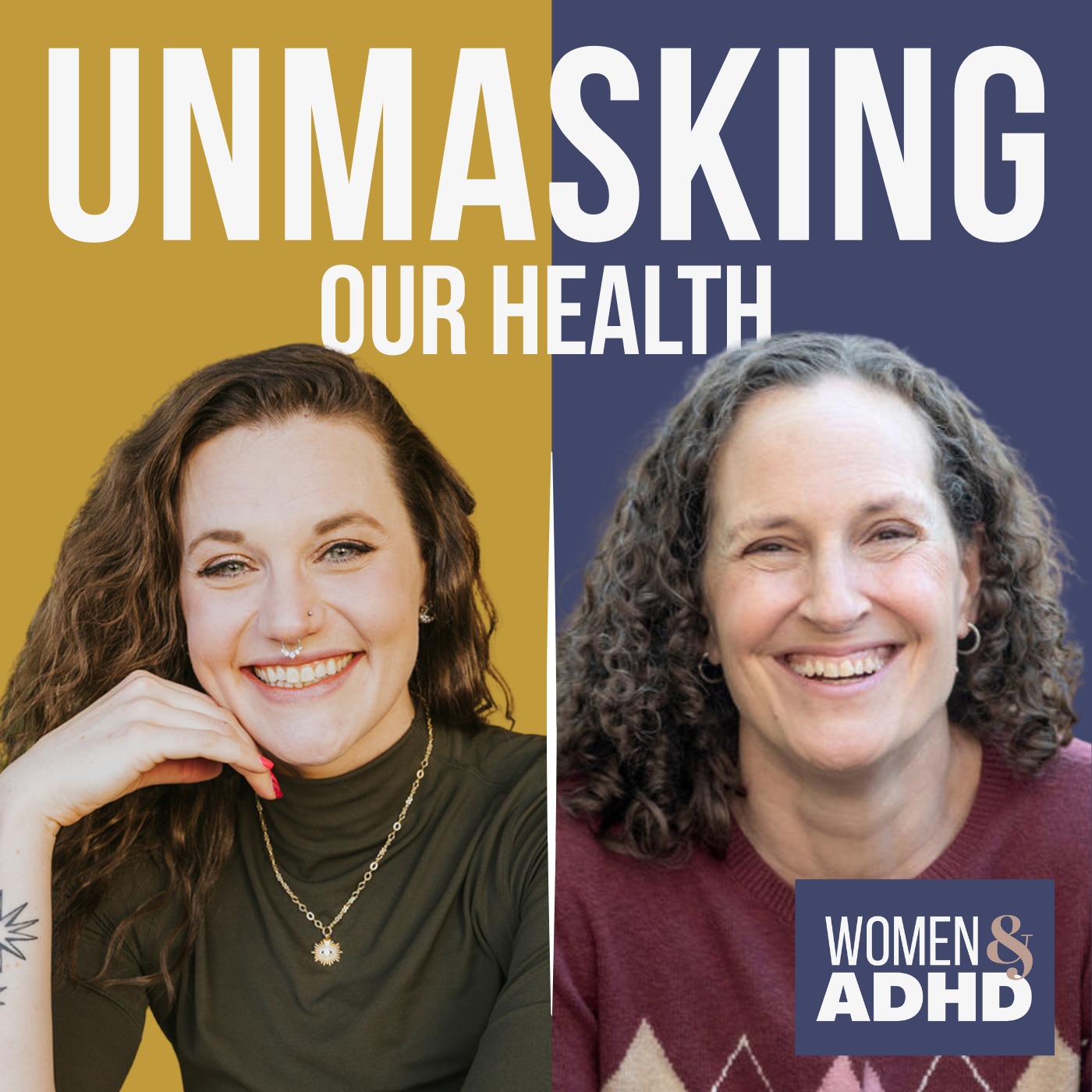
Unmasking Our Health: GLP-1s & ADHD
About This Episode
Episode 213 with Katy Weber & Kalin Johnson
In this first episode of our new series “Unmasking Our Health,” host Katy Weber teams up with cohost Kalin Johnson, PharmD, to explore a side of ADHD in women that isn’t talked about enough: What it’s like to live in a neurodivergent body.
After years of interviewing late‑diagnosed women and seeing the same patterns — chronic pain, fatigue, autoimmune issues, hormonal chaos, gut problems, “mystery” symptoms — Katy created the Unmasking Our Health series to explore the bigger questions behind neurodivergence: What if ADHD isn’t just about our brains, but about our whole bodies — and how and why is the medical system missing the full picture?
Our first topic for discussion: the explosion of GLP-1 medications (think Ozempic, Wegovy, Mounjaro) and what their surprising, wide-reaching effects are revealing about the deeply intertwined relationship between metabolic health, inflammation, hormones, and ADHD.
In this episode, we cover:
- What is metabolic psychiatry? And why it's expanding how we understand ADHD beyond just dopamine and norepinephrine
- GLP-1 medications and ADHD — what patients are actually reporting (quieter brain, less emotional reactivity, reduced compulsive behaviors, improved executive functioning)
- The inflammation connection — how chronic neuroinflammation creates "cognitive drag" and why reducing it may give the ADHD brain more bandwidth
- The vagus nerve and GLP-1 receptors — a fascinating look at how the gut communicates with the brain (and why 80% of vagal fibers run from the body to the brain, not the other way around!)
- Estrogen, perimenopause, and metabolic decline — why women over 50 are going on GLP-1s faster than any other population
- Drug interactions (and physiologic interactions) — what to watch for if you're on stimulants, SSRIs, or HRT while starting a GLP-1
- Food noise, reward-seeking, and binge eating — what GLP-1s are actually doing in the brain's dopamine reward circuits, and what that means for neurodivergent women with disordered eating histories
- Where is all of this going? Kalin shares her genuinely optimistic vision for how GLP-1 research is opening the door to a more holistic, systemic understanding of neurodivergent women's health
Note: Nothing in this episode constitutes medical advice. Always consult with your physician and pharmacist before starting, stopping, or changing any medication.
Kalin’s website: kalinjohnson.com
Instagram: @kalinpharmd
Links & Resources:
- Listen to Kalin's first episode: Episode 97 (August 2022)
- Have a topic you want Katy and Kalin to cover? Contact us
- - - - -
Episode edited by E Podcast Productions
- - - - -
Women & ADHD coaching: www.womenandadhd.com/coaching
- - - - -
Work 1-on-1 with Katy: www.womenandadhd.com/katy
- - - - -
Order the “Hey, it’s ADHD!” course: www.womenandadhd.com/adhdcourse
- - - - -
Did you love this episode? Click here to pledge a one-time donation to the podcast!
- - - - -
If you are a woman who was diagnosed with ADHD and you’d like to apply to be a guest on this podcast, visit womenandadhd.com/podcastguest.
Instagram: @womenandadhdpodcast
Tiktok: @womenandadhdpodcast
Twitter: @womenandadhd
Facebook: @womenandadhd
Advertising Inquiries: https://redcircle.com/brands
Privacy & Opt-Out: https://redcircle.com/privacy
[SPEAKER_01]: What I'm so excited about is it's really expanding the research around the impact of when we help somebody's system that is really struggling with metabolic function, look at everything that can improve.
[SPEAKER_00]: Hello and welcome to the women and ADHD podcast. [SPEAKER_00]: I'm your host, Katie Weber. [SPEAKER_00]: I was diagnosed with ADHD at the age of 45, and it completely turned my world upside down. [SPEAKER_00]: I've been looking back at so much of my life. [SPEAKER_00]: School, jobs, my relationships, all of it with this new lens, and it has been nothing short of overwhelming. [SPEAKER_00]: I quickly discovered I was not the only woman to have this experience, and now I interview other women who like me discovered in adulthood they have ADHD and are finally feeling like they understand who they are and how to best lean into their strengths, both professionally and personally.
[SPEAKER_00]: Hello and welcome back to Women and ADHD. [SPEAKER_00]: Today's episode is a little different from the norm here at Women and ADHD because it is the very first in a brand new semi-regular series that we are calling unmasking our health. [SPEAKER_00]: where we explore topics that reflect the holistic side of ADHD, so not just what's happening in our brains, but what it's like to live in a neurodivergent body. [SPEAKER_00]: For so many of us, neurodivergence isn't just a brain difference, it often comes with a whole host of co-occurring physical symptoms.
[SPEAKER_00]: Many of us living with neurodivergent nervous systems also experience chronic pain, fatigue, autoimmune issues, migraines, gut problems, hypermobility, fiber myalgia, pots, MCAS, the list goes on, not to mention the sleep issues, depression, anxiety and other mystery symptoms that never seem to fit neatly into one diagnosis. [SPEAKER_00]: So, in this series, the unmasking hour health series, we will explore these layers of co-occurring health conditions as we try to make sense of our neurodivergent bodies and how best to heal.
[SPEAKER_00]: I'm very excited to welcome as my co-host, Kaylin Johnson. [SPEAKER_00]: She is one of my absolute favorite humans and a brilliant neurodivergent health practitioner to boot. [SPEAKER_00]: Kaylin is a doctor of pharmacy, a licensed pharmacist based in Nebraska, as well as an ADHD and autistic advocate. [SPEAKER_00]: She spent years working in academia before leaving to build her own practice focused entirely on neurodivergent clients who are in her words unexplainably unwell. [SPEAKER_00]: These are results with that swirl of overlapping issues.
[SPEAKER_00]: So ADHD, chronic illness, pain, fatigue, gut stuff, autoimmune symptoms, hormonal chaos, you name it. [SPEAKER_00]: Clients who have been bounced from specialist to specialist told things like it's just anxiety or you just need a good night's sleep and who have never felt truly seen or understood by the medical system. [SPEAKER_00]: I was one of those women. [SPEAKER_00]: I am one of those women and working with Kalin has absolutely saved my sanity and my health. [SPEAKER_00]: Kalin's approach is the complete opposite of that siloed medicine that so many of us have experienced.
[SPEAKER_00]: She looks at everything, the brain, the body hormones, inflammation, metabolic health, nervous system function, chronic pain, immune issues, and how all of it shows up in our day-to-day lives as neurodivergent women. [SPEAKER_00]: So in this new series, Kaelin and I are going to be digging into what is happening below the neck, things like chypermobility and ailerist and low syndrome. [SPEAKER_00]: chronic pain, autoimmune conditions, long COVID, pots, MCAS, hormones, metabolism, and more.
[SPEAKER_00]: And how all of that intersects with ADHD and executive functioning, especially for those of us who have lived undiagnosed until well into adulthood. [SPEAKER_00]: So, we are kicking things off today with a topic that is absolutely everywhere right now, and one that I have a lot of complicated feelings about, and one that Kaylin has been watching very closely from a clinical perspective, and that is the skyrocketing use of GLP1 medications, specifically the use of them for symptoms related to ADHD.
[SPEAKER_00]: Now, I want to be very clear, this episode is not a commercial for weight loss medications. [SPEAKER_00]: We are not here to tell you whether or not you should be on one of these medications. [SPEAKER_00]: What we are here to do is to take a closer, more informed look at what GLP ones are revealing about the connection between metabolic health and ADHD. [SPEAKER_00]: And what they seem to be revealing about the bodies and brains of neurodivergent women more broadly. [SPEAKER_00]: We also get into estrogen, the vagus nerve, food noise, binge eating, interoception, drug interactions, and my personal favorite geek moment of this episode.
[SPEAKER_00]: How GLP ones are related to gila monsters. [SPEAKER_00]: So you'll have to listen to the episode to find that one out. [SPEAKER_00]: Okay, like I said, this is part one of what is going to be an ongoing series. [SPEAKER_00]: So if you have an idea for a topic for us to discuss related to holistic neurodivergent health, reach out at women and ADHD.com slash contact and let us know. [SPEAKER_00]: All right, I could not be more grateful to Kaylin for partnering with me on this. [SPEAKER_00]: So, enjoy!
[SPEAKER_01]: Okay, I am so excited. [SPEAKER_00]: Hi, Kaylin. [SPEAKER_00]: Hello. [SPEAKER_00]: Can you believe I interviewed you four years ago? [SPEAKER_00]: Episode 97. [SPEAKER_00]: I went and looked it up because I was like, I should mention Kaylin's original episode. [SPEAKER_00]: It was, yeah, it was August of 2022. [SPEAKER_01]: Oh my god. [SPEAKER_00]: I know, right? [SPEAKER_00]: I mean, a lot has changed, right? [SPEAKER_00]: You're a mom. [SPEAKER_00]: That's a big one. [SPEAKER_01]: I say, I have a child.
[SPEAKER_00]: Uh, but yeah, I was going down memory road of just like, oh, you know, like when we first were messaging back and forth in the women in ADHD community, which no longer exists sadly, but like, you know, I'm just so grateful for getting to meet you and interviewing you and interviewing your wife Marnie to and just like, [SPEAKER_00]: You're such a huge part of my life, and I'm just, I just got really for clubs, and I'm so excited to do this series with you. [SPEAKER_00]: So, so a little bit of background before I hand it over to you.
[SPEAKER_00]: So basically, Kaylin is, you know, you're, I don't even know what to call you. [SPEAKER_00]: So I'm going to like you talk about who you are because a little bit of everything. [SPEAKER_00]: I know, right? [SPEAKER_00]: But like officially you are a doctor of pharmacy. [SPEAKER_00]: Yeah. [SPEAKER_00]: Originally, I would like talk to you about medications and kind of ADHD medications. [SPEAKER_00]: I started working with Kaylin really about my own kind of physical stuff and my own body and you know that this neurodivergent Ted to toe that I was realizing a lot of it had to do with neurodivergence but also like [SPEAKER_00]: interviewing clients, interviewing podcast guests over the years.
[SPEAKER_00]: I mean, it's been five years now of interviewing women and seeing these patterns of like, wow, that's another guest with like an immune disorder, right? [SPEAKER_00]: I mean, there's some disorder, like another guest with PCOS, another guest with the fiber myelton and autoimmune disorders, Hashimoto's. [SPEAKER_00]: It just felt like there was a lot of these co-occurring physical things.
[SPEAKER_00]: mobile EDS and seeing a lot more about connective tissues and neurodivergence and these these ben diagrams of the brain and the body were so fascinating to me and coming up everywhere and really you were just like the person that I always came to because you seem to understand it all so well you've you've explained it to me in so many different ways and I wish I could say I
[SPEAKER_00]: I still don't really, which is why I was like, I feel like when we were talking about doing this series, it was like, what of the benefits to me is like, if I could get Caleb down and record all of this movie, I will at least have this for reference later. [SPEAKER_01]: Just put it on loop. [SPEAKER_00]: What we decided to do, what we wanted to do together was to create this series as an end to the adult diagnosis experience, like it's not just a diagnosis of a brain, right? [SPEAKER_00]: Like there is a lot happening below the neck that we are also just researching and understanding about who we are holistically.
[SPEAKER_00]: And so for those listeners who haven't yet experienced you or heard about you on a podcast or heard your episode, like why don't you just give us a little bit of background about who you are and what your interests are. [SPEAKER_01]: Yeah, for sure. [SPEAKER_01]: So like he said, thank you so much for that wonderful introduction to and we love being a part of your family and we love just being a part of your life. [SPEAKER_01]: So yeah, so so glad to be here. [SPEAKER_01]: And yeah, so my background again, like traditionally is I'm a pharmacist, Dr. Pharmacy.
[SPEAKER_01]: Um, so licensed pharmacists here in state of Nebraska and when I got out of pharmacy school, I immediately did a residency that focused a lot in ambulatory care pharmacy, which is all like outpatient based chronic disease statement and I really, really quickly became very frustrated and disenchanted with our health care system recognizing. [SPEAKER_01]: how siloed our approach was. [SPEAKER_01]: And I kept seeing all these patients come in, sometimes with mental symptoms or neurocognitive symptoms or physiological symptoms.
[SPEAKER_01]: And each time, it just felt like well after well after well because every like providers and how our systems are set up is to just look at that condition or that organ. [SPEAKER_01]: or that symptom, but not to really look at this full big picture. [SPEAKER_01]: And so I knew pretty quickly that that's what I not only wanted to do, but with how my brain works, it was like that's the only way I can do it because it's an ADHD autistic individual, which I [SPEAKER_01]: I was saying I didn't know at the time, I think I did know, but I wasn't visually diagnosed then.
[SPEAKER_01]: But I was like, yeah, if I see a whole in a system, I have to plug it. [SPEAKER_01]: Like I have to. [SPEAKER_01]: So I went and worked in academia for eight years, thought that that's where that was going to be the place I was going to really be able to study this make a difference. [SPEAKER_01]: and I did to a degree and then found that that maybe wasn't really exactly the case as well as having my own symptoms kind of go down the drain. [SPEAKER_01]: It a very dramatic fashion in my body, my health, ADHD symptoms, [SPEAKER_01]: completely off the rails burn out all these physical symptoms that maybe had been there but now we're just huge to where I couldn't stand for for a long periods of time.
[SPEAKER_01]: I had brain fog and no doctor I want to seem to know what was going on other than just kept being like oh it's anxiety like oh it's you know just you just need a good night's sleep I've been told that so many times [SPEAKER_01]: Yep, yep, uh, if only Ray, if that only that would fix all the things and I'll tell you now as a mom of an 18 month old who does not like sleep. [SPEAKER_01]: It's not the only problem. [SPEAKER_01]: It's rough. [SPEAKER_01]: But yeah, so then I left and I started this practice and I really went then and kind of got everything else.
[SPEAKER_01]: I felt like I needed to [SPEAKER_01]: be, I would say I feel like I try to be like at like a Yoda or like a Gandalf or a Dumbledore, I need a better female, a professor of mechanical, I don't know.
[SPEAKER_01]: Helping neurodivergent women who were the word I use is quote unexplainably unwell. [SPEAKER_01]: where they have this kind of conglomerate of symptoms that aren't fully explained by any one diagnoses and really starting to see then maybe in their symptoms that ADHD doesn't exist in a silo, right? [SPEAKER_01]: it's impacted by everything else that's happening in the body. [SPEAKER_01]: And so for their quality of life and their understanding of the brain and being able to work with their brain and to feel good in their life, it's not just understanding their ADHD and their ADHD brain, it's understanding their entire body.
[SPEAKER_01]: So my kind of goal and focus has always been around quality of life and what would the world look like if there were a bunch of healthy and well neurodivergent women in it, I think it would look pretty awesome. [SPEAKER_00]: Yeah. [SPEAKER_00]: Right. [SPEAKER_00]: I'm just reminding now of like when we first had our [SPEAKER_00]: consultation and you said your your line let's make you make sense and it was like my whole body just exhale. [SPEAKER_00]: I was like oh like it's all I've been wanting my whole life.
[SPEAKER_00]: I've just that feeling of like trying to connect the dots going to so many different siloed specialists always feeling like I was re-explaining myself and never really understood and the service you provide of like looking at all of these different seemingly unconnected like it's just so valuable. [SPEAKER_00]: So [SPEAKER_00]: We'll talk all about like go have a consultation with Kaylin. [SPEAKER_00]: You will never regret it. [SPEAKER_00]: She is just incredible.
[SPEAKER_00]: So we have a lot of topics we want to discover. [SPEAKER_00]: Talk about in terms of the, you know, we talked about hypermobile EDS, connective tissues, histamine, mass cell, activation syndrome. [SPEAKER_00]: Like I've gone down my own journey about hypermobility. [SPEAKER_00]: I've also like my daughter has gone down her own journey of [SPEAKER_00]: thoughts and kind of that tacky cardic system. [SPEAKER_00]: So we're not going to go too deep for today into some of that stuff. [SPEAKER_00]: But I think like, you know, what I would like to do is have these episodes go deeper into like, what is that connection?
[SPEAKER_00]: And like, you know, I always talk about ADHD as the gateway diagnosis of sort of understanding your body so much more. [SPEAKER_00]: But [SPEAKER_00]: The first topic we decided we wanted to address because it is so popular and so trendy right now. [SPEAKER_00]: And seemingly, like it just feels like the Wild West, as you said earlier before we hit record, like there is a part of me that is like, oh my god, is this the miracle drug? [SPEAKER_00]: Should we have this in our water? [SPEAKER_00]: Should everybody be on this?
[SPEAKER_00]: And then at the same time being like, whoa, like this, the train is on the tracks, there's no breaks, and everybody seems to be talking about it and embracing it, and that's GLP ones. [SPEAKER_00]: and semi-glutides, and terzepotides, and retitude tribes, and all of those. [SPEAKER_00]: So I don't think we can go too deep into the use of them and the rise of them. [SPEAKER_00]: That's probably better for another podcast. [SPEAKER_00]: But what I want to talk about is what I'm seeing and what a lot of us are seeing is the use of [SPEAKER_00]: 80 treating ADHD.
[SPEAKER_00]: So what is going on there? [SPEAKER_00]: Like what as a pharmacist, what are you seeing? [SPEAKER_00]: What are you? [SPEAKER_00]: What have you noticed in terms of like why GLP ones? [SPEAKER_01]: Yeah, first of all, e-ha, right? [SPEAKER_01]: It's the world west of the internet. [SPEAKER_01]: I was like, less so. [SPEAKER_01]: Oh, like, here we go. [SPEAKER_00]: Have we seen anything like this? [SPEAKER_00]: Like, I almost kind of feel like nothing, there's no precedent to this. [SPEAKER_00]: Like, maybe SSRIs and the 80s felt like they flooded the market, but this is just something like, I don't feel like we've seen anything like this where it's like, we're going to test guilty ones for every random disease and dysfunction and just being like, yep, it works.
[SPEAKER_00]: It's like, what is going on? [SPEAKER_01]: Okay, so like we're gonna soak it and do it and it is so exciting because like that is like the first thing honestly like when I heard a kind of about the glp ones and people going on these and like kind of some of these benefits that expanded beyond kind of those traditional ones we think about them regarding like weight loss and food noise and we'll kind of get into that. [SPEAKER_01]: Honestly, first off, it was my first reaction was a bit of curiosity with the healthy dose of skepticism.
[SPEAKER_01]: Right? [SPEAKER_01]: Because it was kind of like, what is this? [SPEAKER_01]: And like, also as a pharmacist, man, people come to you all the time to be like, I heard about this. [SPEAKER_01]: I heard about this. [SPEAKER_01]: I heard about this. [SPEAKER_01]: And you get a little kind of jaded when somebody's like, hey, I heard about this and you're like, yeah, well, especially around diet culture too, right? [SPEAKER_00]: Which is like, are we selling another weight loss drug? [SPEAKER_00]: Is this all about weight or is there something deeper to explore here?
[SPEAKER_00]: So yeah. [SPEAKER_01]: But then, again, here's the deal, as a pharmacist, I've definitely learned that when thousands of patients, like, you don't come to you, where you hear are independently reporting that same unexpected effect. [SPEAKER_01]: That's probably worth paying attention to, right? [SPEAKER_01]: Like, this wasn't just like one off, right? [SPEAKER_01]: It was happening in my own patients. [SPEAKER_01]: I was hearing it from, [SPEAKER_01]: my colleagues and other providers I would chat with and then you start hearing news articles about it.
[SPEAKER_01]: I know that in New York Times just had an article about this too. [SPEAKER_01]: So it was kind of everywhere and you know people weren't just saying things like again like I lost weight. [SPEAKER_01]: Like they were saying things like my brain is quieter. [SPEAKER_01]: I don't feel that same like compulsive drive to the guy at a patient who was just talking about they were a big like nail picker.
[SPEAKER_01]: Yeah, and that that's pretty much gone away since they've been on the GLP one. [SPEAKER_01]: I have a lot of patients talk about like it's so much easier to like pause before reacting, that like kind of emotional, that quickness has kind of quieted down. [SPEAKER_01]: Or even I've heard things like my ADHD meds seem to work better. [SPEAKER_01]: And then when you tie in, again, some of that chronic illness part of this as well, whether that's burnout, HDS, long COVID, long line, I'm hearing things too.
[SPEAKER_01]: Like, I can see it for longer periods of time. [SPEAKER_01]: I had two patients recently. [SPEAKER_01]: Within four weeks of starting GOP ones, their autonomic stability was standing, their pot symptoms, dramatically improved. [SPEAKER_01]: Within four weeks of starting GOP one was crazy. [SPEAKER_01]: minimal pain so like we're hearing all of these things like right these aren't weight loss outcomes these are neurocognitive and physical outcomes so what really fascinated me was that these reports were mirroring though what researchers were starting to study that we were starting to hear that they were really looking more into so they're starting to explore things like addiction right [SPEAKER_01]: compulsive behaviors, reward pathways, inflammation, versus autoimmune conditions, and then metabolic psychiatry as well.
[SPEAKER_01]: So, I don't think GLP ones are treating ADHD directly, but what I do think is they're revealing though how much metabolism, inflammation, and reward signaling, influence ADHD symptoms. [SPEAKER_01]: And I'll say specifically around that and I don't know if it's probably not a term that a lot of people are familiar with, but the idea of metabolic psychiatry right so psychiatry traditionally has focus on neurotransmitters. [SPEAKER_01]: So dopamine, serotonin, nor epinephrine, right?
[SPEAKER_01]: We talk about ADHD. [SPEAKER_01]: We're always talking about neurotransmitters. [SPEAKER_01]: But metabolic psychiatry is really asking a broader question. [SPEAKER_01]: So what if some psychiatric symptoms are not only neurotransmitter problems, but also energy problems, right? [SPEAKER_01]: So in other words, can insulin resistance contribute to depression, can inflammation, worsen ADHD symptoms? [SPEAKER_01]: can mitochondrial dysfunction contribute to brain fog on stable blood sugar, affect emotional regulation, and can improving metabolic health overall include, like, improve any sort of neurocognitive or psychiatric symptoms.
[SPEAKER_01]: And the answer increasingly, for at least some people seems to be yes. [SPEAKER_01]: And so this is super relevant for ADHD patients is that traditional ADHD model really focuses on dopamine and more at the nephrine. [SPEAKER_01]: But metabolic psychiatry doesn't reject that model. [SPEAKER_01]: It just really expands upon it. [SPEAKER_01]: So an ADHD woman could have insulin resistance, chronic inflammation, poor sleep, elevated cortisol, autonomic dysfunction, and all of those factors can worsen executive functioning.
[SPEAKER_01]: So the question that becomes how much really of what we call ADHD severity is actually being amplified by metabolic dysfunction. [SPEAKER_01]: And so that's where metabolic psychiatry really becomes interesting and GLP ones have so much excitement around them because they really intersect at multiple metabolic pathways that guide things like insulin sensitivity, inflammation, [SPEAKER_01]: energy regulation, addiction pathways. [SPEAKER_01]: So, yeah, the patient is saying my brain is quiet or researcher asking, is this a neurotransmitter effect, a metabolic effect, an anti-inflammatory effect, or all three, and the answer is likely a combination.
[SPEAKER_01]: And for those late diagnosis and with ADHD, I think this framework is really, really going to resonate because they've probably spent years being told that there's symptoms [SPEAKER_01]: were purely psychological when in reality, we've got hormones, inflammation, insulin resistance, sleep disruption, chronic stress, nervousness and dysregulation, all affecting the same brain they're trying to use to function every day.
[SPEAKER_00]: As you were talking, I was just thinking about treatment resistant depression too, because I think that's another topic that comes out up a lot for those of us who were diagnosed with depression long before a neurodivergent diagnosis, which is that notion of like stop telling me I'm just depressed, right? [SPEAKER_00]: Because one of the things that I've talked about with you a lot is this even a day day that we're talking about right now, like what even is ADHD? [SPEAKER_00]: And for me, for me, I've tried to understand it as executive dysfunction in the way that it is experienced, kind of internally for so many women, like what we are struggling with when we talk about struggling and the traits that are diagnosable for ADHD tend to be around executive dysfunction deficits.
[SPEAKER_00]: And so that can come from, you know, there's the genetic element, but there's also like a lot of it is related to inflammation, right? [SPEAKER_00]: And so what we know is that inflammation can be caused either by environmental factors, but it can also be caused by stress and trauma, right? [SPEAKER_00]: And so it's like then we get to this idea of like the chronic, [SPEAKER_00]: or the complex PTSD of just being a woman of being an undiagnosed neurodivergent person, right? [SPEAKER_00]: Like there's all of these ways in which it comes back to inflammation for me.
[SPEAKER_00]: around the executive functioning. [SPEAKER_00]: And so like when I think about YGLP ones are working for executive functioning, like that's the first place my mind goes. [SPEAKER_00]: It's like, well, it's just bringing, it's reducing that low-level inflammation that all of us have been girding in our bodies for our whole lives. [SPEAKER_01]: Yes, I mean, you're exactly right there. [SPEAKER_01]: Like that part, again, it's taking away such a big stressor on our body because that inflammation, [SPEAKER_01]: It's so encouraged by that dysfunction in our metabolic pathway.
[SPEAKER_01]: So, if inflammation is creating this kind of like cognitive drag, reducing inflammation, is going to make the brain operate more efficiently. [SPEAKER_01]: So, again, if we're seeing such a decrease in inflammation with the GLP ones, less fatigue, better clarity, improved emotional regulation, those are all things we'd expect if neuron inflammation were going to be reduced. [SPEAKER_01]: Again, that's not like ADHD just appears, but it's the brain has way more bandwidth than for they're not to be so much stress on that specifically.
[SPEAKER_00]: You know, I don't know the numbers around this, mostly this is just sort of like anecdotal readings and the women I've been working with as clients, but like I know that a lot of women
[SPEAKER_00]: kind of over the age of 50 are going on GLP ones. [SPEAKER_00]: I think faster than any other population, right? [SPEAKER_00]: Yeah. [SPEAKER_00]: And so is there what is the connection there between like we talk about estrogen and estrogen levels and their relationship to dopamine? [SPEAKER_00]: How do hormones and estrogen relate to this whole metabolic cycle? [SPEAKER_00]: Is that what you think?
[SPEAKER_00]: Yeah, I feel like every single thing I have to be like explain like I'm five explain like I'm five But yeah, um, what's the hormone side of this? [SPEAKER_01]: Yeah, totally here at like the point next era To say to and Katie and I were talking about starting this. [SPEAKER_01]: I was like are you asking me in part because every two seconds I'm like well, there was a study [SPEAKER_00]: I love it, but this is what I need about, like I come away from these conversations with my mind blown and also I'm like, I don't really understand a lot of what you said, but it sounded really cool.
[SPEAKER_00]: So yeah. [SPEAKER_01]: Well, and again, I'll see that part of it is like, there's so much in the stuff that we talk about too. [SPEAKER_01]: that we don't have a perfect end up understanding of. [SPEAKER_01]: And I think that's what is hard because talking about the wild west, like we are just at the beginning the grassroots of really even understanding what inflammation is. [SPEAKER_01]: Like how the metabolic pathway connects to everything. [SPEAKER_01]: And this is something I'm going to dive into to this answer here that what I'm going to talk about, this combination of estrogen, metabolic system and inflammation.
[SPEAKER_01]: But even understanding how like, [SPEAKER_01]: the body communicates with the brain and how all of these receptors interact and again that it's not siloed. [SPEAKER_01]: So when we think about women over 50 women in Perry Metapaz and Metapaz really, you know, seeking seeing a lot of benefit with these and this kind of puzzle piece here is, so when we think about estrogen, it impacts dopamine, it impacts influence sensitivity, it impacts inflammation, it impacts energy metabolism. [SPEAKER_01]: Dude, that's like everything right there that GLP ones help with RAID.
[SPEAKER_01]: So as estrogen declines, many women notice we're sitting at HD, that increase weak gain, poor sleep quality, greater insulin resistance and increase inflammation. [SPEAKER_01]: All those systems are interacting. [SPEAKER_01]: So a GLP one isn't replacing estrogen, but it may improve a lot of those downstream metabolic consequences that emerge when estrogen declines. [SPEAKER_01]: which is why a lot of women will describe feeling like, okay, I actually am feeling like myself again when I start this GLP1.
[SPEAKER_01]: So we're getting what we're thinking about all of this crossover and again like the body and like hormones while of this really matters. [SPEAKER_01]: The brain is such an energy hungry organ in the body. [SPEAKER_01]: Executive functioning is expensive. [SPEAKER_01]: Attention is expensive. [SPEAKER_01]: Impulse control is expensive. [SPEAKER_01]: We need all systems and hormones operating on go to [SPEAKER_01]: pay the price to pay the paper, but when the body is inflamed, the brain has fewer resources available for those higher order tasks.
[SPEAKER_01]: So brain energy, the brain uses 20% of the body's energy, even though it only represents about 2% of the body weight. [SPEAKER_01]: And so executive function, things like attention, planning, emotional regulation, and impulse control are all energy intensive. [SPEAKER_01]: And if the brain cannot efficiently access or utilize fuel cognitive performance is going to suffer. [SPEAKER_01]: And one of the most interesting things too is when we're often thinking about kind of like the brain and the body, I think people often, and I think especially ADHDers, [SPEAKER_01]: We think the brain's controlling everything, right, but so much of what controls our autonomic nervous system, right?
[SPEAKER_01]: So the vagus nerve, which has glp1 receptors on it, so again, glp1 isn't just found in the gut, it's also found in the brain, it's found in the brain's stem, the vagal nerve, 80% of vagal fibers carry information from the body to the brain. [SPEAKER_01]: So not the other way around. [SPEAKER_01]: So many people think of the brain as directing the body, but in reality, the body is constantly reporting its status back to the brain. [SPEAKER_01]: So that vagus nerve, it really has this information highway, I guess, connecting the gut, the liver, the pancreas, the heart, and the immune system.
[SPEAKER_01]: So [SPEAKER_01]: when GLP1s activate that vagus nerve after eating those gut cells release GLP1 and that GLP1 then activates receptors on the vagal sensory neurons and that travels into the brainstem. [SPEAKER_01]: And the brain receives messages like we've eaten calories are coming slow down. [SPEAKER_01]: We don't need to look for more food, and then the brain adjusts appetite, cshd, glucose regulation, and reward behavior, which means that GLP1 can affect the brain without ever physically even entering.
[SPEAKER_01]: larger portions of the brain itself, which is pretty dang cool. [SPEAKER_01]: And so for ADHD, this is really intriguing because that means, again, the vagus nerve doesn't just transmit hunger signals. [SPEAKER_01]: It also influences emotional regulation, stress responses, attention and arousal, impulsivity, emotional reactivity, overwhelm all of these things. [SPEAKER_01]: So instead of the brain receiving like this constant stream, also of like maybe we're hungry, maybe we need to [SPEAKER_01]: The GOP ones are kind of like turning down the static of the signal.
[SPEAKER_01]: They're really improving the signal quality. [SPEAKER_01]: And when again, talk about back to like women in midlife. [SPEAKER_01]: When you take away the estrogen, the static becomes even more intense, right? [SPEAKER_01]: So like having that downstream consequence of an impaired metabolic pathway work much more efficiently is going to be huge for them having an improved quality of life and improved executive functioning. [SPEAKER_00]: Now, you mentioned earlier about like some of your clients, patients, you noticing that the GLP ones are actually helping the ADHD meds.
[SPEAKER_00]: And so Mike, I have a bigger question around like, what is it safe to continue taking? [SPEAKER_00]: Like, is there any, are there any negative interactions if somebody decides to take a GLP ones either in terms of like estrogen, like HRT, or SSRIs, or ADHD meds? [SPEAKER_00]: Or do you just continue as with your cocktail of medication? [SPEAKER_01]: That's a really great question. [SPEAKER_01]: Of course, always make sure you talk to your pharmacist, talk to your doctor about your med specifically, including your supplements as well, just to check and be sure.
[SPEAKER_01]: but they're really great thing about the GLP ones is they compare to a lot of just meds in general, not a ton of drug interactions. [SPEAKER_01]: We do have to be careful about a couple of different things or adjusting doses sometimes because that's really the biggest thing is a lot of the drug interactions around GLP ones aren't direct, it's a physiological interaction. [SPEAKER_01]: So if we think about like stimulants specifically,
[SPEAKER_01]: So GLP ones, the big side effect that probably everybody hears about, and again, part of the reason why it works, is it slows gastric emptying, which that's going to alter the absorption timing of oral medications. [SPEAKER_01]: So anything you take orally could potentially be impacted. [SPEAKER_01]: So for ADHD patients, I'm usually saying things like, hey, pay attention to any changes and how effective your [SPEAKER_01]: or stacking of appetite suppression because we know sometimes stimulants also suppress that as well dehydration, constipation, things like that.
[SPEAKER_01]: So with that slow gastric emptying, it can take longer for the medication than to take effect, right? [SPEAKER_01]: It has takes longer to kind of reach your system to be able to start breaking down. [SPEAKER_01]: So as well, the medication is going to stay in your system longer because of delay gastric emptying. [SPEAKER_01]: So you made it need to take it earlier. [SPEAKER_01]: for it to work. [SPEAKER_01]: So if you're used to taking it and it's you're like, I didn't work at 9 a.m. [SPEAKER_01]: I could take it at 8 and that's no problem.
[SPEAKER_01]: But all of a sudden now, you're not noticing it. [SPEAKER_01]: Take a fact till 9.30 10. [SPEAKER_01]: Okay, we may have to up that time because the late gastric emptying or you may need to lower the dose. [SPEAKER_01]: That's probably the thing I found the most then is needing to decrease that dose. [SPEAKER_01]: And part of that is that effectiveness piece that the late gastric emptying, but also if [SPEAKER_01]: their part of the problem of the executive functioning was metabolic dysfunction.
[SPEAKER_01]: All of a sudden, we may not need as high of a dose either, and we may start seeing more of adverse effects from the med without the benefit. [SPEAKER_01]: So if the medication isn't working as well, we may know also need to look at other things again like dehydration, nutrition issues to make sure also that the GLP1
[SPEAKER_01]: that could then worsen executive functioning. [SPEAKER_01]: And so, less worry, really on drug-drug interactions with this med, but more about the physiologic changes, it causes that can then impact the medication. [SPEAKER_00]: Yeah, which people with ADHD are really good at observing the different effects of medication. [SPEAKER_00]: I can attest. [SPEAKER_00]: I'm super attentive to how I'm feeling from day to day. [SPEAKER_01]: Well, that actually brings highlights of really, really, I think, important part about GLP ones in ADHD is so one thing that's missing often from that broader conversation around GLP one, conversation is in tear assumption.
[SPEAKER_01]: So if we already have a hard time with that and then you give us a medication where the purpose is partly to like, especially to suppress hunger signals, like that can become problematic. [SPEAKER_01]: Plus, you're also here's the irony, right? [SPEAKER_01]: You're given the GLP1 med that requires a ton of executive functioning often to even get. [SPEAKER_01]: So all of a sudden, patients are having to manage prior authorizations. [SPEAKER_01]: refill timing, med shortages, injections, dose titrations, maybe insurance appeals or like inconsistency where you're getting it or I have some patients who have to go into the office every time they get their injection.
[SPEAKER_01]: depending on what their office, how their system runs. [SPEAKER_01]: So a lot of ADHD years, even though some of it sounds like, oh my gosh, look, this is so awesome. [SPEAKER_01]: It improves all these metabolic things. [SPEAKER_01]: It's really hard though to try to do medication and be on board with this when the health care system really asks them to perform dozens of executive functioning tasks. [SPEAKER_01]: Well, sometimes we'll continuously try to even get them in. [SPEAKER_01]: Oh my god.
[SPEAKER_01]: Creech. [SPEAKER_00]: Yeah. [SPEAKER_00]: But it does feel like the tracks are being laid for a much easier sort of distribution and less costly distribution. [SPEAKER_00]: Like it does feel like we are going in a direction of like mass widespread usage. [SPEAKER_00]: And so, [SPEAKER_00]: you know, what does that mean for us and like should we be excited or should we be really worried? [SPEAKER_00]: Can I, you know, and I don't want this episode to come off as like a commercial for GLP ones, but it is fascinating and I, you know, there is a part of me that's like, is there anything any red flags right now other than like the digestive stuff that some people are talking and the price too and the cost, right?
[SPEAKER_00]: I think the biggest red flag for me as somebody who has been very open about my own history with yo-yo dieting and diet culture and has really embraced body neutrality. [SPEAKER_00]: I feel like there was like we were really going to a really good place of accepting all bodies and sizes. [SPEAKER_00]: redefining how we look at health and now we've really done this backslide with GLP1s in terms of dye culture and so I mean there is a part of me that feels wary I think there's a lot of disordered eating in neurodivergent communities especially binge eating and so it's like what are your thoughts because you're talking about food noise earlier?
[SPEAKER_00]: And just the compulsive static and I like how you talked about like turning the noise down on that static, but also, you know, to the flip side of that, like are we turning it down too much so that we are putting ourselves in real danger in terms of like we're already forgetting to eat on ADHD meds, are we setting ourselves up for some real [SPEAKER_00]: Disordered. [SPEAKER_00]: Yeah, I don't feel like I'm seeing a lot of that and I don't know if that's just the loudness of Diet culture just being like it's fine.
[SPEAKER_00]: It's fine. [SPEAKER_00]: Way less is great. [SPEAKER_00]: But like are you seeing people like having any real like side effects in terms of like Nutrition and you know, I know they talk about like muscle mass and that kind of stuff. [SPEAKER_01]: Yeah, that's a really good question. [SPEAKER_01]: So you know [SPEAKER_01]: Exactly. [SPEAKER_01]: There are some things, again, that we definitely need to be wary of. [SPEAKER_01]: Again, the biggest thing, I would say the biggest kind of like seek side of fact that I do see is the issue with the delayed gastric emptying, causing issues where we kind of get like everything basically backed up and then if that saves that way, that's really not a good thing surgery things can then happen, et cetera, et cetera.
[SPEAKER_01]: Talking just to my own provider, just kind of in conversation, just kind of picking her brain about it. [SPEAKER_01]: My own PCP, she's had a number of patients have to have that happen. [SPEAKER_01]: But again, I will say for a lot of patients that is dose dependent. [SPEAKER_01]: So, hi, doses being more likely to again cause that. [SPEAKER_01]: Which I should also say that like when we're also exploring these medications outside of weight loss again, they're not none of them are FDA approved for this, but if you have a conversation with your doctor and that is something that is considered.
[SPEAKER_01]: They are also looking at doing what we'll call micro doses, so much smaller doses too, where you may be able to receive the metabolic benefits without having the more intense delay gastric emptying and maybe not as much weight loss folks. [SPEAKER_01]: Do you may not see as many of those benefits from that? [SPEAKER_01]: I think kind of helps parlay those kind of, you know, scary or issues like you talk about like them kind of maybe they're being abused or contributing to diet culture issues.
[SPEAKER_01]: I haven't really seen a ton of that and actually like you said, I have a number of patients with binge eating disorders and I have seen these be helpful very much again and reducing some of that food noise, but I have had still patients though, it doesn't solve the full problem. [SPEAKER_01]: I guess I'll say. [SPEAKER_01]: And I think maybe that's a reality too to like again see with these also is like so many like you talked about earlier with ADHD. [SPEAKER_01]: It's an onion of contributions that impact executive functioning and ADHD severity.
[SPEAKER_01]: these meds are helping with one aspect of that, but it's not going to take away all of that, so we're still sometimes left with things to identify and course correct. [SPEAKER_01]: So yeah, those are kind of the big worries, but right now I'm not seeing it be at least this big,
[SPEAKER_00]: We'll see. [SPEAKER_00]: Well, and the other thing that it just came to me, too, was this notion of I think there's like an existential or philosophical notion around like medications that you should take for the rest of your life and medications that you shouldn't take for the rest of your life, right? [SPEAKER_00]: And this kind of falls into this like, well, we're [SPEAKER_00]: not really solving the issue. [SPEAKER_00]: Like I see a lot of influencers like medical influencers who will talk about this like in this very shaming way of like you're not really changing your lifestyle.
[SPEAKER_00]: Like always coming back to this idea that if you just like got off the couch and went for a run, your life would be solved. [SPEAKER_00]: And so they're still working within that framework and not really looking at at what is happening on a metabolic level as like disease. [SPEAKER_00]: Yes. [SPEAKER_00]: And so there is this shaming of like, well, this, you know, what are you going to do? [SPEAKER_00]: You're just going to be on this for the rest of your life. [SPEAKER_00]: But like, we don't have that shaming around other medications that are just like, yeah, you're on this for the rest of your life.
[SPEAKER_00]: Exactly. [SPEAKER_00]: Right. [SPEAKER_00]: And so, but I do think, you know, any kind of medication, especially what it's costing right now for a lot of people. [SPEAKER_00]: It's it's daunting to think about like, do I have to be on this for the rest of my life? [SPEAKER_00]: And I think that's a wider conversation about the pressure to ween off of. [SPEAKER_00]: medications as soon as possible. [SPEAKER_00]: That's happening right now on a national scale too. [SPEAKER_00]: Yes, but I wanted to also get back to this idea of food noise too because I feel it like or even just the compulsive static.
[SPEAKER_00]: I'm fascinated like what? [SPEAKER_00]: Do you think causes the compulsive static? [SPEAKER_00]: Is that also just like inflammation and ADHD genetics and like what do you think like it feels like a little bit of a chicken egg thing there in terms of like calming it down versus what's creating it in the first place? [SPEAKER_01]: Exactly. [SPEAKER_01]: I think there's a lot of chicken the a component. [SPEAKER_01]: I think there's a lot of different possibilities that can kind of contribute to that.
[SPEAKER_01]: But generally, again, like food noise really when it comes down to it, it really is reward seeking behavior. [SPEAKER_01]: So that when we talk about the ADHD brain, it's constantly scanning for simulation, novelty, dopamine, and relief. [SPEAKER_01]: I think that's what we don't talk about enough to do that the ADHD brain is also constantly looking for for that relief. [SPEAKER_01]: And food happens to be one of the fastest and most reliable sources of dopamine. [SPEAKER_01]: So GLP ones appear to dampen that activity in those reward circuits involving dopamine signalling.
[SPEAKER_01]: So the result is less pleasure, it's less urgency. [SPEAKER_01]: So patients will often describe it as like, I can still want something. [SPEAKER_01]: I just don't feel as a driven by it. [SPEAKER_01]: That's a very different neurological experience because it's not having like we are seeing those adjustments in those dopamine pathways. [SPEAKER_01]: So [SPEAKER_01]: we're not needing that same simulation novelty dopamine relief. [SPEAKER_01]: It's just the one that's filling it, which is again, why we're seeing this being studied in addictive behaviors, because that's really why things are addictive, right?
[SPEAKER_01]: Even when it comes to alcohol, alcohol is addicting, not because like people who struggle with addiction, it's not the alcohol, it's what the alcohol is doing, right? [SPEAKER_01]: And then the brain learns, oh, that helps that quickly. [SPEAKER_01]: I want that. [SPEAKER_01]: And that's what starts creating those pathways. [SPEAKER_01]: So the same here with this, it's going to quiet that piece that really is just looking for something to fill those receptors, that pathway, that dopamine to fill that piece.
[SPEAKER_01]: And if we don't have that anymore, then we don't necessarily need that for that reason. [SPEAKER_00]: So then by that logic, wouldn't GLP ones replace most ADHD beds? [SPEAKER_00]: I mean, should they be working together? [SPEAKER_00]: Is it like does it feel like a viable replacement? [SPEAKER_01]: So that's a really good question. [SPEAKER_01]: So I really think that more than likely they're going to be things that like really work in tandem. [SPEAKER_01]: So I think that what we'll likely see is.
[SPEAKER_01]: The GLP ones are going to be especially relevant, again, for people who have metabolic issues, right, metabolic dysfunction. [SPEAKER_01]: That's deriving that issue with dopamine, right? [SPEAKER_01]: And dopamine regulation. [SPEAKER_01]: But that dopamine can be impacted also beyond things that are just related to metabolic dysfunction. [SPEAKER_01]: I mean, when we take the hormone piece of that, too, like [SPEAKER_01]: The GLP1 is helping a lot of that downstream effect, but the estrogen is still a big part of that, so our GLP1 is completely replacing meds for people who are in like perimenopause, not necessarily, but they may be working in tandem as well with the estrogen.
[SPEAKER_01]: And the other thing to with these is every medication we're trying to get the dose high enough to wear the med is effective but not so high that we're seeing a lot of adverse effects. [SPEAKER_01]: And sometimes, too, for people, though, do we see this even like with simulants, we may not be able to get the dose high enough to get all the benefit that we want in those areas. [SPEAKER_01]: And so sometimes having meds in other areas as well can then be helpful to kind of even that out.
[SPEAKER_01]: So we don't really have evidence yet to support that GLP1's alone are going to [SPEAKER_01]: be it. [SPEAKER_01]: But for a certain sort of group of people, I think it's going to be a really important tool. [SPEAKER_01]: So those again, who struggle with insulin resistance, binge eating, chronic inflammation, reward, dysregulation, or other metabolic-based issues, they're really a modifier of the ADHD experience in a primary ADHD treatment.
[SPEAKER_00]: Where do you think this is going to be going? [SPEAKER_00]: I mean,
[SPEAKER_00]: We're having pills, we're having monthly injections instead of weekly. [SPEAKER_00]: Like it just feels like, I don't know, do you have any theories about what this is, what's going to happen next or where this is leading? [SPEAKER_00]: Do you think we're all going to be on GLP1? [SPEAKER_00]: Like I feel like so much of this feels very much like the end of like the biohacking version of the end of [SPEAKER_00]: Oh, crap. [SPEAKER_00]: What's the movie with with Evie and Wally? [SPEAKER_00]: Yes, oh my gosh.
[SPEAKER_00]: The dystopian version of Wally, but instead we're all going to be like biohacking. [SPEAKER_01]: Yes. [SPEAKER_01]: One time, Marty and I say, we did a Disney run and we dressed as the by and large people on the ship for the run. [SPEAKER_01]: So yes, I'm, yes, right there with you, it was great. [SPEAKER_01]: But yeah, like, yeah, so here's the deal. [SPEAKER_01]: There's the, I don't know, maybe I'm a bit of a positive poly at heart where I do tend to kind of look at, where do I think this is going in a lot of good ways?
[SPEAKER_01]: And where I think this is going in ways that gives me really, really excited is this expansion of the idea again of metabolic psychiatry and again [SPEAKER_01]: no longer, I think it's really expanding our research and people's eyes and providers, other providers beyond me, looking at things and saying, hey guys, this isn't just one thing, influencing this condition. [SPEAKER_01]: That's not true for any condition. [SPEAKER_01]: And so what I'm so excited about is it's really expanding their research around the impact of when we help somebody's system that is really struggling with metabolic [SPEAKER_01]: look at everything that can improve.
[SPEAKER_01]: I mean, again, like, I'm hearing, you know, Marty, my wife has multiple sclerosis in that community. [SPEAKER_01]: There's talk of people with autoimmune conditions getting off their biologics that come with awful side effects because they're able to manage them on GLP ones. [SPEAKER_01]: And again, this isn't, this isn't every patient, but some people are finding that. [SPEAKER_01]: So then looking at, okay, it was their autoimmune condition really influenced by the stress of a dysfunction metabolic,
[SPEAKER_01]: Like that's the stuff I'm so excited about is really this expansion of us understanding the the body and the brain and how all of this connects in this really, really full picture. [SPEAKER_01]: So that's my big like with who like part of that, because I've been waiting for that and if it took the glv ones or driving the research for that and the understanding of that, that's really, really cool. [SPEAKER_00]: Yeah, have you that just reminded me of psoriasis because that's another one that I sort of feel like is one of the like fiber mileage, which is just like this huge first of all this huge medication industry.
[SPEAKER_00]: with massively scary side effects, and a lot of people who have it and don't know why. [SPEAKER_00]: Is there anything about GLP ones in Surrey? [SPEAKER_00]: So I guess I could Google it. [SPEAKER_00]: Oh, yes. [SPEAKER_01]: Yes. [SPEAKER_00]: So similar, it falls under that same umbrella. [SPEAKER_00]: So it's like, is there anything that doesn't seem to be affecting? [SPEAKER_00]: I saw, I googled it just earlier today. [SPEAKER_00]: And it looks like the trials for Alzheimer's were kind of not as impressive as they were hoping it would be in terms of dementia.
[SPEAKER_01]: Yes. [SPEAKER_01]: So I think that what you're seeing those how many conditions, which are a lot of them, and I almost want to say most that are influenced by a dysfunctional metabolic system, and how I want to say easy it is for a metabolic system to start to have issues, to start to have struggles, because it is influenced by so many different things. [SPEAKER_01]: So it can be a piece behind the added stress that can lead us down into any sort of condition. [SPEAKER_01]: Now, yes, like there are things then where there are conditions where that maybe isn't as much of the primary impact or you may see it for a smaller subgroup of patients where it's maybe that primary driver where you don't for another subset of patients.
[SPEAKER_01]: And again, I'll say that's even what I'm seeing right now with, again, most of my patients, hypermobile, L.A. Sandlow syndrome, long COVID, and then kind of a conglomerate of a bunch of different autoimmune conditions. [SPEAKER_01]: And I'm probably seeing gosh, I'd say maybe about 60% of my patients on GLP ones. [SPEAKER_01]: have really, really positive side effects and at least some of their symptoms, maybe not all of them, but at least some of them. [SPEAKER_01]: And then I'm having probably, yeah, I would say about 30% that of patients who are on GLP ones, where those impacts are pretty minimal.
[SPEAKER_01]: And then we have to start looking at, okay, like, what else is going on? [SPEAKER_01]: Right? [SPEAKER_01]: So, like, I've won patient who, you know,
[SPEAKER_01]: in some resiliency of her symptoms, again, prologue sanding, things like that. [SPEAKER_01]: But overall, not a huge impact. [SPEAKER_01]: Well, we got her lab work back, and her iron and ferretine were completely a bit small. [SPEAKER_01]: So yeah, like your executive functioning is going to be rotten, and you're going to be super tired and fatigued and hungry. [SPEAKER_01]: And all of these things, no matter what we do for the metabolic system, we got to fix this other thing. [SPEAKER_01]: So it's just one huge area of the body that has so much impact [SPEAKER_01]: So I get, like, that's where I'm the most excited.
[SPEAKER_01]: So do I think it will be in the water? [SPEAKER_01]: No, do I think everyone will be on it? [SPEAKER_01]: No, but I think it will be a med that should be in conversation around a lot of conditions of, you know, patients going ahead and like, asking their doctor, having conversations, like with their doctor, about things kind of like, you know, what is my bed of all, like, health, like, [SPEAKER_01]: could influence a sense of contributing to my symptoms. [SPEAKER_01]: Do I have metabolic risk factors?
[SPEAKER_01]: Are there inflammatory issues affecting my health? [SPEAKER_01]: How are my hormones influencing my ADHD about inflammation? [SPEAKER_01]: power sleep and stress affecting my executive functioning, and then would a GLP-1 be appropriate given my overall health picture. [SPEAKER_01]: And again, this big thing is like ADHD, and any of these conditions they don't exist in isolation. [SPEAKER_01]: The brain is connected to the immune system, the endocrine system that got and the metabolic system.
[SPEAKER_01]: So that future of ADHD care and also care of all these other conditions we're talking about isn't really choosing between psychiatry and metabolism, it's really recognizing that they're deeply intertwined. [SPEAKER_00]: Yeah. [SPEAKER_00]: Yeah. [SPEAKER_00]: And it sounds like also this, this, this, this, your recum moment with this medication, it, and like you said, like it's, it's pointing to the, the connection between the metabolic system and how it's affecting the brain. [SPEAKER_00]: And it's, it's almost like it's pointing to how we can then see all of this from a holistic viewpoint and then, and then see it from a preventative.
[SPEAKER_00]: viewpoint, right? [SPEAKER_00]: Which is like, you know, because my interest has always been in the like, why are we diagnosing people for systemic issues? [SPEAKER_00]: Like, why aren't we focused? [SPEAKER_00]: Like, if we're diagnosing individuals and we're treating individuals, it's giving us a reason to not look at the systemic issues that are that are creating the inflammation and the disease in the first place, right? [SPEAKER_00]: Preach, right? [SPEAKER_00]: Like, it feels like seeing the way in which all of this one, [SPEAKER_00]: this one approach and this one medication is affecting people on such a massive scale like it feels like it would open up more conversations for like systemic prevention, you know, and looking at like, oh, there might be this connection between the rise of autoimmune disorders and young women and stress and like looking at ways that we can kind of, I guess, get to the the nitty-gritty of what is actually going on with people with the seemingly disparate diagnoses.
[SPEAKER_01]: it's holding up a big mirror, right? [SPEAKER_01]: And I think with it should come in apology to a lot of neurodivergent women with complex chronic illness because they're likely the ones who've been told things like it's all in your head dismissed, given, pick your name out of the hat, psychiatric, kind of like diagnosis that was ill-fitting. [SPEAKER_01]: It's kind of like [SPEAKER_01]: especially the neurodivergent women who are having success with these medications, they're likely the ones that current society has kind of labeled like the modern hysterical women, right?
[SPEAKER_01]: You follow back hundreds and hundreds and thousands of years of history. [SPEAKER_01]: And there's always been that, which I always find this word connection we found and digging back through one of my family members loves to look back down our lineage. [SPEAKER_01]: And one of my ancestors was one of the last, which is tried in Salem. [SPEAKER_01]: And she actually, her husband, Berkara Jail. [SPEAKER_01]: She was sentenced to death, but they were able to escape to New York. [SPEAKER_01]: hence why I'm here.
[SPEAKER_01]: But I can't help but think, why would she target it? [SPEAKER_01]: She was probably neurodivergent. [SPEAKER_01]: She was probably hypermobile, other families than Jerome, right? [SPEAKER_01]: She was different and all of these different ways and she made a great target as this quote like modern hysterical woman and that's what this is now and again I think this med holds up a big mirror to people who struggle
[SPEAKER_01]: The things that we have just set up in our capitalistic society that puts a lot of stress on the individual. [SPEAKER_01]: This is one of the things though where I think a lot of people get on maybe the negative darker side. [SPEAKER_01]: That would be really great if we started looking at that mirror. [SPEAKER_01]: But I think instead it'll kind of be like, oh cool, we don't have to change any of those systems because we've got this med that will just kind of. [SPEAKER_01]: Uh-huh.
[SPEAKER_01]: Do it for us. [SPEAKER_01]: Yep. [SPEAKER_00]: Yeah. [SPEAKER_00]: That part too.
[SPEAKER_01]: Yeah. [SPEAKER_00]: Oh my goodness. [SPEAKER_00]: This is so exciting. [SPEAKER_00]: I mean, I'm just, there's so many topics. [SPEAKER_00]: I'm excited to tackle with you. [SPEAKER_00]: Thank you so much for for agreeing to do this and sharing your wisdom and understanding. [SPEAKER_00]: And [SPEAKER_00]: while I blink, blink, back at your, just be like, I kind of understand. [SPEAKER_00]: And as I get, you know, I just find it also fascinating, like I said. [SPEAKER_00]: And so next time we're going to talk about hypermobile, Ailerist Standler syndrome, which is another really sort of big topic.
[SPEAKER_00]: A lot of people, you know, a lot of research around it right now. [SPEAKER_00]: And I think that is such a fascinating. [SPEAKER_00]: field and overlap, so I'm really excited to talk more about that with you. [SPEAKER_00]: What other topics should we talk about? [SPEAKER_00]: I mean, also if you're listening and you want us to talk about, you know, some topics around chronic pain, inflammation, you know, anything we're really just looking at the connection between a neurodivergent brain and everything else that's happening in our bodies.
[SPEAKER_00]: That's making us hysterical and hormonal hypermobile.
[SPEAKER_00]: Yeah, whatever is your version of modern historical woman, right? [SPEAKER_00]: That's what we should call this series. [SPEAKER_01]: Oh, I'm surprised. [SPEAKER_00]: A historical hypermobile and hormonal and, yeah, really, I think also like MCAS2s and other one I really would love to dig into a little more. [SPEAKER_01]: Yeah, I think pots, like you said, I think pain, I think even also just talking about like having conversations, like with your doctor, also about all of this, too, and kind of like how do you even navigate all of this or even navigating?
[SPEAKER_01]: I know this is something that pops up for a lot of my patients, too, of like [SPEAKER_01]: feeling like, is it safe for me to have these conversations? [SPEAKER_01]: Like, with my doctor, do I feel safe too? [SPEAKER_01]: Or even to tell them about, like, my ADHD, like, is that going to, like, I think really what I'm getting at is, like, bias in the healthcare system, which is a thousand percent there. [SPEAKER_01]: Like, [SPEAKER_01]: A lot of you, what we're talking about is perlade into it being an necessity to have a provider who is able and willing to be a thought partner and who believes your suggestion of experience, which should be present no matter the office you walk into, but we both know that's not unfortunately, the reality.
[SPEAKER_01]: So there's also a whole array of topics that could go down that road, autoimmune conditions that could be
[SPEAKER_01]: I think that would be interesting, so give them to us. [SPEAKER_01]: Oh, and I have to because maybe I'll have like a little nerd fact at the end of every episode if you wait till you get your little sprinkle of nerd magic. [SPEAKER_01]: Okay, so I think this is the coolest thing. [SPEAKER_01]: So when I was in pharmacy school, true nerd dumb, just pushed my little glasses up. [SPEAKER_01]: GLP ones were my favorite drug because [SPEAKER_01]: I thought it was so cool how they discovered it.
[SPEAKER_01]: So they were able to make this drug from studying the saliva of the guilla monster. [SPEAKER_01]: So it was back in the 1990s, researchers were able to release study the saliva hormones, and they found this one called Extended Four, and that basically mimics GLP ones that are found in humans. [SPEAKER_01]: But the guilla monster uses this peptide to be able to regulate its metasmolism and to see an energy. [SPEAKER_01]: because it only eats like three times a year, which is crazy, right?
[SPEAKER_01]: So the extended four, they found the, oh, that like it didn't break down in the bloodstream like GLP1 in humans, it tends to break down the bloodstream within minutes. [SPEAKER_01]: So they were able to look this extended four, this really highly resistant to enzymatic breakdown peptide that really allowed
[SPEAKER_01]: They were able to make the GLP-1 receptor agonist first excenetite, or Vietta, which isn't really as popular anymore, but that laid the ground worth then for them creating semelutite and trusepotite. [SPEAKER_01]: So what you're taking then was discovered from the Gila Monster, which I just think is so cool. [SPEAKER_01]: So there's your little medfact. [SPEAKER_00]: And I do not believe any guillabossers have been diagnosed with ADHD. [SPEAKER_00]: So I think they're executive functioning is on fleek, but like that was not that long ago, right?
[SPEAKER_00]: Like, I feel like we are just this one massive human experiment right now. [SPEAKER_00]: 100% we are. [SPEAKER_01]: These were just coming out, honestly, when the... [SPEAKER_01]: and make me feel very nice and old, but like when I was graduating from pharmacy school, which was like 2012, that was by Edda, an excited tie. [SPEAKER_01]: It was just coming on the scene as like, whoa, cool, we've got this, you know, weight loss med for patients with type 1 type 2 diabetes and that was kind of the hot thing, but it came with a lot more side effects and then from there, they kind of kept working on it finding these new versions.
[SPEAKER_01]: So yeah, you're right. [SPEAKER_01]: we don't know. [SPEAKER_01]: And I think that is the big thing when we think about the ethical guardrails of all of this is really again that that all leave that will leave you here with and in talking with your doctor too is that exactly we don't know. [SPEAKER_01]: And so just really understanding the possible risks of that, the possible benefits of the medication just along with that. [SPEAKER_01]: and again, I guess the thing I'm seeing those for these patients who are really struggling in these ways, there's a lot of desperation and so a lot of willingness to be like, hey, let's give this a go.
[SPEAKER_00]: So, end to bypass medical, uh, [SPEAKER_00]: consultation which I also really worries me that there's so much like kind of this gray market ordering of stuff online and yes it's all happening so fast and there hasn't been a lot of studies and not a lot of these things are FDA-proof. [SPEAKER_00]: I just like it's like madness. [SPEAKER_01]: But I feel like a lot of, a lot of, at least PCPs are on board with this. [SPEAKER_00]: Like, I'm not getting, I'm not hearing from a lot of people who are getting, like, gas lit by their PCPs about this.
[SPEAKER_00]: And you also think about, like, our government right now, has been very vocal about ADHD meds and SSRIs. [SPEAKER_00]: But they've been curiously quiet about GLP ones. [SPEAKER_00]: So, like, nobody, I don't feel like if this is something you want to try. [SPEAKER_00]: I don't think there's going to be a lot of backlash, I mean, other than the expense. [SPEAKER_01]: I haven't had any patients yet really have much pushback at all. [SPEAKER_01]: So like you said, I think a lot of providers, for whatever reason, this has been the thing back to my positive polymoment that is opening their eyes to the impact of improving metabolic health in a lot of different areas and that a lot of us again, because of our systems, because of a lot of things struggle with metabolic health.
[SPEAKER_01]: So I think a lot of providers are pretty
[SPEAKER_01]: And yeah, see if this may be something that will be helpful for you. [SPEAKER_00]: Yeah. [SPEAKER_01]: Trude Carefully, right? [SPEAKER_01]: Yeah. [SPEAKER_00]: Yeah. [SPEAKER_00]: I don't know. [SPEAKER_00]: I don't know. [SPEAKER_00]: Like, that's what I mean. [SPEAKER_00]: I've like, I don't want this to seem like this crazy commercial for GLP1, but I also feel like it is this miracle drug. [SPEAKER_00]: Like, I'm really at that sort of intersection of curiosity, amazement, and also like you were saying or like there's some cynicism and concern, but also not really knowing what to make a bit.
[SPEAKER_01]: Well, when I think of anything commercial for that I will say is like, I guess my push always for patients [SPEAKER_01]: Exactly what I said earlier, is that what I get excited about in the push force to open the dialogue with your providers about what is the status of my metabolic health, what are my metabolic risk factors? [SPEAKER_01]: Do you think that this could be impacting any of the things I'm struggling with? [SPEAKER_01]: That's exciting to start having those conversations because what you're opening up the dialogue about is you are unsyloating whatever you're experiencing.
[SPEAKER_01]: And that's exciting and that that I encourage you to do. [SPEAKER_00]: Oh, well, thank you. [SPEAKER_00]: You're awesome. [SPEAKER_00]: This has been great. [SPEAKER_00]: I cannot wait to have more conversations. [SPEAKER_00]: All right, you heck yeah. [SPEAKER_00]: I'll be back.
[SPEAKER_00]: There you have it! [SPEAKER_00]: Thank you for listening and I really hope you enjoyed this episode at the Women and ADHD podcast. [SPEAKER_00]: If you'd like to find out more about me and my coaching programs, head over to Women and ADHD.com. [SPEAKER_00]: If you're a woman who was diagnosed with ADHD and you'd like to apply to be a guest on this podcast, visit Women and ADHD.com slash podcast guest and you can find that link in the episode's show. [SPEAKER_00]: Also, you know we ADHD are great feedback.
[SPEAKER_00]: And I would really appreciate hearing from you, the listener. [SPEAKER_00]: Please take a moment to leave me a review on Apple Podcasts or audible. [SPEAKER_00]: And if that feels like too much and I totally get it, please just take a few seconds right now to give me a five-star rating. [SPEAKER_00]: Or share this episode on your own social media to help reach more women who maybe have yet to discover and lean into this gift of neurodivergency. [SPEAKER_00]: And they may be struggling and they don't even know why.
[SPEAKER_00]: I'll see you next time when I interview another amazing woman who discovered she's not lazy or crazy or broken, but she has ADHD. [SPEAKER_00]: And she's now on the path to understanding her neurodivergent mind and finally using this gift to her advantage. [SPEAKER_00]: Take care till then!
 Apple Podcasts
 Castbox
 Castro
 Goodpods
 Moon FM
 Overcast
 Pocket Casts
 Podbean
 Podcast Addict
 Podcast Republic
 Spotify