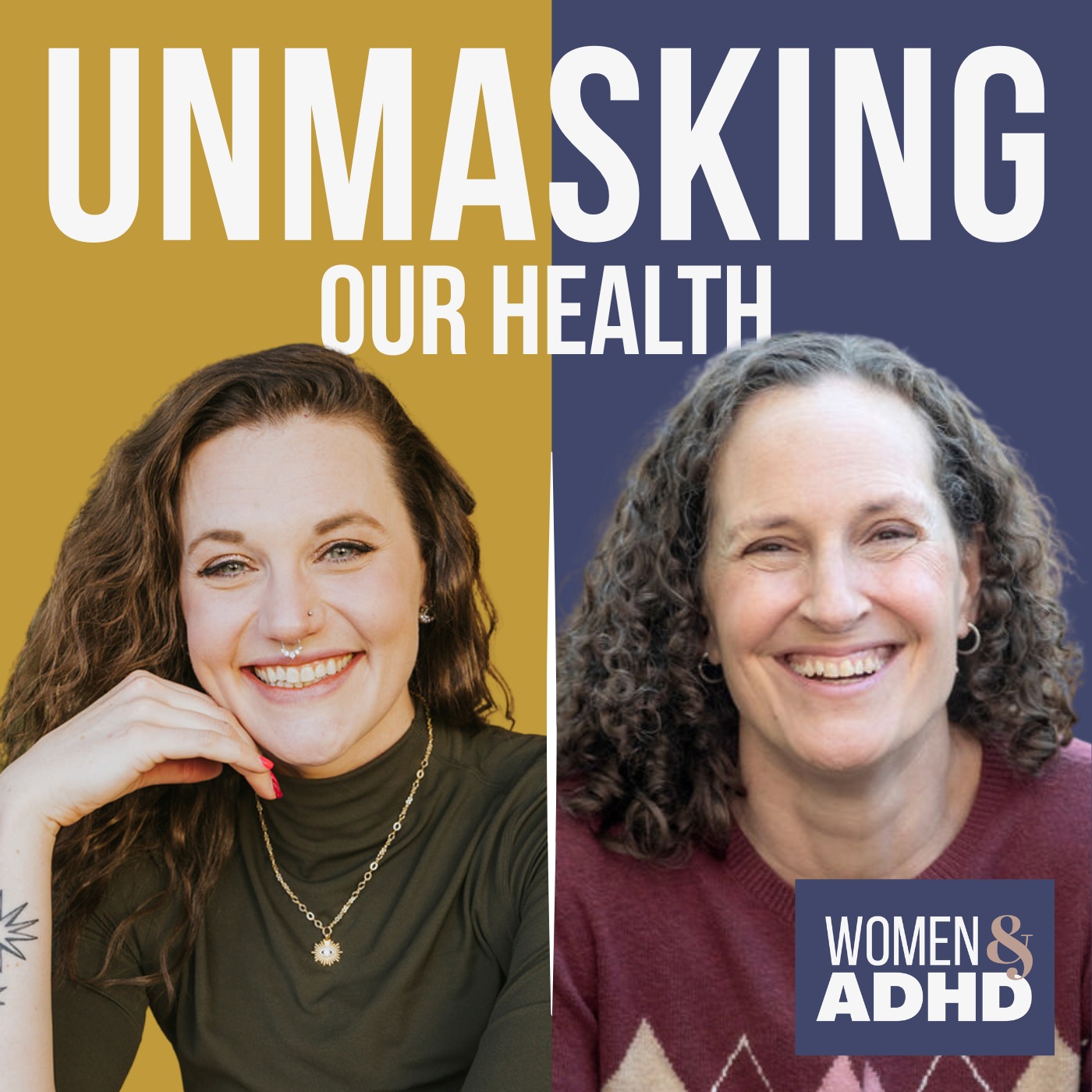
Unmasking Our Health: Hypermobility & hypermobile Ehlers-Danlos syndrome (hEDS), Part 1
About This Episode
Episode 215 with Katy Weber & Kalin Johnson
Welcome back to our new series, “Unmasking Our Health,” in which host Katy Weber teams up with medical expert Dr. Kalin Johnson, PharmD, to look beyond the neurodivergent brain and explore what it means to live in a neurodivergent body.
After years of interviewing late‑diagnosed women and seeing the same patterns — chronic pain, fatigue, autoimmune issues, hormonal chaos, gut problems, “mystery” symptoms — Katy created the Unmasking Our Health series to explore the bigger questions behind neurodivergence: What if ADHD isn’t just about our brains, but about our whole bodies — and how and why is the medical system missing the full picture?
In part one of a 2-part series, we unpack hypermobile Ehlers-Danlos syndrome (hEDS) and hypermobility, and why these connective tissue conditions so often show up alongside ADHD and autism. This episode focuses on the lived experience, the diagnostic gray areas, and the body-wide symptoms that can look unrelated until you understand the connective tissue thread running through them.
We discuss how hypermobility is different from flexibility, why the Beighton score can miss real cases, and why symptoms like bruising, pain, dizziness, brain fog, and poor stamina often get mislabeled as “just clumsiness” or “just anxiety.”
In this episode, we cover:
- The difference between hypermobility spectrum disorder and hypermobile EDS, including the extra diagnostic criteria for hEDS beyond joint laxity
- Kalin explains the difference between flexibility and hypermobility using the rope-versus-bolts analogy
- The Beighton score is helpful as a screening tool, but it only checks five joints and can miss people whose hypermobility shows up elsewhere, especially with age
- Kalin shares her diagnosis story, including years of worsening symptoms, specialist dead ends, and being told it was mental health before the physical pattern was recognized
- We discuss why ADHD and autism appear more often in hypermobile people, with possible shared genetics, connective tissue differences in the brain, autonomic nervous system dysregulation, and altered sensory processing
- The connections between hEDS and POTS, orthostatic intolerance, fatigue, GI symptoms, interoception differences, mast cell issues, and inflammation
- Common real-life clues like “party tricks,” joint pain in yoga, easy bruising, weak grip, poor stamina, and the feeling of being “a creaky old lady” after sitting too long
- Why car rides, standing still, and long periods of upright posture can be especially hard because of blood flow, proprioception, and joint instability
- Why some people with hEDS need more numbing medication at the dentist, and why urinary leakage, pelvic floor fatigue, and foot pain can all be part of the same connective tissue story
- Practical next steps: track symptoms, document family history, protect joints and autonomic function, and look for a provider or physical therapist familiar with hEDS
Note: Nothing in this episode constitutes medical advice. Always consult with your physician and pharmacist before starting, stopping, or changing any medication.
Kalin’s website: kalinjohnson.com
Instagram: @kalinpharmd
Links & Resources:
- NYT Magazine article: Inflammation Keeps Us Alive. It's Also Making Us Sick.
- ADDitude Magazine: Bendy Bodies, ADHD Brains: Connecting the Dots
- The Beighton Scoring System
- Hypermobility Screening Tool
- Growing Up with Ehlers-Danlos Syndrome: 27 Telltale Signs
- Have a topic you want Katy and Kalin to cover? Contact us
- - - - -
Episode edited by E Podcast Productions
- - - - -
Women & ADHD coaching: www.womenandadhd.com/coaching
- - - - -
Work 1-on-1 with Katy: www.womenandadhd.com/katy
- - - - -
Order the “Hey, it’s ADHD!” course: www.womenandadhd.com/adhdcourse
- - - - -
Did you love this episode? Click here to pledge a one-time donation to the podcast!
- - - - -
If you are a woman who was diagnosed with ADHD and you’d like to apply to be a guest on this podcast, visit womenandadhd.com/podcastguest.
Instagram: @womenandadhdpodcast
Tiktok: @womenandadhdpodcast
Twitter: @womenandadhd
Facebook: @womenandadhd
Advertising Inquiries: https://redcircle.com/brands
Privacy & Opt-Out: https://redcircle.com/privacy
[SPEAKER_00]: Executive functioning is going to depend on adequate blood flow, stable arousal, appropriate nor up in reference signaling. [SPEAKER_00]: So if every time you stand up, your nervous system releases adrenaline, your brain has to constantly adapt. [SPEAKER_00]: It's kind of like somebody trying to organize their desk while someone keeps pulling the fire alarm.
[SPEAKER_01]: Hello and welcome to the women and ADHD podcast. [SPEAKER_01]: I'm your host, Katie Weber. [SPEAKER_01]: I was diagnosed with ADHD at the age of 45, and it completely turned my world upside down. [SPEAKER_01]: I've been looking back at so much of my life. [SPEAKER_01]: School, jobs, my relationships, all of it with this new lens, and it has been nothing short of overwhelming. [SPEAKER_01]: I quickly discovered I was not the only woman to have this experience and now I interview other women who like me discovered in adulthood they have ADHD and are finally feeling like they understand who they are and how to best lean into their strengths both professionally and personally.
[SPEAKER_01]: Hello there, today I'm back in the studio with my co-host Dr. Kailin Johnson for another segment of unmasking our health. [SPEAKER_01]: A new series in which we look beyond the neurodivergent brain and explore what it means to live in a neurodivergent body. [SPEAKER_01]: In this episode we talk about what is up with hypermobility and hypermobile alers danlos syndrome and why are these
[SPEAKER_01]: We realize while recording this episode that there is a lot more to discuss about this particular topic, so consider this part one of two. [SPEAKER_01]: If you have a bendy body, or if you experience chronic joint pain, or both, or you're just curious about the connection between neurodivergence and connective tissue, I know you are going to love this one. [SPEAKER_01]: So buckle up, keep arms and legs inside at all times, and enjoy the ride. [SPEAKER_01]: We've got Caleb in the studio and we are back with another episode of unmasking our help.
[SPEAKER_01]: Now, first of all, before we get started, we had a lot of really great feedback from listeners, a lot of listeners reaching out, saying, you know, first of all, love this idea, which I'm grateful for because I, you know, [SPEAKER_01]: It was a risk. [SPEAKER_01]: Yeah, I love this idea. [SPEAKER_01]: But I, you know, wasn't sure how it was going to be received. [SPEAKER_01]: So gotten nothing but positive feedback and a lot of suggestions from people already asking about like, what's the deal with ADHD and Crohn's?
[SPEAKER_01]: What's the deal with ADHD and TMJ? [SPEAKER_01]: Bring it on. [SPEAKER_01]: we have a long list and are exactly right we're going to we're going to get into it and also just before we hit record we were talking about even this topic which we are going to talk about today this might end up being you know more than one episode as well because it is so much did you actually do you see the article in Times magazine this weekend about low-level inflammation no I haven't seen it yet [SPEAKER_01]: You know, it was an interesting article about low level inflammation and just this notion of like the way in which medical clinicians are trained is very siloed right is all based on expertise and developing that expertise and and so this was like much like this like discovery of meridians and fashion that the Western world is doing right now low level inflammation seems to be this new frontier of you know ways in which.
[SPEAKER_01]: disparate diseases are all coming under this umbrella and it was really interesting. [SPEAKER_01]: I didn't feel like they went deep enough. [SPEAKER_01]: They talked a little bit about GLP ones, but I don't think they talked enough about the brain and the connection between low-level information and executive functioning and ADHD, which is what we're talking about and what I'm most interested in, which is like [SPEAKER_01]: If we're developing low-level inflammation over the course of our lives through countless sources, how is that ending up with this whole population, especially of adult women who are experiencing executive functioning deficits?
[SPEAKER_00]: So, Ray, I mean, exactly, I think almost with every topic you and I end up talking about low-level inflammation is going to come out because it is such a driving force for all chronic disease. [SPEAKER_00]: And they even think about, like, myself, my own laps as an example. [SPEAKER_00]: So if you want to test for inflammation, the first test we use is the CRPC reactive protein. [SPEAKER_00]: And it tells us what that level of inflammation is. [SPEAKER_00]: Well, there's a number cut off for that, but that number cut off is what we use to really diagnose then autoimmune conditions.
[SPEAKER_00]: So there were not talking low lying inflammation there. [SPEAKER_00]: We're talking pretty high levels there. [SPEAKER_00]: But not even that long ago, I was in some flares of my, [SPEAKER_00]: Hi, I'm Roba Ellish, the analyst syndrome, which is what we're going to talk about today. [SPEAKER_00]: And my provider was like, you know what? [SPEAKER_00]: Let's just check your CRP again. [SPEAKER_00]: Let's see how your inflammation is. [SPEAKER_00]: And I got it back. [SPEAKER_00]: And while it didn't hit the autoimmune cutoff, I was like two points lower than that.
[SPEAKER_00]: Information you usually see in somebody who's like a chronic smoker. [SPEAKER_00]: who has a lot of obesity related diseases. [SPEAKER_00]: And we live our life, my wife and I, we try to do everything we can for our health. [SPEAKER_00]: And my doctor was like, everything looks good. [SPEAKER_00]: And I was like, girl, I was like, no, it doesn't. [SPEAKER_01]: It does not look good. [SPEAKER_00]: I think I was like, I get it. [SPEAKER_00]: I'm not, I have crossed the border to full blown out of immune disease yet.
[SPEAKER_00]: But I would like this to not be where it's at, but this is the thing, too. [SPEAKER_00]: It's like there's also so many different things in our world, not like, and I don't mean this like in conspiracy, like theory way, like with that. [SPEAKER_00]: But like if just like you said, we're collecting kind of these low levels of information through our life. [SPEAKER_00]: And our Western health care system has not known what to do. [SPEAKER_00]: with that, until again, you're in full blood autoimmune disease.
[SPEAKER_00]: But it really for me, kind of, was like, that kick in the butt to be like, all right, I got to really look at certain secondary conditions to HDS and making sure I get some tighter control. [SPEAKER_00]: And even just how I was addressing stress in my own life. [SPEAKER_01]: Yeah. [SPEAKER_01]: You just reminded me we should have an episode on how to read your blood labs because I feel like you schooled me on, you know, numbers that worked within normal range and our green instead of orange or red may not actually, you know, or may point to more information that your doctor might just like, and be like, it's all good.
[SPEAKER_00]: Yeah, our Western medicine tends to be with those. [SPEAKER_00]: It's like either, you know, are you dying? [SPEAKER_00]: Or are you not? [SPEAKER_00]: And that's kind of the separation in the cutoff. [SPEAKER_00]: But just because you're not in the red with it, it doesn't mean you're not okay or there's still not symptoms. [SPEAKER_00]: Um, and still not things that we can do to help improve that and improve your overall health too. [SPEAKER_00]: So you're right. [SPEAKER_00]: Another episode down the line, shout out if that sounds like something you want.
[SPEAKER_00]: I'm feeling like it probably is. [SPEAKER_01]: All right, but today we are, as you've said, we are going to be talking about hypermobility or hypermobile EDS, Aler Stanlos Syndrome. [SPEAKER_01]: I feel like it's, you know, having it's day in the neurodivergent community, I think there's a lot of research right now on a lot of awareness in terms of the correlation. [SPEAKER_01]: So I wanted to get into it. [SPEAKER_01]: I have a few basic like housekeeping
[SPEAKER_01]: Well, I know there are several versions of or several strains. [SPEAKER_01]: I guess you would call it of Ehler Stanless Syndrome EDS and hypermobile EDS or hypermobile. [SPEAKER_01]: Okay, first of all, what is the difference? [SPEAKER_01]: Is there a difference between hypermobility spectrum disorder and hypermobile EDS or are they the same thing? [SPEAKER_01]: difference. [SPEAKER_00]: So yes, so the difference really between these two, a big part of it was, you know, researchers trying to capture these two different groups of people.
[SPEAKER_00]: So we had people who were showing up with this classic joint hypervubility, which is the hallmark of AGDS. [SPEAKER_00]: is seeing the laxity in these joints. [SPEAKER_00]: But to have the diagnosis of each EDS, there are other criteria. [SPEAKER_00]: You have to meet that include things like there's different clinical presentations like having skin laxity, having things like a narrow palate, dental crowding, basically connective tissue issues showing up in other areas of the body or in other family members.
[SPEAKER_00]: So having first degree family members who meet the [SPEAKER_00]: um, and chronic joint pain. [SPEAKER_00]: So different things like that, you had to meet those as well to have that HDS diagnosis. [SPEAKER_00]: But if you only have the joint instability, hypervubility, piece of it, but you didn't meet that other criteria, researchers still wanted to capture that population, they then get the hypervubility spectrum disorder diagnosis versus the HDS diagnosis. [SPEAKER_01]: Okay. [SPEAKER_01]: And then also, what, I mean, I grew up my whole life just being like, I'm a flexible person with party tricks, right?
[SPEAKER_01]: And you know, double jointed style party tricks, which I think we'll get into more, but this idea of like, I'm just a flexible person. [SPEAKER_01]: I like yoga and I can do, you know, I can do all sorts of weird
[SPEAKER_00]: Yes, so flexibility is what your muscles can do, right? [SPEAKER_00]: And hypermobility is what your connective tissue allows you to do. [SPEAKER_00]: So what we think about, you know, like a gymnast may stretch into the splits because of muscle flexibility, but someone with HEDS may sit in the splits without ever stretching, like they can just fall into it. [SPEAKER_00]: Like, whoops, like, look at me, right? [SPEAKER_00]: Didn't have to work for this, this just happened. [SPEAKER_00]: AKA, pretty track.
[SPEAKER_00]: But what we want to think of as is muscles are like ropes and then ligaments are the bolts for the ropes. [SPEAKER_00]: So you can have [SPEAKER_00]: ropes that are tight attached to loose bolts. [SPEAKER_00]: So what are the things, too? [SPEAKER_00]: Like even for myself and I've encountered this with patients sometimes when I'm like, hey, like maybe we should think about HVS, like look into this for you, but they're like, but I'm not flexible, right? [SPEAKER_00]: So what can happen, too, is when the ligaments are so loose, because that's what's made up of connective tissue, those muscles try to overcompensate then for [SPEAKER_00]: the loose bolts themselves.
[SPEAKER_00]: So you'll get this weird mix of really flexible, but then also really tight, maybe in some areas, like for me, like my hips might turn out of my hips or extremely flexible. [SPEAKER_00]: My ligaments, girl, they do nothing there. [SPEAKER_00]: Like they're just like, buy, piece out, like Lucy Goosey. [SPEAKER_00]: My legs just turn out like crazy, but because of that, [SPEAKER_00]: My hamstrings have to do tons of extra work to try to keep my legs turned in all of the time. [SPEAKER_00]: So I was a dancer growing up, but I always felt like, which is a classic for HDS, we find ourselves inflexible, S-sports, but I always considered myself to be one of the least flexible of all my dancer friends, but a big part of that was because I had such tight hamstrings that we're trying to make up for where those lose ligaments.
[SPEAKER_00]: were. [SPEAKER_00]: So it's like muscles versus ligaments, flexibility versus high mobility, rope versus bolts. [SPEAKER_01]: I find that really helpful. [SPEAKER_01]: Yeah. [SPEAKER_01]: Okay. [SPEAKER_01]: So now I want to hear your story, you know, similar to a diagnosis story, which was like, how did you become aware of a hypermovalidious? [SPEAKER_01]: Because honestly, you were talking about it before I had heard anyone else. [SPEAKER_01]: about it in my own life. [SPEAKER_01]: You are the person you and Marnie actually, where the people who introduced me to it, but yeah, I'm just curious, like how how did you become aware?
[SPEAKER_00]: Yeah, yeah. [SPEAKER_00]: So this is one of those things that, you know, I had, like, in looking back, like, once I became aware of it, the diagnoses, I was like, whoa, okay, yeah. [SPEAKER_00]: Now all of these individual things that had been a little bit different or a struggle in my life, now all of a sudden made sense, but it wasn't until my symptoms, [SPEAKER_00]: just really show themselves very aggressively around my early thirties. [SPEAKER_00]: So these symptoms around HEDS, like for a lot of people, they may be at a level that are manageable, and then all of a sudden they weren't, right?
[SPEAKER_00]: So for some reason, that's a slow build of increased stressors over time. [SPEAKER_00]: What aging brings along, also increased weakening of connective tissue, hormonal changes. [SPEAKER_00]: And then for others, it can be a really drastic window of tolerance change, dependent on any sort of stressor catalyst. [SPEAKER_00]: So I became aware, then like I said in my early 30s, when there was, it was right on the time of COVID. [SPEAKER_00]: So like looking back, it also all makes sense.
[SPEAKER_00]: There was stress of early COVID days. [SPEAKER_00]: I can't confirm, but it was sick around that time. [SPEAKER_00]: very likely could have been COVID itself a viral stressor there. [SPEAKER_00]: A tons of big emotional stressors, Marty had just been diagnosed with multiple sclerosis. [SPEAKER_00]: I'd broken my foot. [SPEAKER_00]: I was on crutches, which was a big no-no for HDS, which cuts off blood flow. [SPEAKER_00]: We'll get into a kind of more of some of the symptoms later, but I had that going on.
[SPEAKER_00]: Um, I've been pushing my body. [SPEAKER_00]: I was running these like ultra like marathon races where I do like 50 miles over four days, which is terrible for an HDS body. [SPEAKER_00]: But I was putting my body under all of this stress and I started having just symptoms where like I was having terrible brain fog. [SPEAKER_00]: If I was standing for prolonged periods of time. [SPEAKER_00]: My vision felt like it would black out. [SPEAKER_00]: I couldn't think straight. [SPEAKER_00]: I couldn't find words.
[SPEAKER_00]: I was getting these like allergic reaction, ask symptoms where like my face would get all swollen. [SPEAKER_00]: And my eyes would and get tingling my mouth and burning in my gut. [SPEAKER_00]: And all these GI symptoms, yeah, bleeding, constipation. [SPEAKER_00]: You know, all these things, like, it filled my body with on fire. [SPEAKER_00]: My brain was on fire. [SPEAKER_00]: And nothing made sense. [SPEAKER_00]: So I went to my doctor who sent me to different specialists. [SPEAKER_00]: Everything was fine.
[SPEAKER_00]: Everything was fine. [SPEAKER_00]: must be your mental health. [SPEAKER_00]: I've never heard that one before, right? [SPEAKER_00]: Shocker. [SPEAKER_00]: So that's where I got sent. [SPEAKER_00]: And same thing, they were like, yep. [SPEAKER_00]: And that's where they first originally gave me the diagnosis of borderline, borderline personality disorder. [SPEAKER_00]: And I was like, in part of it was because I was definitely though, like, no, you guys don't get it. [SPEAKER_00]: Like, you don't get it.
[SPEAKER_00]: Like, something's not right. [SPEAKER_00]: Something's not okay. [SPEAKER_00]: Finally, I found myself with some mental health providers. [SPEAKER_00]: who were like, yeah, no, this doesn't make sense. [SPEAKER_00]: This looks physiological, not mental. [SPEAKER_00]: Like, we have to look at what comes first, right? [SPEAKER_00]: The chicken or the egg. [SPEAKER_00]: Wonderful PCP, but she was kind of at a loss for what to do. [SPEAKER_00]: So I was just doing my own research. [SPEAKER_00]: And at that time, I'd come then give it a diagnosis by my mental health professionals of ADHD and autism.
[SPEAKER_00]: And I was looking up different conditions that were common in that population of where there was maybe connections. [SPEAKER_00]: And I came across. [SPEAKER_00]: Ella Stanley of Syndrome and Hyper Mobility. [SPEAKER_00]: And I was looking at it and I was like, oh my god, everything, everything all of a sudden starts to make, it's starting to make sense. [SPEAKER_00]: And I took it to my primary care physician. [SPEAKER_00]: I'll never forget it. [SPEAKER_00]: She looked at it. [SPEAKER_00]: She was Kayla and this is you.
[SPEAKER_00]: And I just like burst into tears. [SPEAKER_00]: And she then got me into the geneticist to be evaluated and was able to go through diagnostic process.
[SPEAKER_00]: You know, low and behold, that's the diagnosis they received, which you kind of alluded to this. [SPEAKER_00]: But, you know, there are 13 different strains of genetic variations of L.S. [SPEAKER_00]: Danlos syndrome. [SPEAKER_00]: Hibernability is the only one. [SPEAKER_00]: We don't have the genetic marker for. [SPEAKER_00]: We do for the other 12. [SPEAKER_00]: They are all differentiated by genetic variations that cause differences in different collagen, collagen is a big part of what makes up connective tissue, but we actually have 28 different types of collagen.
[SPEAKER_00]: So that's why things show up a little bit different. [SPEAKER_00]: We have these different kinds, but that genetic testing came back normal for all of those. [SPEAKER_00]: And so it's kind of a ruling out deal and that the clinical symptoms for the others. [SPEAKER_00]: And so [SPEAKER_01]: Yeah, you came out of the rabbit hole with what I find just super I mean for me I think it's one of the more concrete connections between the brain and the body when we talk about the neurodivergent.
[SPEAKER_00]: nervous system, right? [SPEAKER_01]: Is this connective tissue and very early on? [SPEAKER_01]: I think you had said if you can't connect the issue, uh, the connective tissue, right? [SPEAKER_01]: That's it. [SPEAKER_01]: In terms of those of us who have been walking around or, you know, most of our lives with these medical mysteries, this seems like it really does answer a lot of questions. [SPEAKER_01]: And I want to get into the checklist, too, of the EDS checklist, because that was that sort of moment that I had that blew my mind, similar to ADHD.
[SPEAKER_01]: where I was like you have to be kidding me. [SPEAKER_01]: What does this have to do with connective tissue? [SPEAKER_01]: And I kind of just want to go through the list with you and have you answer like what does this have to do with connective tissue? [SPEAKER_01]: Because for me it was so mind-blowing and I also thought there were so many of these things that I had experienced throughout my life that I just assumed were my own fault. [SPEAKER_01]: Yeah, so basically for my standpoint, I had, you know, with somebody who was always very flexible, but also experience a lot of joint pain throughout my life starting, you know, in my 20s and 30s and thought will yoga is the answer to my joint pain.
[SPEAKER_01]: and I was also naturally kind of flexible and good at it, but I would also have these moments where I would be doing something too deep. [SPEAKER_01]: I wouldn't really kind of like know what my limits were, and I would go into a pose too deeply, and I would injure myself. [SPEAKER_01]: And that was sort of a normal experience to me where I was like, did I just dislocate my shoulder in this pot? [SPEAKER_01]: I'm not sure, but I would like end up having a lot of flare ups and pain, and [SPEAKER_01]: never really understood it was just sort of like okay don't go too deeply into it but hadn't really put two and two together and then i was working with your wife marney uh who is a personal trainer and i was working with her virtually and she started to see in me these like ways in which i could [SPEAKER_01]: can tort my body I guess a little more than some of her typical clients and I think she started to put two and two together and I was also constantly complaining about joint pain in my shoulders and my hips and that's when she kind of tipped me off to looking into it and [SPEAKER_01]: I guess when I started working with you was when I had, I don't remember what the order of everything, but it was really like taking that the hypermobile self test, which I'll put links to in the show notes, because there's the hypermobile and hypermobile spectrum disorder self test, and then there's also the signs you grew up with EDS self test, which blew my mind.
[SPEAKER_01]: again here i am i'm somebody who used to have party tricks either it was the so we haven't talked about the bechtel test to which i guess we could kind of talk about where is it bechtel no was it called bain bain sorry bechtel who's bechtel oh that's the female movie one right yeah [SPEAKER_01]: The Baton score, which is sort of the typical hypermobileDS score that, you know, most practitioners use right now, but not terribly not 100% like I personally at my age at the age of almost 52 would not pass this test.
[SPEAKER_01]: I would have in my younger days. [SPEAKER_01]: I did a lot of these things. [SPEAKER_01]: I had a lot of, um, [SPEAKER_01]: the, you know, being able to touch your wrists or your thumb to your forearm, those kinds of things I used to be able to do, but now I'm a creaky old lady and I can't do any of them. [SPEAKER_01]: So I don't know if I would pass the Baton score today. [SPEAKER_01]: So what are your thoughts on the Baton score? [SPEAKER_00]: Yeah, so the bait and the score, my thoughts aren't great because we're literally, we just picked, we just picked five joints.
[SPEAKER_00]: I feel like Willie Nillie to say, like, let's look at these five joints. [SPEAKER_00]: Is this person overly flexible in these five joints? [SPEAKER_00]: If you are, yeah, you get the time, we're looking deeper into the diagnosis and if you don't, then we're not, but it's only looking at these five joints. [SPEAKER_00]: So again, it doesn't always show up similarly. [SPEAKER_00]: It said, mine, my hips. [SPEAKER_00]: were a huge one for me for other people. [SPEAKER_00]: They may not have that in that area at all.
[SPEAKER_00]: So we look at the knuckle of the pinky finger on both hands. [SPEAKER_00]: We look at the base of both thumbs. [SPEAKER_00]: We look at the elbows. [SPEAKER_00]: We look at the knees. [SPEAKER_00]: We look at the spine. [SPEAKER_00]: So and just like you said too, you know, as we get older and if we also have more injury to those joints, that tends to go away, too. [SPEAKER_00]: We don't have that same range of motion there.
[SPEAKER_00]: a perfect score. [SPEAKER_00]: You get point for each joint that you get that positive result for. [SPEAKER_00]: So we're looking for a score of five out of nine is a positive baton score amount, and then for children, so pre-puberty, a six out of nine, and then if you are over 50, four out of nine. [SPEAKER_00]: So they tailor it just a little bit for that, but overall it's, yeah, it's not great at capturing. [SPEAKER_00]: that group. [SPEAKER_00]: So, I know there are a lot of conversations.
[SPEAKER_00]: I know actually at the L.A. Stanless conference this year that just happened about like a week ago, a big part of the conversation was about changing and figuring out how do we change the clinical guidelines, how do we change the diagnostic criteria to actually capture this group in a, you know, one of the most challenging things is
[SPEAKER_00]: because connective tissue is found literally everywhere in the body, the array of symptoms that can pop up is huge. [SPEAKER_00]: So how do you also create a diagnostic criteria that could be repeatable by physicians in clinics all over to be able to capture this population? [SPEAKER_00]: And it is a more challenging diagnosis to be able to do that for, but Baton's war is not really it. [SPEAKER_01]: Yeah. [SPEAKER_01]: So I guess all of that to say is that Baton scores usually where you start, but if you don't feel like you're passing it with flying colors, it's not necessarily an indication that this is not, you know, that you should stop looking into this.
[SPEAKER_00]: Exactly.
[SPEAKER_01]: So I want to go over the the science you grew up and some of these like seemingly disparate mind blowing yes to biology but also like I guess before we get into that I wanted I want to have you explain like what is the correlation between connective tissue and [SPEAKER_01]: neurodivergence. [SPEAKER_01]: How is an especially autism? [SPEAKER_01]: Like there's like a 50% correlation rate or something like I was like random, you know, I was looking at the studies just in preparation for this conversation and was again just like, what is happening?
[SPEAKER_01]: Why would somebody with a neurodivergent brain have connective tissue issues? [SPEAKER_00]: Yep. [SPEAKER_00]: Yes. [SPEAKER_00]: Yes. [SPEAKER_00]: Let's talk about it. [SPEAKER_01]: And just to say, I have had Caleb explain this to me at least twice before. [SPEAKER_01]: And I still don't understand. [SPEAKER_01]: So this is for my benefit, but also if you don't understand it, need to read this into this episode. [SPEAKER_01]: Don't feel bad because that's how I feel a lot of this time when I'm talking to Caleb.
[SPEAKER_00]: That's okay. [SPEAKER_00]: It's a lot, it's because it is real-life system and multi-factorial. [SPEAKER_00]: Like that's a thing too with all of HEDS patients. [SPEAKER_00]: It's never one thing, right? [SPEAKER_00]: It's always like multiple things going on because multiple systems. [SPEAKER_00]: And again, our brains, especially in Western world and Western medicine, are taught to silo things. [SPEAKER_00]: And that's not how this condition works. [SPEAKER_00]: So you're right, that is one of the most fascinating findings that we have over the past decade, is that ADHD and autism are occurring more frequently and people with hypermovility, then we'd expect by chance, right?
[SPEAKER_00]: Clearly, it's not chance here. [SPEAKER_00]: So we don't think it's one necessarily causes the other. [SPEAKER_00]: Instead, we think that they may be share some underlying biology. [SPEAKER_00]: So most obvious, the most intuitive place to start is shared genetics, right?
[SPEAKER_00]: is that some of those same genes that influence connective tissue development, inflammation may also influence brain development. [SPEAKER_00]: So we know that connective tissue proteins are not only found in the joints, but they're found all over the brain, including the extracellular matrix, which is basically what helps the developing brain build those neurons, where those neurons are like, [SPEAKER_00]: where to go, basically, when to stop and how to form these different networks.
[SPEAKER_00]: So, if connect with tissue biology is going to be altered, it's not unreasonable then to think that brain development is also going to be altered as well. [SPEAKER_00]: So, if you're building a city, you're going to build roads and buildings together all the same time, but if that infrastructure changes early on, traffic patterns are going to change too. [SPEAKER_00]: that system is built different. [SPEAKER_00]: So we've got that hard. [SPEAKER_00]: So along with that again we got this connected tissue difference in the brain and another interesting hypothesis is there's also differences in the glimphatic system which basically depends on normal connected tissue architecture to move fluid around and waste clearance while we're sleeping.
[SPEAKER_00]: So this hasn't been specifically established
[SPEAKER_00]: Now, the big dog here is going to be the autonomic nervous system. [SPEAKER_00]: So, the autonomic nervous system is basically that bridge between the body and the brain. [SPEAKER_00]: So, people with HDS have higher rates of things like a pot, potural or the satire tapacardic syndrome. [SPEAKER_00]: Basically, you're your pressure in your body blood pressure. [SPEAKER_00]: Heart rate has a hard time adjusting when you change in different body positions. [SPEAKER_00]: For the static intolerance, hyper-adjudic state.
[SPEAKER_00]: So pumping out more of an effort and cortisol at just seemingly small stressors, temperature dysregulation, GI disability. [SPEAKER_00]: Now, think about ADHD. [SPEAKER_00]: Executive functioning is going to depend on adequate blood flow.
[SPEAKER_00]: appropriate nor up in reference signaling. [SPEAKER_00]: So if every time you stand up, your nervous system releases adrenaline, your brain has to constantly adapt. [SPEAKER_00]: It's kind of like somebody trying to like organize their desk while someone keeps pulling the fire alarm. [SPEAKER_00]: The executive function challenges are still ADHD, but autonomic instability can amplify them. [SPEAKER_00]: So I think often too, like, you know, in school, if you've got like a kiddo who's sitting at their desk and they can't [SPEAKER_00]: and they have brain fog and they're wanting to get up and run around is it just simply only dopamine seeking or other other also underlying physiological like mechanism saying that like no I'm not getting out of the blood flow to my brain and the best way to do so is through movement is not sitting in a position that's causing blood flow to pool in my lower extremities.
[SPEAKER_00]: So we've got that
[SPEAKER_00]: The tear assumption is basically how well your brain senses what's, you know, happening inside of your body. [SPEAKER_00]: So things like hunger, thirst, you know, bladder fullness, heart rate, temperature, pain, fatigue, all these things. [SPEAKER_00]: We know many autistic and ADHD individuals have differences in tear assumption. [SPEAKER_00]: So people with HDS often do too. [SPEAKER_00]: Well, why is this? [SPEAKER_00]: Well, possibly because we have these differences in connected tissue, they're found in Macano receptors.
[SPEAKER_00]: Autonomic dysfunction is going to alter those internal signals. [SPEAKER_00]: Chronic pain is going to change how we process those signals. [SPEAKER_00]: So imagine if you're receiving fuzzy information all day, it becomes harder to know. [SPEAKER_00]: Am I anxious? [SPEAKER_00]: Am I dehydrated? [SPEAKER_00]: Am I over-simulated? [SPEAKER_00]: Do I need to eat? [SPEAKER_00]: Am I about to faint? [SPEAKER_00]: Right? [SPEAKER_00]: So we've also got immune dysregulation. [SPEAKER_00]: That's really kind of one of the last year, you know, big ones that we think about connection here too.
[SPEAKER_00]: So we're a lot of HEDSers also have mass cell disorders. [SPEAKER_00]: And they have autoimmune diseases and they have chronic inflammation. [SPEAKER_00]: So neuroimmune interactions are increasingly recognized as well in the ADHD and autism research. [SPEAKER_00]: And those mass cells, cytokines, and inflammation signaling, all influence brain development. [SPEAKER_00]: So that doesn't mean inflammation causes ADHD or autism, but what it does mean is the immune system and the nervous system are communicating constantly.
[SPEAKER_00]: And the brain doesn't live in isolation. [SPEAKER_00]: There's actually some really interesting research around autism. [SPEAKER_00]: and mass cells in histamine that some of those genetic changes that warrant autism also change histamine of signaling to the point where histamine can build up in the brain. [SPEAKER_00]: So when you have these mass cells that are just destabilized and you've got these dumps of histamines, you're going to be more likely to see neuropsychiatric symptoms like overstimulation that are actually because
[SPEAKER_00]: which leads me to the last thing of connections here, which is that altered sensory processing. [SPEAKER_00]: So we know people with ADHD and autism frequently have those sensory sensitivities, difficulty filtering, maybe information, and heightened awareness of some sensations. [SPEAKER_00]: So now you put HDS on top of it, and you need proprioceptive input. [SPEAKER_00]: P proprioceptive input is the body decently communicating back to the brain, where we in space and time, like what's happening.
[SPEAKER_00]: and proprioceptive input comes from joints, which is going to be less precise because girly, you don't have bolts, right? [SPEAKER_00]: Like, like events are relaxed. [SPEAKER_00]: So everything's really nilly and the brain, the body, you're like, where are we? [SPEAKER_00]: So that autonomic input is more variable. [SPEAKER_00]: Pain signals are going to be more frequent. [SPEAKER_00]: The stibular input may be different, and the brain has to integrate all of that. [SPEAKER_00]: So it's kind of like your brain is trying to [SPEAKER_00]: where several of those instruments are slightly out of tune.
[SPEAKER_00]: The music is still happening, but it takes way more effort to try to make sense of it. [SPEAKER_00]: So, [SPEAKER_00]: The brain isn't just reacting to the world, it's constantly trying to predict what's going to happen next. [SPEAKER_00]: And it's using all of those different parts of the body, all made of a connected tissue to create this internal model of the body. [SPEAKER_00]: Those inputs are noisy or less reliable because of connected tissue differences. [SPEAKER_00]: I don't know if it's in civility, altered sensory processing.
[SPEAKER_00]: The brain has to work harder to update its predictions and so that can contribute to fatigue since we overload and a heightened sense of the body being unpredictable. [SPEAKER_00]: Not a short answer, but
[SPEAKER_01]: no, not at all. [SPEAKER_01]: I zoned it out a little bit here and there so that's no, it's super. [SPEAKER_01]: I love when you geek out, I'll just let you go. [SPEAKER_01]: But no, one of the things that has been really helpful for me, just in terms of that connection and I'm going to make the connection joke all the time in this episode. [SPEAKER_01]: But like this, the connection between like a lot of these, you know, similarities
[SPEAKER_01]: right and it's like oh do I bruise easily because I'm really clumsy and I bump into things and I have poor proprioception, yes, but also do I bruise easily for other reasons like like really getting to the why behind why are these why are these like similar traits among a lot of people in our population and is it just [SPEAKER_01]: like your clumsy because you're distractable because you have ADHD or is there something more about the proprioception part which was like when you when you were talking to me about my fear of heights and we were like getting really clear on like I'm not afraid of heights when I'm like on a bridge but I'm afraid of heights when I have to stand on a chair.
[SPEAKER_01]: And like what's that about and you started talking about my own trust in my wobbly joints that was like mind blowing to me where it was like it's true like where you were kind of like are you afraid that like there's just sort of this lifetime of lack of trust of is my ankle going to give out is my knee going to give out that I'm going to fall off this very small, you know, height as opposed to like it's not actually the height is the fear of your own bodies. [SPEAKER_01]: inability to like hold you up and that was like I was like oh that makes so much sense when we are talking about proprioceptive, you know, differences.
[SPEAKER_00]: Right, so like what I'm looking for in women like that is like, okay, if I put you in like a like an airplane or like you're in a gaundala or something like going up a mountain does that scare you a lot of those women will be like, no, that's okay, but right, like, but I stand on the edge of a big ledge or something or it's slippery out like it rained all the sudden now I have this fear of heights for a falling. [SPEAKER_00]: There's actually a research study about women and increase fear of falling in the hypermobile population.
[SPEAKER_00]: I love that they've even done research about that. [SPEAKER_00]: But yeah, you're exactly right. [SPEAKER_00]: It's that trust and joint. [SPEAKER_00]: So you've got then again the brains getting this fuzzy proprioceptive information. [SPEAKER_00]: So back to like your point about bruising. [SPEAKER_00]: So we are more likely than to bump into walls, bruise, roll ankles, trip. [SPEAKER_00]: You know, hold on to too much tension trying to stabilize that has nothing to do with, like, forgetfulness or if not focusing, but also kind of have to do with that as well.
[SPEAKER_00]: Again, amplifying that to you. [SPEAKER_00]: And then you add in that our capillaries and our tissues are made up of connected tissues. [SPEAKER_00]: You have more fragile capillaries, they're more likely. [SPEAKER_00]: to burst, to bruise, to lead less tissue support, so more likely to rip, to have injury to it, and just more accidental impacts. [SPEAKER_00]: So it's all of the above. [SPEAKER_01]: Mm-hmm. [SPEAKER_01]: Yeah. [SPEAKER_01]: Okay, so let's go over this checklist. [SPEAKER_01]: So the first one was extraordinary flexibility, which I think we talked about just in terms of like, did you, when you were growing up, did you have little party tricks?
[SPEAKER_01]: My famous party trick was that I could take my arm and wrap it around my head and touch my ear, [SPEAKER_00]: more, but I could only do it. [SPEAKER_01]: I could touch my earlobe and grab onto it and I could only do it with one arm and nobody can understand and every time I would freak people out when I would do it and they'd be like, what's happening? [SPEAKER_01]: How are you able to do that? [SPEAKER_01]: And I like made up a story that I dislocated my shoulder on the uneven bars and gymnastics, which I've never done.
[SPEAKER_01]: I've never been on it. [SPEAKER_01]: So, but like I have told people over the course of fighting the young life that that's how I did that, which I also think is so weird and I'm kind of maybe reflect on it therapy, [SPEAKER_01]: But it was that weird that I felt the need to make up a story about why I could do it, which hopefully is relatable to somebody out there, but okay, so that is a side where you able to do these sort of strange quasi dislocating, you know, people who can like, you know, hold hands and step through your arms backwards or those kinds of things like stuff like that.
[SPEAKER_01]: where you're really thinking about more of the joint than you are the muscle in terms of flexibility. [SPEAKER_01]: That's really helpful for me because it's true. [SPEAKER_01]: That's what I used to do. [SPEAKER_01]: And now, look at me, I'm old and I have like miserable shoulders and hips. [SPEAKER_00]: Yeah. [SPEAKER_01]: Yeah, okay, so then the next one is easy bruising, which is like heavy, you know, do you bruise Lee have you always kind of brushed it off as clumsyness, but then there's also like you said the connection with capillaries and like do you bruise for longer or is it does it take longer for your wounds to heal or healing?
[SPEAKER_01]: So is that similar in terms of just like that the thin skin, creepy skin? [SPEAKER_01]: What does the thinness of skin have to do with connective tissue? [SPEAKER_00]: Exactly. [SPEAKER_00]: So we have collagen and connected tissue makes up again the skin there too. [SPEAKER_00]: So like if that is again more prone to injury weaker. [SPEAKER_00]: it tends to also take longer for it to also do a job in healing. [SPEAKER_00]: In addition to like, it makes it easier for you to like injure it again.
[SPEAKER_00]: So like, I actually have, I don't know if this was a partying trick, but extreme tissue fragility. [SPEAKER_00]: This was not the joint part, but it was something though that like stood out to everyone around me and even like friends and things like that that had really soft skin. [SPEAKER_00]: Everyone always wanted to like touch my skin, stroke my arms like I would have friends like do it and be like, oh my god Like what a first-minute morning. [SPEAKER_01]: She was like how was your skin so soft and I was like I don't know and I'm like it's my it's my disease She was like one lotion to you use right exactly.
[SPEAKER_00]: She was like, ooh And I'm like I just use regular lotion, but yeah, like I we've been on the rowing team and my coaches didn't know what to do with me because [SPEAKER_00]: my hands were just like open wounds all the time from the rubbing on the or and they were like oh you're hands with you so everybody's hands with you so that's what my never got used to it and it would take forever to heal in between that time because that connective tissue just is so lacks I always think of it like if if you're thinking of like a like a tight matrix like if you could see me listen or sorry about it [SPEAKER_00]: like my hands right now like if I put them together really really tight there's not much space between but that connective tissue one now let's kind of bring those fingers apart a little bit more and you see there's just the holes and opportunity again for for weakness and just a little bit more difficult for that to rebuild.
[SPEAKER_01]: Well, and I'm curious as a, as a, as a rower, like, one of the things on this list is poor hand strength and poor grip, is that something that you, you felt connected to in terms of like holding your pencil weird, like was that I don't know if I held my pencil weird. [SPEAKER_01]: Maybe I don't feel like it did, but I definitely remember back in my day pre internet like getting the huge callus on my finger from like the from, but I don't feel like that was terribly unusual. [SPEAKER_00]: So that may have been again for you in those hands and finger joints, may not have been some against some of the more relaxed or weaker ones where you had it in other areas.
[SPEAKER_00]: Like, I had like a death grip on like my pencil and Marty always tells me. [SPEAKER_00]: Yeah, I definitely do the death grip, huh? [SPEAKER_00]: And so that was a bit more, I guess, in rowing. [SPEAKER_00]: So you have to, they call it feathering the ore, where when you bring the ore out of the water, you flip it so then it's parallel with the ground. [SPEAKER_00]: So you don't, they call it catching a crab. [SPEAKER_00]: where the organs grab by the water, and grow, or really get ejected from the boat.
[SPEAKER_00]: Girl, it's no joke. [SPEAKER_00]: Like, you get thrown out of a fire or, right? [SPEAKER_00]: Yeah. [SPEAKER_00]: So, but there were times, where I get other people seem to be fine, and I think literally couldn't feather it anymore. [SPEAKER_00]: I had no strength left in my hands in my forearms, but one of the things that and I'm trying to, I think it may be on this list too, but one of the things that's a common in
[SPEAKER_00]: we get really really good at ignoring pain or pushing through pain or discomfort, extremely high pain tolerance. [SPEAKER_00]: So while that was the case, it was no big deal for me. [SPEAKER_00]: I'd been accommodating those things and figuring out how to do it my whole life and had been called even by some people like on the road team. [SPEAKER_00]: They were like, oh, like, I was like, I was like, I was like, I liked it, but I was like, I didn't like it, but I didn't have any other choice, but to try to figure out how to [SPEAKER_00]: Like do the things I wanted to do would be like everyone else.
[SPEAKER_00]: with this body that didn't have that same stamina, and didn't have that same ability to be chill while doing these things, everything was tight and tension. [SPEAKER_01]: Right, and that was something I had to work through with Marny when I first started working with her, which was like, I had a lot of fear around weightlifting and weight training because I felt like I was very difficult for me to know if I was using two heavy weights, and I would injure myself in a burdenly,
[SPEAKER_01]: be doing something wrong. [SPEAKER_01]: Like I, you know, really need somebody to be watching me and helping me out and making sure that I had that accountability, but just like I felt like I was always very afraid of injuring myself or dislocating something or, you know, pulling out of joint, and still do like the weight train. [SPEAKER_01]: I think like heavy weight lifting really still
[SPEAKER_00]: which is again a valid fear that we have because we are more prone to injury. [SPEAKER_00]: So we do have to be really careful in finding that balance of just because we can do it. [SPEAKER_00]: Does it mean we should like within our bodies? [SPEAKER_00]: Like there's a kind of a pulling back of certain, to recognize, oh, that's the sign to stop and pull back. [SPEAKER_00]: And that's actually what I find is like so important for us when it does come to things like we lifting, because we lifting though is really helpful for us with HDS.
[SPEAKER_00]: good muscle around those joints helps do some of the job that those lacks ligaments can't do for us. [SPEAKER_00]: But we also don't want to be so built up and so tight then that there's now again this tightness, this stiffness there. [SPEAKER_00]: So it's kind of this [SPEAKER_00]: little, like, in between world, but you kind of alluded to this too, but a lot of HDS are sent carry a lot of shame and embarrassment about their bodies too of feeling like maybe called things like dramatic or lazy, um, because their subjective experience with their body around, like, fitness and doing fitness related things wasn't what other people were experiencing.
[SPEAKER_00]: I know I had that, especially when I had very young age, I'd get really dizzy [SPEAKER_00]: in gym class and was so comfortable and really shungled to do it and felt like it was kind of like, what's wrong with you? [SPEAKER_00]: Like, you're nine. [SPEAKER_00]: Like, you can do a bear call. [SPEAKER_00]: You're not dizzy. [SPEAKER_00]: Like, you're not, you know, 75, like what? [SPEAKER_00]: But like, I'm responding that way. [SPEAKER_00]: And I didn't know what to do it other than height it and figure out how to push through it, which was what made me a really good athlete then for a while and tell my body completely broke down under that.
[SPEAKER_01]: Yeah, yeah. [SPEAKER_01]: So yeah, that brings me to the endurance and stamina question, which was holding your arm up in class or running in gym is exhausting. [SPEAKER_01]: And I was like, I feel like that's the typical kid pose of like holding your arm up, but then using your other, you know, have been raising your hand in class, but then using your second arm to hold up your elbow was like a classic feeling of like, I can't do this for very long. [SPEAKER_01]: Or like you were saying, like, I think also just stamina relate to this idea of just kind of fits and starts of like going too fast and then burning out, you know, burning through and then losing, you know, like consistency is never been a strong suit.
[SPEAKER_01]: So, but also like you said, just not really knowing how to ease into things. [SPEAKER_00]: completely and not understanding then to even, you know, one of the things you mentioned to and like working with marketing with the like physical trainer or personal trainer is even understanding then am I using those correct muscles or ever am I compensating with other muscles? [SPEAKER_00]: So HDSers tend to because we do have weakness in our joints. [SPEAKER_00]: to compensate with other things again or like squeeze everything which is going to cause again way more fatigue way quicker so like if you have let's say the kid holding their hand up you have instability in your elbow you have instability in your shoulder you're having to use way more muscles and way more energy to even hold that arm up.
[SPEAKER_00]: And then we also have issues to get back to the blood flow part of it. [SPEAKER_00]: So our veins are arteries and our capillaries are all made up of connected tissue too. [SPEAKER_00]: And they're like lymph noodles. [SPEAKER_00]: Like if you had a straw and you're, you know, sucking liquid up it, you want that straw to be firm. [SPEAKER_00]: You want it to be easy. [SPEAKER_00]: If you do that, you don't have to suck very hard. [SPEAKER_00]: But if you try to like suck water up a lymph noodle, you'd have to suck pretty hard to get that to happen.
[SPEAKER_00]: What is it doing like is it making the joints work over time and is it making blood flow try to work over time if it is you're using way more energy without energy really even there to do the work that you want it to do hence why you're not going to be able to do things for as long as maybe others are without a lot of work.
[SPEAKER_01]: All right, so just come for it on long car rides definitely makes a little more sense looking through this notion of sitting together for you know sitting still can cause hip and back pain and also that feeling of getting up from a long car ride and getting out of the car and being like when did I turn into a 95 year old person like that feeling of I am not old enough like I'm in decent shape I should not be feeling this kind of [SPEAKER_01]: when I get out of a car and that kind of seems to help with that feeling of like okay it's what is it just like the staying stable for too long that's really what's happening there.
[SPEAKER_00]: Yeah, a couple different reasons. [SPEAKER_00]: So again, one batch of the blood flow. [SPEAKER_00]: So often again, we're sitting in cars. [SPEAKER_00]: We're sitting in a upright seated position where our feet are down on the floor. [SPEAKER_00]: And again, our body, our best positions for us is basically where it's not having to work against gravity. [SPEAKER_00]: So it's called a zero gravity position. [SPEAKER_00]: We're like your head, shoulders, knees, feet are all like about at her level, right?
[SPEAKER_00]: But if you're upright, that's number one going to have to work against gravity. [SPEAKER_00]: feet down on the ground, chair cutting into the back of your legs, even harder for things to work against gravity. [SPEAKER_00]: Constant vibrations in a car as well can really irritate and again throw off the body's like proprioception. [SPEAKER_00]: Trying to balance in a car trying to hold joints and things stable. [SPEAKER_00]: as well as specific pressure on the SI joint. [SPEAKER_00]: You're safer early after joint down there, kind of about the top of your bum, like that there that's prolonged seated position can really irritate that joint.
[SPEAKER_00]: Or like a lot of people have similar to me, are the hip issues where the hips turn out and so your body is constantly either trying to hold them in so you're using vessels too or if you're like me, you don't, you just frog like it all the time, but basically when I'm sitting in that position, [SPEAKER_00]: Then my hips are overextending that entire period of time. [SPEAKER_00]: So one little trick for you, HDS without there. [SPEAKER_00]: If you do have a lot of, you feel really stiff when you get out.
[SPEAKER_00]: You have some of that hit or lower back issue. [SPEAKER_00]: You can take one of the little like therapists and wrap it around your knees. [SPEAKER_00]: while you're sitting in a prolonged position so you've got a flight, you're on a car, right? [SPEAKER_00]: And that therapy end will do the job for your legs to hold them together. [SPEAKER_00]: So you don't feel quite as achy when you get up to walk again. [SPEAKER_01]: Ah, okay, that's cool. [SPEAKER_01]: Yeah, I saw that on Instagram a while ago.
[SPEAKER_01]: I saw something talking about that. [SPEAKER_01]: It made sense to me because I think we do that by crossing our legs, right? [SPEAKER_01]: Which is like, you know, I feel like if you see somebody who's crossed their legs and then they like cross their ankle back up, [SPEAKER_01]: I'm like, that's pretty much a diagnosis right there, but like, oh, yeah. [SPEAKER_01]: I think crossing our, you know, if you have a really hard time not crossing your legs and sitting in that kind of proper upright position or like they always told us like, you know, be Prim and proper and only cross your ankles and I was like, I can't do that like they really can.
[SPEAKER_01]: Yeah. [SPEAKER_01]: Okay. [SPEAKER_01]: That makes sense. [SPEAKER_01]: That's why that's kind of a hack there for car rides. [SPEAKER_01]: Now the one, okay, there was two of them that blew my mind. [SPEAKER_01]: The first one was what's the injections when you're getting like a cavity filling. [SPEAKER_01]: Oh, like, light a cane, light a cane, yeah, so basically do you feel like you never get enough numbing agent when you are having dental surgery or does and for me, I always felt like yes, I never feel like the first dose is enough.
[SPEAKER_01]: I always have to ask for more and I always just sort of had this like internalized fat phobia around the fact that they were giving me the lady dose and I probably am way more than what they're [SPEAKER_01]: typical doses and so I had to ask for more, which is like such a fucked up thing to think anyway in the first place. [SPEAKER_01]: But it really blew my mind that this is like a pretty common, you know, sign of weekend connective tissue. [SPEAKER_01]: And so what is that? [SPEAKER_01]: What's happening in the gum there?
[SPEAKER_00]: Yeah, so a lot of it isn't even necessarily in the gum, but has to do a lot more with like central nervousism processing. [SPEAKER_00]: And so when we're looking at, especially when it comes to again injections, we're not necessarily talking about ultra-direct metabolism, which is also a thing that we struggle with because of GI disability, so this one being an injection. [SPEAKER_00]: So, [SPEAKER_00]: are paid signals tend to be dialed up. [SPEAKER_00]: So we have higher paid responses rather than just specific like tissue damage, making any sort of like standard localized painkillers much less effective.
[SPEAKER_00]: Plus, then you have frequently co-occurring with this, again, like dysadonomia, right? [SPEAKER_00]: So, like, this dysregulation of the autonomic nervous system. [SPEAKER_00]: So, if we're in any sort of stressful environment, we are more likely to have bursts of neurodegenergic activities, or our body dumping nor up enough for an incord as all, things like that, which make those, again, like, not work as well. [SPEAKER_00]: If your body is, like, basically, in this, like, high stress state that kind of, like, cancels out a lot of what that medication is trying to do.
[SPEAKER_01]: Yeah. [SPEAKER_01]: And then the other one was, you know, do you peel it when you sneeze, which I as somebody who had kids was kind of like, that's just what happens. [SPEAKER_01]: What do you have kids? [SPEAKER_01]: I probably didn't do enough cables. [SPEAKER_01]: But no, it doesn't have to do with cables. [SPEAKER_01]: It has to do with the connective tissue basically struggling to hold your bladder, which is my version. [SPEAKER_01]: You tell the
[SPEAKER_00]: Yes, yes, great, so like pelvic floor dysfunction and like all of these different issues great. [SPEAKER_00]: So again, happens after you have kids and sometimes and this was me it happened to me even like when I was in my teens. [SPEAKER_00]: It was like a thing my volleyball team knew that like when we were having to go do any sort of like jumping exercise and I was like jumping jack. [SPEAKER_01]: I was like jumping jack. [SPEAKER_01]: Yeah, I dread them. [SPEAKER_00]: I would always be like, Caitlyn's going to go to the bathroom, sorry guys, I'll come back out and do them, but I'm going to go make sure I have an empty bladder, otherwise I'm going to pee my pants, like, and I'm like 15, like, great.
[SPEAKER_00]: I'm going to have kids at this point, so like, which now it's even worse, but right. [SPEAKER_00]: So everything there, I think of it kind of like, all of our organs are just like Lucy Goosey, like connected to Shew also holds everything up right and where it's supposed to be. [SPEAKER_00]: So even like our internal organs are just like, [SPEAKER_00]: like just like lived like noodles, right? [SPEAKER_00]: So everything is just like weaker there. [SPEAKER_00]: And then you have the part with again, the pelvic floor piece of it, too, where ours are already having to work over time.
[SPEAKER_00]: And when you think about pelvic floor issues, and you're trying to like hold the bladder, it's not as much about that that area's weak, it's that it's having to work constantly. [SPEAKER_00]: So it is super, super tired and fatigued, and that makes it more difficult for it to basically do a job adequately. [SPEAKER_00]: So even me, I was having it really bad post having my baby and again, they sent me to the physical therapist, and she was like, you're like, [SPEAKER_00]: Keyholes and all of those things that they basically test for, I think, nice little lecture like up your bum to like see like that you are doing it when you're supposed to be doing it and have strength in it, she's like your textbook and I'm like, if I'm textbook even post baby why am I still paying my pants then right.
[SPEAKER_00]: Well, because of this connective tissue issue, I've got all of this stuff working against me. [SPEAKER_00]: My pelvic floor just extra has to work over time to try to hold everything together, and then even the pressure of like internal organs, then like even dropping down, pushing down on that as well, just causing that issue. [SPEAKER_00]: It's just how to do it more work. [SPEAKER_01]: Oh, you know, as you were talking, you were just reminding me of this like frequent experience.
[SPEAKER_01]: I would have like in Chavassana, which was, you know, you're sort of like be conscious about releasing and relaxing your whole body. [SPEAKER_01]: So Chavassana and yoga is like at the very end where you're relaxing your whole body. [SPEAKER_01]: And I would have to like relax my whole body. [SPEAKER_01]: And then if I would stop thinking about relaxing my whole body, I would notice that it wasn't relaxing anymore. [SPEAKER_01]: And I would have to continue like I still like I have to be very conscious about
[SPEAKER_01]: relax my whole body and it doesn't remain in that state. [SPEAKER_01]: It just slowly kind of coils back up again, unless I'm being really intentional about it. [SPEAKER_01]: Yeah. [SPEAKER_00]: So I always think of HDSR. [SPEAKER_00]: It's almost like our physical body has PTSD, right? [SPEAKER_00]: It's constantly in a guarding state. [SPEAKER_00]: It's constantly in a, like, but remember that one time, like we were really loose. [SPEAKER_00]: And that thing happened. [SPEAKER_00]: Like we should probably be tight all around here.
[SPEAKER_00]: It's common that like each of you guys don't take big deep breaths because big deep breaths expand the ribs. [SPEAKER_00]: And we may have, you know, dislocated or had rib pain or back pain. [SPEAKER_00]: So we tend to like guard all these different areas. [SPEAKER_00]: But the thing is that actually isn't helpful. [SPEAKER_00]: It actually can lead you more likely to be injured in. [SPEAKER_00]: those areas. [SPEAKER_00]: So like keeping those things tight. [SPEAKER_00]: So I always think of that.
[SPEAKER_00]: Like, I'm from the Midwest, from Kansas, tornado alley. [SPEAKER_00]: And there were always, you know, stories of like people who survived being in tornadoes. [SPEAKER_00]: And generally, again, they were, you know, one people who'd like passed out being thrown. [SPEAKER_00]: But if you're passed out and your body's all limp, when you're thrown and you fall, you are less likely to be injured. [SPEAKER_00]: Again, they say, [SPEAKER_00]: If you're, you know, rollerblading and you fall, don't try to put your arm out to catch yourself.
[SPEAKER_00]: When you guard it and you put it tight, you're more likely to cause injury and your body basically can't take that impact, then if everything is tight. [SPEAKER_00]: So we're more prone to injury because of the joy we have. [SPEAKER_00]: And then we're extra more prone to injury because of guarding and this like physical PTSD that we carry around that actually doesn't even allow our body to take much impact because we are holding everything so tight all the time. [SPEAKER_01]: All right, we are definitely going to have to do a part two on this because I don't feel like we've been talked about like who are the experts who just scratched the surface I know and well not only that because that's a really difficult one too, which is like how do people even understand it I even suggested to my ENT at one point, you know, how much do you know sir about hypermobile EDS and it was like no, no, no, you couldn't possibly have it because you would have vascular issues and I'm like, well, first of all I do, but also like.
[SPEAKER_01]: You know just the misconceptions out there in the in the clinical field right now and like who are the people that you would even see But so basically there's this I'll put links in the show notes to I guess the hypermobile test and the EDS self test just as a place to start if for somebody who's like holy crap [SPEAKER_01]: This feels like something I might be experiencing because even like, you know, the one thing like, you know, walking on tipto right, especially with kids right that was another one that I was like a lot of autistic kids that sort of a giveaway right, which is they walk on tipto and I always felt that that was like a sensory thing, but what's the connective tissue part there what's what's that about.
[SPEAKER_00]: Yeah, so two different things there that tend to be happening one is feeling instability or pain in the feet. [SPEAKER_00]: So again, there's so many joints in the feet. [SPEAKER_00]: And so it's also really common that EGISers have really high arches or flat arches, but have a lot of feet pain. [SPEAKER_00]: And again, instability, but when you're up on your toes, you kind of avoid then that intense like movement of the foot that would put your joints possibly in more injury-prone issue or test those legaments.
[SPEAKER_00]: I used to bruise. [SPEAKER_00]: My feet just walking all the time from basically pulling ligaments in the inside and the outside of my feet where I started walking with my feet rolled out all the time because I would always have ligament issues on the inside of my feet. [SPEAKER_00]: But toe walking is one way that can do that. [SPEAKER_00]: The other is it causes your calves to be in a constant tight state which helps blood flow. [SPEAKER_00]: So one of the signs, too, that some HES which we'll have is overdeveloped calf muscles.
[SPEAKER_00]: Because the calves are one of the main areas that are helping to pump the blood from the lower half of the body [SPEAKER_00]: to the upper, if you stand up on your toes, keeps your calves in a constant compressed state, kind of like again, like compression stockings and be really helpful for us, but it helps again to get that blood flow up to our brain. [SPEAKER_01]: Okay. [SPEAKER_01]: Yeah, I think we can officially call this part one of at least two so because I know you have to go and I feel like there's so much more to talk about so stay tuned everyone will get into a little bit more next time about what to do and also just kind of like how the best ways to treat and care for your body because it's not.
[SPEAKER_01]: Sometimes what you think it is. [SPEAKER_01]: So I think we can get into that and more, but this is so fascinating. [SPEAKER_01]: Is there anything like the we should have in the show notes you think that's yeah. [SPEAKER_00]: So the things that I'll kind of say here to you know, if you end up only like hearing this episode too that kind of put a bow here is like. [SPEAKER_00]: What I usually tell patients next steps if you think this may be you, start documenting your symptoms, start documenting what you're experiencing, even seemingly things that maybe don't relate.
[SPEAKER_00]: Again, the big part with HEDS is helping to figure out, like what's the story the body is telling us here, right? [SPEAKER_00]: So start documenting your symptoms, document your family history related to this as well. [SPEAKER_00]: But again, you can use the two resources. [SPEAKER_00]: You put the 23 signs and the checklist as well. [SPEAKER_00]: to start with those and then start projecting your joints and automatic autonomic nervousism now. [SPEAKER_00]: Like, you don't have to wait to do that to get diagnosed.
[SPEAKER_00]: And that's something we can talk about next time, but that's not always easy to do. [SPEAKER_00]: But you can start learning and thinking about ways that you can start protecting both of those things. [SPEAKER_00]: And then it's finding a provider who's familiar with HEDS. [SPEAKER_00]: That's easier said than done. [SPEAKER_00]: But if you can start with your primary care physician, see what they know, use resources in your area. [SPEAKER_00]: You can use things like the L or Stanley of Society.
[SPEAKER_00]: We can put a link to that as well in the show notes. [SPEAKER_00]: They have lists of providers who are EDS aware. [SPEAKER_00]: You may be able to find local pages on Facebook or things like that, EDS and hypermobility support groups for dysadonomia organizations. [SPEAKER_00]: For another great place to like to have patients start is if you can find a physical therapist maybe who specializes in hypermobility in your area and sometimes those providers then can send you to other ones they know.
[SPEAKER_00]: Don't be discouraged if the first answers you get or I don't know or this could be. [SPEAKER_00]: This isn't emphasized in a lot of medical training for physicians. [SPEAKER_00]: So unfortunately that's really common but you're looking for a team not a hero. [SPEAKER_00]: for this, unfortunately, which there was a hero for it, but start tracking symptoms, start looking, start now. [SPEAKER_01]: All right, well stay tuned, and again, thank you so much. [SPEAKER_01]: This has been a wealth of information as usual.
[SPEAKER_01]: So thank you, Kaylin, and until next time,
[SPEAKER_01]: There you have it! [SPEAKER_01]: Thank you for listening and I really hope you enjoyed this episode of the Women and ADHD podcast. [SPEAKER_01]: If you'd like to find out more about me and my coaching programs, head over to women and ADHD.com. [SPEAKER_01]: If you're a woman who was diagnosed with ADHD and you'd like to apply to be a guest on this podcast, visit women and ADHD.com slash podcast guest and you can find that link in the episode's show. [SPEAKER_01]: Also you know we ADHD are great feedback.
[SPEAKER_01]: And I would really appreciate hearing from you, the listener. [SPEAKER_01]: Please take a moment to leave me a review on Apple Podcasts or audible. [SPEAKER_01]: And if that feels like too much and I totally get it, please just take a few seconds right now to give me a five-star rating. [SPEAKER_01]: Or share this episode on your own social media to help reach more women who [SPEAKER_01]: maybe have yet to discover and lean into this gift of neurodivergency and they may be struggling and they don't even know why.
[SPEAKER_01]: I'll see you next time when I interview another amazing woman who discovered she's not lazy or crazy or broken but she has ADHD and she's now on the path to understanding her neurodivergent mind and finally using this gift to her advantage. [SPEAKER_01]: Take care till then!
 Apple Podcasts
 Castbox
 Castro
 Goodpods
 Moon FM
 Overcast
 Pocket Casts
 Podbean
 Podcast Addict
 Podcast Republic
 Spotify