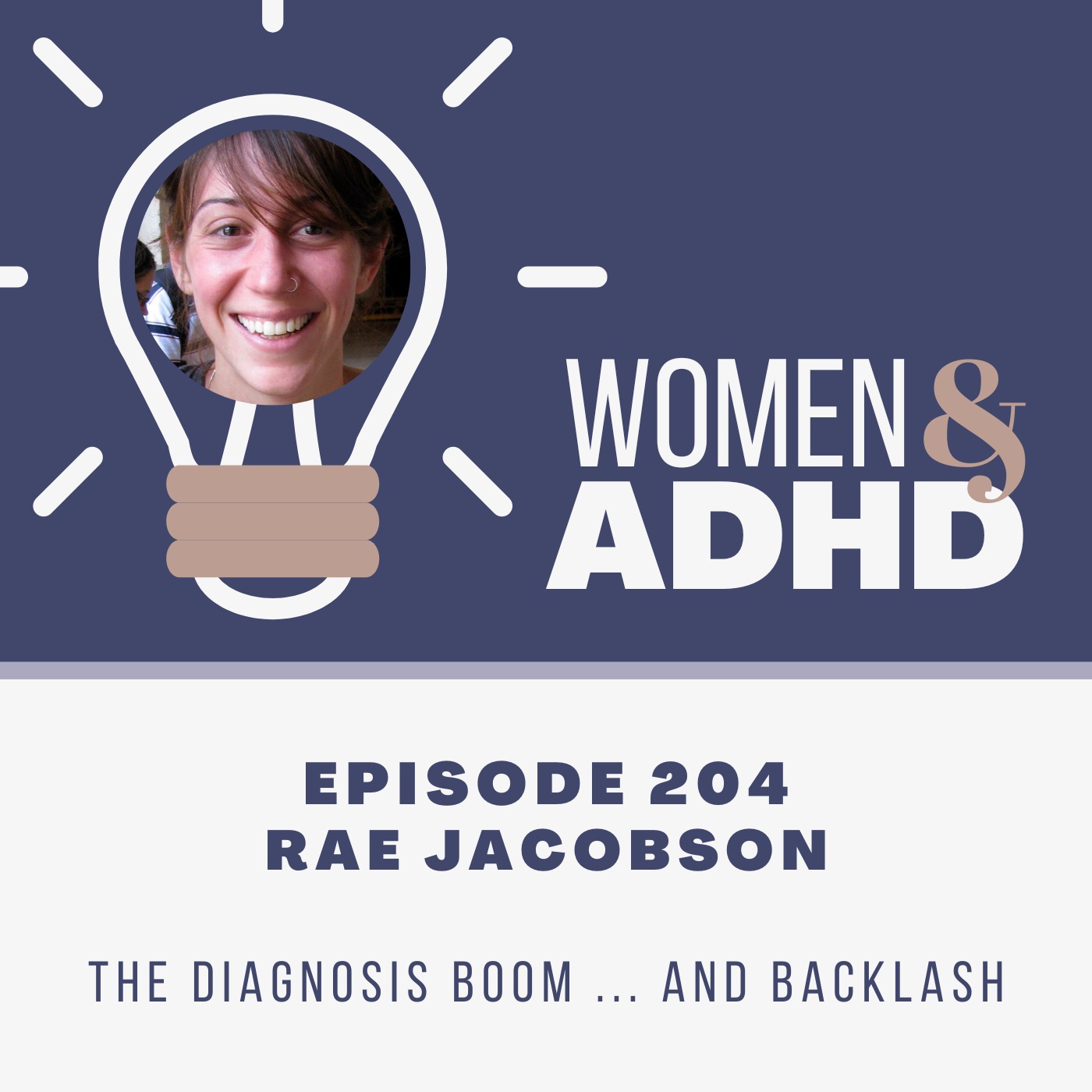
Rae Jacobson: The diagnosis boom … and backlash
About This Episode
Episode 204 with Rae Jacobson.
“There is a difference between traits and impairment. If we dilute the idea of ADHD into something that just seems familiar, we risk shutting out the people who really need help.”
Rae is a journalist, an ADHD and learning disorders expert, and the Lead of Insight at Understood, where she also hosts the podcast Hyperfocus. Rae has spent over 20 years digging into the stories and science of neurodivergence. She’s a former senior editor at the Child Mind Institute, and her work has appeared in New York Magazine, the Daily Beast, Rolling Stone, Parenting, American Girl, and more.
Rae and I talk about her very winding path to an ADHD diagnosis: growing up as the “smart kid who did terribly at school,” getting diagnosed with LD-NOS, dyscalculia, and dysgraphia, and then finally, in her early 20s, realizing she has ADHD. Rae shares the life-changing experience of attending Landmark College — a school specifically for students with ADHD and learning disabilities.
We also wrestle with the current ADHD discourse: the difference between relatable traits and true impairment, what happens when “everyone has ADHD,” and why that can both broaden awareness and quietly shut people out of care. We talk about internalized ableism, the ongoing cycles of skepticism (“quit your whining”) and backlash online, and the need for voices that pair lived experience with journalistic fact-checking.
And of course, we talk about Hyperfocus, Rae’s podcast at Understood that zeroes in on what fascinates us most about ADHD, mental health, and learning.
Website: Understood.org
Instagram: @understoodorg
Links & Resources:
The Berkeley Girls with ADHD Longitudinal Study (S. Hinshaw)
- - - - -
Episode edited by E Podcast Productions
Find the transcript of this episode at www.womenandadhd.com/transcripts
- - - - -
Women & ADHD coaching: www.womenandadhd.com/coaching
- - - - -
Work 1-on-1 with Katy: www.womenandadhd.com/katy
- - - - -
Order the “Hey, it’s ADHD!” course: www.womenandadhd.com/adhdcourse
- - - - -
Did you love this episode? Click here to pledge a one-time donation to the podcast!
- - - - -
If you are a woman who was diagnosed with ADHD and you’d like to apply to be a guest on this podcast, visit womenandadhd.com/podcastguest.
Instagram: @womenandadhdpodcast
Tiktok: @womenandadhdpodcast
Twitter: @womenandadhd
Facebook: @womenandadhd
Advertising Inquiries: https://redcircle.com/brands
Privacy & Opt-Out: https://redcircle.com/privacy
[SPEAKER_02]: All I wanted was just to be able to fit in with my friends. [SPEAKER_02]: You know, it wasn't that I was such a joiner, but like, I just wanted to be the person who wasn't in trouble. [SPEAKER_02]: And that's a really powerful thing. [SPEAKER_02]: And so when people tell you you need help, and you can see very clearly the consequences when you don't get to help or accept the help, it doesn't make you feel like, wow, I'm worthy of like this support. [SPEAKER_02]: It makes you feel like, I guess without this, I can't do it.
[SPEAKER_02]: I hope now, and I hope this isn't changing in our current situation, [SPEAKER_02]: the way that we talk about all of this is pretty different than it was when I was a kid.
[SPEAKER_00]: Hello and welcome to the women and ADHD podcast. [SPEAKER_00]: I'm your host, Katie Weber. [SPEAKER_00]: I was diagnosed with ADHD at the age of 45, and it completely turned my world upside down. [SPEAKER_00]: I've been looking back at so much of my life. [SPEAKER_00]: School, jobs, my relationships, all of it with this new lens, and it has been nothing short of overwhelming. [SPEAKER_00]: I quickly discovered I was not the only woman to have this experience, and now I interview other women who like me discovered in adulthood they have ADHD, and are finally feeling like they understand who they are and how to best lean into their strengths, both professionally and personally.
[SPEAKER_00]: Hello, hello, hello, you are in for a fantastic episode today, but before we get started, I want to remind you that wherever you are on your ADHD journey, women and ADHD.com has the resources to meet you where you're at. [SPEAKER_00]: If you're in learning mode, we have tons of free support, downloadable infographics, comprehensive guides, and our recommendations for self-assessments for women, and of course more than 200 episodes of this podcast. [SPEAKER_00]: If you're looking for more structure but you need flexibility, our self-led course called, hey, it's ADHD is a great next step you can take at your own pace.
[SPEAKER_00]: And if you're ready for more personalized help, our ADHD coaching team is here for you with strength space support to help you move past the overwhelm and feel more like yourself again. [SPEAKER_00]: just head to women and ADHD.com. [SPEAKER_00]: Whether you're dipping a toe in or you're ready for deeper guidance, take what you need when you need it. [SPEAKER_00]: We're here for you whenever you're ready. [SPEAKER_00]: Again, that's women and ADHD.com. [SPEAKER_00]: Okay, here we are at episode 204 in which I interview Ray Jacobson.
[SPEAKER_00]: Ray is a journalist, an ADHD and learning disorders expert and the lead of insight at understood where she also hosts [SPEAKER_00]: Ray has spent over 20 years digging into the stories and science of neurodivergence. [SPEAKER_00]: She's a former senior editor of the Child Mind Institute and her work has appeared in New York magazine, The Daily Beast, Rolling Stone, Parenting, American Girl, and more. [SPEAKER_00]: Ray and I talk about her very winding path to an ADHD diagnosis. [SPEAKER_00]: Growing up as the, quote, smart kid who did terribly at school, getting labeled with learning disorders like dyscalculia and dysgraphia, and finally in her early 20s ADHD.
[SPEAKER_00]: Ray shares the life-changing experience of attending landmark college, a school specifically for students with ADHD and learning disabilities. [SPEAKER_00]: And we also discuss the current ADHD discourse, and the difference between relatable traits on TikTok and true impairment. [SPEAKER_00]: We also talk about this notion that everybody has ADHD now, and why widening the neurodivergent umbrella can both broaden awareness and quietly alienate others. [SPEAKER_00]: We talk about internalized abalism, the ongoing cycles of skepticism, and backlash online, and the need for voices that pair lived experience, [SPEAKER_00]: with journalistic fact checking.
[SPEAKER_00]: And of course we talk all about hyperfocus, race podcasts, and understood that zeros in on what fascinates us most about ADHD, mental health, and learning. [SPEAKER_00]: So here's my conversation with Ray, enjoy. [SPEAKER_00]: Hi Ray, thank you for being on Women in ADHD, it's so nice to have you. [SPEAKER_00]: Hi, Katie, thank you so much for having me. [SPEAKER_02]: I'm really excited to be here. [SPEAKER_00]: So I understand that you were diagnosed with dyscalculia as a child, and then you were later diagnosed with ADHD, right?
[SPEAKER_02]: Right, yeah. [SPEAKER_00]: And so I'm most curious, I mean, I've had guests who have been diagnosed with some sort of neurodivergent learning disorder in childhood, and then later were diagnosed with ADHD. [SPEAKER_00]: I'm curious from your point of view, being diagnosed in your early 20s, what was happening around that time? [SPEAKER_00]: that made you or the people around you think, okay, maybe this is actually ADHD or maybe ADHD is also in the mix. [SPEAKER_02]: So I, you say I diagnosed with dysgoculia as a kid, which is sort of true, but when I was really diagnosed, it was, and I think probably a lot of our listeners might have experienced something similar if they're close to my age, and female LDNOS.
[SPEAKER_02]: So learning disability not otherwise specified, because I had what we now feel very familiar about, but at the time, [SPEAKER_02]: very verbal, very chatty, very performed well in terms of like, oh, that's a smart kid, you know, that was a thing I was good at, and did terribly at school. [SPEAKER_02]: I mean, weeping over homework, all the classic signs. [SPEAKER_02]: And then I do have Descalculia, and at that point, still sort of were not sure, like it seemed like I should be doing better, you know, the discrepancy between ability and aptitude [SPEAKER_02]: For example, my SAT score was an 800 on the verbal and a 300 on the math, which you get for writing your name correctly.
[SPEAKER_02]: It was pretty clear, but I also had dysgraphia and some sort of spatial stuff that was a little bit complicating, I think, for folks and the ADHD got kind of lost in that bog, I think. [SPEAKER_02]: And so for a long time, [SPEAKER_02]: I thought I didn't have ADHD, despite occasionally trying medication for it and being like really like if you were to write down all of my ADHD symptoms you'd be like oh that is a person within an incentive ADHD like there's nothing about this that is unusual or unexpected like textbook.
[SPEAKER_02]: But in the 1980s girls have ADHD and an incentive ADHD really wasn't something that we talked about in the way we do now as you well though. [SPEAKER_02]: So it wasn't until I was 21 and I had failed out of college and I had gone to multiple high schools and I was just dipping my toes sort of back in the water of education after doing much of crummy jobs and sort of wandering the wilderness for a while. [SPEAKER_02]: At the school called landmark college, have you ever heard of that?
[SPEAKER_02]: No, it's a sort of an unusual place but it might be interesting to the people who are seeing your show. [SPEAKER_02]: It's a school that is just for students with learning disabilities. [SPEAKER_02]: Vermont, okay, yeah. [SPEAKER_02]: Lovely, beautiful, Vermont. [SPEAKER_02]: There's hills, it's very nice. [SPEAKER_02]: As a New Yorker, I was like, it's beautiful here, wow, that's trees everywhere. [SPEAKER_02]: So, very excited to be in Vermont, but I learned about it by genuinely sheer luck.
[SPEAKER_02]: My mom, who also has ADHD, had gone to a school called Windham College in Vermont that shut down. [SPEAKER_02]: I think because they led you to have both bombs and dogs in the dorm, so that didn't come out. [SPEAKER_02]: It became landmark in the 1980s and it was just for kids with ADHD and specific learning disabilities then and now they cover kids on the spectrum and it's a poor college but when I went it was two years and I just was looking for any lifeline. [SPEAKER_02]: I was so sort of deep in the bell jar and just wanted to know where does it go?
[SPEAKER_02]: Like how do I get out of this? [SPEAKER_02]: we went up to see the school and they, who was like a revelation I had never heard people talk about learning differently. [SPEAKER_02]: I had never heard people talk about ADHD. [SPEAKER_02]: It was completely new to me. [SPEAKER_02]: You know, it had just been adults telling me what was wrong with me before. [SPEAKER_02]: It was the first time I met her people my own age. [SPEAKER_02]: speak about it at all. [SPEAKER_02]: And so I went there and I saw one of the, you know, they have coaches there and I talked to one of them and they said, she said, you don't think you have ADHD and I said, no, you know, no, they told me that I did.
[SPEAKER_02]: She said, oh, you definitely do. [SPEAKER_02]: Like you should definitely go get tested. [SPEAKER_02]: So I went finally, you know, at home, saw, got the full battery of tests. [SPEAKER_02]: And the woman again said basically the same should no one ever tells you of ADHD. [SPEAKER_02]: I said, no, [SPEAKER_02]: and I burst into tears because I was so relieved to finally know what this was. [SPEAKER_02]: Goodbye then, I kind of understood about ADHD. [SPEAKER_02]: I'd see my friends who had it and I could be like, God, it sounds like me, but I guess it's not because they would have told me by now.
[SPEAKER_02]: And of course not, so that was my sort of diagnosis, aha story. [SPEAKER_02]: It was this sort of maybe not the big light bulb, but a rambling kind of like, you know, like in horror movies where the [SPEAKER_02]: The lights light up as they walk down the corridor. [SPEAKER_00]: It was more like, I love that visual. [SPEAKER_00]: I mean, honestly, I feel still think a lot of the time there's that rambling way to the diagnosis. [SPEAKER_00]: And then also, even post diagnosis, a lot of what I think we both talk about on our podcast of like, [SPEAKER_00]: What even is this?
[SPEAKER_00]: Why is there such stigma still? [SPEAKER_00]: You know, why does it feel like everybody is suddenly has ADHD and right and why do people keep rolling their eyes still right like it feels like suddenly it felt like it was this answer to all of my [SPEAKER_00]: of seemingly random struggles over the course of my life, but now there's this new pushback about like, oh, for crazy, like what you're whining and, you know, like I don't feel like that inner voice that internalized ableism magically went away.
[SPEAKER_00]: It's just changed, it's tone. [SPEAKER_02]: Yeah, it sounds like we're like the internet now, right?
[SPEAKER_00]: So you've been a journalist for, I guess, how many years at this point? [SPEAKER_00]: I don't think it's bizarre at all. [SPEAKER_00]: I feel like journalism was filled with people with ADHD. [SPEAKER_02]: No, no, I just, I was like, God, am I old enough to have been a journalist for 20 years? [SPEAKER_00]: But I always say, okay, because I often, I'm like, you know, I find that most of us have like, we meet, right? [SPEAKER_00]: It's like every two years you kind of shift to a different place or a different job or different, like I've been so many different jobs at this point.
[SPEAKER_02]: What was your strangest job? [SPEAKER_02]: What was your, I'm always interested in this, what best were people of ADHD? [SPEAKER_02]: What's the weirdest job you've ever had? [SPEAKER_00]: I mean, I would say the weirdest job I've ever had was I was a weight watcher's leader. [SPEAKER_00]: Wow. [SPEAKER_00]: That's a good one. [SPEAKER_00]: Which kind of got me, and so it was basically like, we had moved from the city up to the Hudson Valley, and I was a stay at home mom because I really struggled with my first kid in the city and was sort of like, if we ever have another kid, I'm gonna have to be in a situation where I'm a stay at home mom.
[SPEAKER_00]: It wasn't easier, spoiler alert. [SPEAKER_00]: It was actually hard in a whole new way, but this was all pre-diagnosis. [SPEAKER_00]: So anyway, I was like a stay at home mom for many years and trying to do as many, [SPEAKER_00]: You know, just fill my life with things and ended up at Weight Watchers and then ended up becoming a Weight Watchers leader. [SPEAKER_00]: It's not something I talk about very much right now because I feel like I should have a t-shirt that said, I went to Weight Watchers and all I gave me was this binge eating disorder.
[SPEAKER_00]: But it led to me being, I say, that would do well. [SPEAKER_02]: I know, right? [SPEAKER_02]: It's not a good idea. [SPEAKER_02]: That t-shirt. [SPEAKER_02]: I feel like a lot of people would buy that yet. [SPEAKER_00]: But we watchers and then the fall, you know, the binge eating disorder that came from weight watchers led me to becoming a health coach, an anti diet health coach. [SPEAKER_00]: And it was really interesting when I got my ADHD diagnosis looking back and being like, binge eating, okay, right?
[SPEAKER_00]: That's high comorbidity. [SPEAKER_00]: Yeah, sure, high comorbidity. [SPEAKER_00]: I wanted to go back and talk to all my old health coaching clients and be like, guess what, we all have ADHD, right? [SPEAKER_00]: Yeah, hey, but I'm curious from somebody [SPEAKER_00]: pre-pandemic I guess like for me it's like there's pre-pandemic and post-pandemic in terms of ADHD landscape it's how I understand it because I always diagnosed right at 20 in 2020. [SPEAKER_00]: As you've been watching it with the curiosity of a journalist what do you think about [SPEAKER_00]: the way that we are talking about it now.
[SPEAKER_00]: I mean, it must, like, for me, it feels like I was diagnosed, it's kind of like moving to a new neighborhood in New York, right? [SPEAKER_00]: Where it's like, you get to a new neighborhood and automatically, it's like, it peaks in coolness right as you're there, and everybody who comes after words, it's just like a Johnny Cummiley. [SPEAKER_00]: Yeah, it's like, [SPEAKER_02]: Yeah, I know you're in. [SPEAKER_00]: Right, but I feel that way sometimes about my own ADHD diagnosis where I'm like, I had diagnosed with ADHD before it was cool.
[SPEAKER_00]: I didn't. [SPEAKER_00]: I got diagnosed in 2020. [SPEAKER_00]: But there's a sense of looking at the swell of, now it feels like everybody has it. [SPEAKER_00]: Didn't feel that way for you specifically from 2020 on or didn't feel that way for you when you were diagnosed. [SPEAKER_00]: Like, did you look at everybody around you the way I feel like I do sometimes and think, [SPEAKER_02]: I think for me, because I spent so much of my life, like my ADHD was not that anyone isn't significant, but it was pretty bad, like in terms of how the impact on my life was pretty serious.
[SPEAKER_02]: Like a lot of, [SPEAKER_02]: the classic ADHD challenges that you sort of hear about as like the extremes I experienced like school failure job loss you know trouble with drugs more of sort of like just the the deep lack of self esteem that you get like you know we all have various versions of all these things like whether it's experiencing binge eating disorder after like dealing with weight watchers or like going you know too far down the rabbit hole with expires you like there's a million ways that [SPEAKER_02]: We're pretty classic and but the biggest one and this is personal, but is also I think kind of universal was a sense of being like and I say this lot like the one of these things that is not like the others like I felt very [SPEAKER_02]: different in a bad way, like special in all the wrong ways, you know, I was the kid getting pulled out.
[SPEAKER_02]: I was the kid who was like, you know, held back for recess because she didn't do her homework and she never did her homework. [SPEAKER_02]: I went in a ward for being spaced out in school when everybody else got awards for, you know, like being a great basketball player or whatever. [SPEAKER_02]: Like it was a very sort of specific ADHD path that was carved in a way that felt like [SPEAKER_02]: a canyon, like I didn't have anywhere else that I could like turn off, you know, and I was able to like find places where I could use who I am to find relationships and comfort, you know, I have great friendships and I'm very lucky that like I was always able to like, like, if I had a teacher who was having trouble with their boyfriend, I'd be like, let's talk about it.
[SPEAKER_02]: I can help you and they would almost always tell me and I can give good advice. [SPEAKER_02]: You know, we all have our ways, but the core of everything for me for so long was like, [SPEAKER_02]: Yeah, yeah, like I'm a fuck up. [SPEAKER_02]: I am a fuck up and this is my core self and everything else is just window dressing. [SPEAKER_02]: And that's who I am, and that's who I'm always gonna be. [SPEAKER_02]: And because I'm like that, I have no idea how to get a job. [SPEAKER_02]: I have no idea how to become somebody who I like more.
[SPEAKER_02]: I have no idea how to be anything other than like the person I am now, which felt like somebody who was a constantly tap dancing to be like, how can I make you happy and make things okay for people? [SPEAKER_02]: Well, you just like, don't look at my closet and don't look at my room and don't look at me and don't look at my fingernails because my now posture to look every part of me felt like it was somehow. [SPEAKER_02]: something to be like cut back. [SPEAKER_02]: So when I got diagnosed, it was so early in our conversation about women with ADHD.
[SPEAKER_02]: I was 21. [SPEAKER_02]: I'm 42 now. [SPEAKER_02]: So do the math that I cannot do to tell me what that was. [SPEAKER_02]: But, you know, it's not something that felt like I wanted. [SPEAKER_02]: I wanted all the people to come to my neighborhood so badly, because I didn't know how to talk about it. [SPEAKER_02]: I wanted anyone [SPEAKER_02]: when I was about 23, I didn't know how I'll talk about it and landmark gave me an opportunity because I had all these friends, all the sudden, these people who were like brilliant and cool and so funny and so smart and so much like the people that I loved and wanted to be around who also had ADHD, who also had dyslexia, who also I don't have dyslexia, also had learning disabilities and it was like, [SPEAKER_02]: revelatory for me like I felt so glad to be a part of that it made was like the most changing thing for me the most beneficial thing for me was being around these other wonderful people who also have learning disabilities because [SPEAKER_02]: Before that, I just felt like, you know, the odd thing that doesn't fit in the whole, because I have all these incredible friends I grew up with, I'm very lucky to, like, still be friends with the people I've known on my life, but they are, you know, they went to top to your colleges, they were star students, they're amazing.
[SPEAKER_02]: Three of them are doctors, which I don't know if you can contribute that to us all being Jewish from New York, but like, [SPEAKER_02]: You know, it's like these, I had these kind of I achieving friends and I remember when they were looking at colleges and I was just not saying anything because I knew I wasn't going to get to go anywhere near what was going to happen. [SPEAKER_02]: You know, I was shocked I got to kind of college at all. [SPEAKER_02]: So it's kind of like when you ask that, I think my feeling is that at that time, all I wanted was to feel like I belonged anywhere.
[SPEAKER_02]: And that had not been my experience at all. [SPEAKER_02]: And when I finally found that little club of other people who could talk about it, it was such an unbelievable relief. [SPEAKER_02]: Like I felt like I finally, you know, like kind of like little matchgirl style. [SPEAKER_02]: Like I flipped and I was inside, finally. [SPEAKER_02]: I think at the end of that story, she actually burned herself to death. [SPEAKER_02]: But taking that away, I was in in the warm window. [SPEAKER_02]: You know, and that felt really good to me.
[SPEAKER_02]: Flash forward to 2020. [SPEAKER_02]: In the interim of that, like I became a journalist, I started working in ADHD, I got a master's in counseling. [SPEAKER_02]: I did all of these things specifically to bring the conversation about ADHD and women to the four. [SPEAKER_02]: I specialized in it when I was working with clients. [SPEAKER_02]: I talked about it every chance. [SPEAKER_02]: I got people that really sick of hearing me talk about it. [SPEAKER_02]: I used to work at a place called the Child Mind Institute, which is here.
[SPEAKER_02]: I was their senior editor. [SPEAKER_02]: I wrote our first articles on girls with ADHD. [SPEAKER_02]: sort of like a very strong advocate for it. [SPEAKER_02]: So when 2020 came and I had experienced all this time of being like, please pay attention us, please, like, please look around. [SPEAKER_02]: It was less like, I think you have it, and I think you have it, and I think you have it, and more like, look, this is something we need to be focusing on because I could see like, you know, I knew the suffering that happens when you don't know.
[SPEAKER_02]: And then when that happened, I was so excited. [SPEAKER_02]: And then, [SPEAKER_02]: And maybe you have an opinion on this too, what I call the ADHD cycle kicked in, right? [SPEAKER_02]: Like people start talking about ADHD. [SPEAKER_02]: And then people start talking about like, well, isn't that real? [SPEAKER_02]: Is it something you could just like maybe do better at? [SPEAKER_02]: Oh, you know what it is? [SPEAKER_02]: It's cheating. [SPEAKER_02]: It's a people and it always comes down and this is my thing.
[SPEAKER_02]: It always comes down to [SPEAKER_02]: People, if they can relate to it, but it's not harming them, they dismiss it. [SPEAKER_02]: Like, I've lost my keys. [SPEAKER_02]: I've had a hard time paying attention in boring lectures. [SPEAKER_02]: I sometimes lose things and forget things and I'm late for things. [SPEAKER_02]: Like, what is the issue? [SPEAKER_02]: Why are you having all these complaints? [SPEAKER_02]: Like, there's that piece of it that I do think, and I wish I were wrong about this, but I do think a lot of it centers on the medication that you get.
[SPEAKER_02]: and they become instantly skeptical and instantly focused on the idea that this is somehow cheating or drug-seeking or like a play to get this thing that is illegal. [SPEAKER_02]: So it's like it's twisted up in all of these different strands and what you get in the end is people who are like either oversimplifying because so much of it is relatable and drawing forth like I think a lot of people who would benefit from a deeper look at what is actually going on with them like ADHD can look like so many other things.
[SPEAKER_02]: or people who were like, well, they just want the drugs. [SPEAKER_02]: And none of that is accurate. [SPEAKER_02]: So it's less about like, don't move to my neighborhood and more like come here if you need to be here. [SPEAKER_02]: Like we would love to have you. [SPEAKER_02]: This is important. [SPEAKER_02]: I hope that feeling that I had is your feeling now, but they're all these other people who are gonna move in and they're gonna be like, you know what I wanna do is build a condo.
[SPEAKER_02]: Can we build super awesome condos and knock down all the old houses? [SPEAKER_02]: That's my version of ADHD. [SPEAKER_02]: Or you're gonna get the people who are like, and neighborhoods over the sucks.
[SPEAKER_00]: One of the things that has also made it complicated is the fact that we widened the spectrum a little bit, right, like ADHD used to look very much admittedly like a little white boy, but it had a very like specific look to it that people could understand and it was associated with deficit and I think that one of the things that has made it more complicated. [SPEAKER_00]: with the in recent years is like you were talking about earlier this rise of the understanding of an attentive ADHD and that inner experience that a lot of us now are realizing, oh, that feeling of never fitting in and that feeling of always catching up and the, you know, the metaphor of the swan with the madly paddling underneath and [SPEAKER_00]: you know, that also is what ADHD looks like.
[SPEAKER_00]: And honestly, I had a very similar experience to you and I was never diagnosed with anything, but I was in the gifted program. [SPEAKER_00]: And there was a handful of us, thankfully, who were like me, who always seemed to flunk out of everything, but never worked kicked out of the gifted program. [SPEAKER_00]: But we're waiting, like, why haven't we been kicked out yet? [SPEAKER_00]: So we were always told things like, you're really, really smart, you're really, really bright, but there was always a butt that followed it.
[SPEAKER_00]: And it sounds like landmark just got rid of the butt. [SPEAKER_00]: Yeah. [SPEAKER_00]: There was always this feeling like we were doing something wrong and I also, you know, I dropped out of, I had to redo high school my senior year. [SPEAKER_00]: I had to drop out of college. [SPEAKER_00]: So I had a lot of the, like, textbook obvious signs when I was diagnosed, to look back and think, like, oh, yeah, the signs were there all along. [SPEAKER_00]: But it wasn't until I started interviewing women.
[SPEAKER_00]: on my podcast that I started to see that like the vast majority of the women I was interviewing were women who did very well in school who were white knuckling it and holding it together and ended up like it was actually I remember it was your colleague Laura Key was one of the first like interviews where we really talked about like the anxiety piece. [SPEAKER_00]: of holding it together, right? [SPEAKER_00]: And how like that's what ADHD also looks like. [SPEAKER_00]: And so you like I was diagnosed before my kids, which I think is rare for for moms, but like my son was very much like a, you know, cut from the same cloth as me.
[SPEAKER_00]: He was very easy for me to be like, oh, if I haven't you have it, but my daughter was very much that very high performing did really well. [SPEAKER_00]: Great grades, you know, total perfectionist, but also like had a panic attack if she got a 75 and in on a French test and I had to like pick her up from school because she couldn't stop crying. [SPEAKER_00]: It was like, wait a minute. [SPEAKER_00]: That's also ADHD. [SPEAKER_00]: So so basically it's like as we widen kind of our understanding, whereas we widen the spectrum.
[SPEAKER_00]: Very similar to when we got rid of the term asfergers and autism suddenly became this vast. [SPEAKER_00]: spectrum of support needs. [SPEAKER_00]: It's like on the one hand, it's really great for advocacy and reducing stigma, but it also makes it really difficult for those people who benefit from having a certain type of understanding of what the disorder looks like. [SPEAKER_00]: And so I do feel like the more we're like, you have it and you have it and we all have it. [SPEAKER_00]: It's great because then it's like, [SPEAKER_00]: I think that also contributes to the eye rolling of like, okay, well, if everybody has it, then does anyone have it?
[SPEAKER_00]: Right? [SPEAKER_00]: Then let's stop caring. [SPEAKER_02]: Yeah. [SPEAKER_02]: It's a tricky one. [SPEAKER_02]: Yeah, it is. [SPEAKER_02]: I mean, I think you don't want to gatekeep and you want people to get the community and the benefit and stuff. [SPEAKER_02]: And I am... [SPEAKER_02]: Far from unique, but like I, you know, I think everybody comes to this differently, like I know a lot of people who strongly feel this is not a disorder. [SPEAKER_02]: This is a neuro type. [SPEAKER_02]: I feel very like good within myself and my ADHD's part of me and that is like a wonderful way to proceed.
[SPEAKER_02]: I think equally valid is the experience of being like, this has been really challenging for me. [SPEAKER_02]: This has caused a lot of damage in my life. [SPEAKER_02]: For me, it feels like a disorder. [SPEAKER_02]: And I think sometimes when I'm talking to people, I'll explain in the language I use, like I use disorder because for me, that's what it's felt like. [SPEAKER_02]: But I also understand what people just say. [SPEAKER_02]: Like, I'm an ADHD or like, you know, there's a lot of different ways we come to it.
[SPEAKER_02]: But there is a difference between traits, [SPEAKER_02]: and impairment, right? [SPEAKER_02]: And I think that's where the kind of like, how big does the 10th get thing becomes really important? [SPEAKER_02]: Because it's like, everybody does experience some stuff like this. [SPEAKER_02]: However, if you're having a panic attack, that's not something because your French test didn't work out. [SPEAKER_02]: That's not the same as being someone who just does really well in school and also loses their backpack sometimes.
[SPEAKER_02]: Like, I think for, to be pushed into this category of somebody who needs assistance or support or treatment for ADHD, that's something where it's really important to figure out for me anyway, like, is this really ADHD? [SPEAKER_02]: Is this something else, and that's one of the places where I get very concerned about the, like, we've all got it, and everyone's in, you know, like, come on down, because it's like, it could genuinely be an anxiety, you know, something that needs a very different course of help.
[SPEAKER_02]: like an anxiety disorder, it could be trauma, it could be all these things wrapped into one. [SPEAKER_02]: Maybe you have ADHD and something else, but if you talk to any clinician and I've talked to eight million of them, I'm sure you have too, you say like, oh, ADHD and depression, what would you treat first? [SPEAKER_02]: Nate 100% I'm trying to say depression, because that is the more dangerous piece of the puzzle. [SPEAKER_02]: That is the thing that it's holding you in a certain space where you can't really move forward so we need to deal with that before we deal with this.
[SPEAKER_02]: You know, there's certain pieces to this [SPEAKER_02]: I think acceptance and inclusion and community are really beneficial, but it's also important to say like, okay, what? [SPEAKER_02]: In terms of like, is this just something where I'm like, you know what this helps me to explain myself a little bit better and I'm feeling good about it? [SPEAKER_02]: Or is it like, oh, now I understand why I had those panic attacks? [SPEAKER_02]: Now I understand why that's was so hard even when I was doing while I was like panic all the time.
[SPEAKER_02]: Or like now I understand why I failed out of school and repeated my senior year even though everybody told me I was so smart. [SPEAKER_02]: Then we all kind of have ADHD, which I frankly don't agree with. [SPEAKER_02]: I don't know. [SPEAKER_02]: I'm not saying it as clearly as I'd like to, but I think what it comes down to for me is, if we dilute the idea of ADHD into something that is just like, I don't know, like, seems like kind of familiar. [SPEAKER_02]: Like, I kind of like that.
[SPEAKER_02]: Like, yeah, I relate to that. [SPEAKER_02]: Let's get with that, which is to some degree, like, beneficial for a lot of people because it feels good to be part of something. [SPEAKER_02]: And then we also look at what ADHD can do to, you know, some of the research that I know you know about, like this Steven Henshaw study, the Brookly Girl study, Sociality and Girls who have combined type ADHD is significantly higher than it is in neurotypical girls or girls who even have other types of ADHD.
[SPEAKER_02]: Like, there are things where it's like, this isn't a fuzzy boundary. [SPEAKER_02]: This is something we need to understand so that we can help people be healthy, be okay, be able to navigate their lives [SPEAKER_02]: manageable. [SPEAKER_02]: So it's it's tricky that conversation because you don't want to leave anybody out and you don't want to close any doors and you don't want to be the person who pulls up the ladder. [SPEAKER_02]: But at the same time, it is true that if everybody has ADHD somehow all the time, then none of us do, right?
[SPEAKER_02]: Because then it's just being a person and that shuts a lot of people out from getting help. [SPEAKER_00]: Right. [SPEAKER_00]: Well, and I think also it it mutates the waters too when we try to use clinically [SPEAKER_00]: the limit test of whether you have it or not, right? [SPEAKER_00]: Because I think also like there's a lot of ways in which in a success capitalist society like what is dangerous like eating disorders and. [SPEAKER_00]: depression, suicidality, substance use, like, yes, these are all very dangerous, but, like, as a society, we don't look at those things as dangerous, right?
[SPEAKER_00]: You know, we look at them as sort of like quirky or just sort of like, that's just what it's like, like we sort of look at it as part of life. [SPEAKER_00]: And so I think like when we talk about being clinically significant in terms of. [SPEAKER_00]: ADHD traits are you know like I always joke nobody comes to their ADHD diagnosis because their life is great and they're like I need a name for the superpower like everybody who's diagnosed with ADHD relates to the struggles of living life with ADHD but in theory if we're diagnosing children and understanding more you know I'm part of the find the ADHD girls [SPEAKER_00]: organization, which is, you know, this movement to make sure that, you know, all girls are at least assessed by the time they are seven or eight.
[SPEAKER_00]: And in theory, it's really wonderful. [SPEAKER_00]: Like wouldn't it be great if the little girl who is sitting still and well behaved and not bothering the teacher, but is, you know, a million miles away and really really struggling or has some sort of learning disorder that she doesn't understand yet. [SPEAKER_00]: You know, if we could recognize that as ADHD, it's great, but also like in theory if we're diagnosing children with ADHD, then their traits should be clinically a significant by adulthood, right?
[SPEAKER_00]: Like it's the misdiagnosis. [SPEAKER_00]: It's the misunderstanding of our ADHD that has led us to have clinically significant traits. [SPEAKER_00]: Maybe you're not like you're sort of like, yeah, but like, I think what's confusing me to is I recently started working with so I'm in school for mental health counseling right now and grad school and so I'm doing my internship with adolescents at a partial hospitalization program. [SPEAKER_00]: The kids were coming in there are high risk they're suicidal.
[SPEAKER_00]: They have substance use issues. [SPEAKER_00]: So every single kid who walks with that door, I'm like, they're neurodivergent. [SPEAKER_00]: Like, I see it in every single kid, and then I start to doubt myself. [SPEAKER_00]: Like, am I seeing it, like, is it something else, right? [SPEAKER_00]: Like, why does it seem like every kid is neurodivergent? [SPEAKER_00]: On the one hand, I'm like, well, look at where you work. [SPEAKER_00]: Of course every kid that comes to the door is going to be neurodivergent.
[SPEAKER_00]: They're all struggling with the things that we struggle with, but then nobody else is talking about it, too. [SPEAKER_00]: And in the field, [SPEAKER_00]: If it feels like I'm speaking a different language a lot of the time when I say it's clearly autism and they look at me and I'm they're like I don't know what you're talking about there's no signs of Anyway, I want to hold tangent at this point, but I think this all idea of like when we Put a really fine point on it when it comes to clinically significant then we're relying on our own internal like compass [SPEAKER_00]: uh, in terms of how much we do or do not struggle with something and then I, then that becomes really many because I, I gaslight myself all the time about my own struggles, right?
[SPEAKER_00]: I gaslight myself all the time about whether this is worthy of help or whether I just need to like buckle down and figure it out on on my own and all of that. [SPEAKER_00]: And so there are times where I feel like [SPEAKER_00]: I don't know if my ADHD is clinically significant. [SPEAKER_00]: I don't even know what that means a lot of the time, right? [SPEAKER_00]: But if I look at my life and the timeline of all the times I had near misses from really to ridiculous impulse of decisions or looking academically like all the things where I'm like, oh, clearly that was ADHD, would my life have been different if I was diagnosed as a kid?
[SPEAKER_00]: I don't know. [SPEAKER_02]: to me. [SPEAKER_02]: And this is something that I feel like is like I'm saying now to kind of everything we've been saying. [SPEAKER_02]: The thing about diagnosis is that it is just one thing, right? [SPEAKER_02]: Like it's not the journey. [SPEAKER_02]: It is a step. [SPEAKER_02]: And that is often, especially in the way that people talk about things now, it's a kind of held up as like the ultimate goal, like you got diagnosed, but it's like, what does that do for you?
[SPEAKER_02]: You know, like I got diagnosed with ADHD, I was thrilled about it because I was so glad to have like an explanation. [SPEAKER_02]: And then I still didn't know how to do any of the executive functioning things that had helped me back my whole life. [SPEAKER_02]: It took me decades. [SPEAKER_02]: I'm still working on it. [SPEAKER_02]: I think that is part of the problem of like, [SPEAKER_02]: It's like quick fix and it's like, no, not so much though, because also, and then you also have to do with all the, the self-esteem piece and the psychological piece and all the other things that come along with it are all the other things that it makes you like a greater risk for like for example, I had terrible postpartum depression which we just learned ADHD makes you five times more likely to have so like there's a lot of stuff like that that is kind of like an unfolding piece of this, but I feel like you said capitalism and like it's like my favorite thing to talk about so I'm going to hold on to it, but like, [SPEAKER_02]: You know, there's a lot of conversation right now.
[SPEAKER_02]: I know you've seen it about is ADHD like just a collection of traits that are held over from a hundred gather or times and like really it's just a different type of brain that like, you know, is adapted to a different sort of a living and you can just find the right way to live ADHD will become insignificant in your life and you know what? [SPEAKER_02]: maybe. [SPEAKER_02]: But you know what I have to do? [SPEAKER_02]: Have a job. [SPEAKER_02]: You know what I have to do? [SPEAKER_02]: Take care of my kid.
[SPEAKER_02]: When I was a kid, I had to go to school. [SPEAKER_02]: There's nothing. [SPEAKER_02]: I feel like in that theory, which is like, if you have a million dollars and you can start an organic farmer something or like, leave and go off and join the circus. [SPEAKER_02]: I don't know what that world is like because I don't live in it. [SPEAKER_02]: But like, [SPEAKER_02]: I don't think that's the best way to talk about ADHD because it ignores the fact that we do live under capitalism and we do have to have these things that butt up against who we are and how our brains work regardless, right?
[SPEAKER_02]: Like, and when you talk about the kids who come in to your center and are they neurodiversion or are they not? [SPEAKER_02]: Like a person who is not doing well to the point that you're seeing them, that's [SPEAKER_02]: a person who is in distress, regardless, whether this trust is coming from neurodivergence, or this trust is coming from trauma, and also how broad is the description that we were like, you know, the umbrella of neurodivergence, like does it include mental health? [SPEAKER_02]: That's like something where I feel like I get very itchy about the capitalism piece, where I'm like, we've created a world where so many people who live in it and have different types of brains cannot thrive.
[SPEAKER_02]: Like, we are constantly trying to like bend ourselves [SPEAKER_02]: just to be able to like survive. [SPEAKER_02]: And it's harder for black and brown people, it's harder for women, it's harder for trans people, it's harder for the further you've strayed from the white male norm. [SPEAKER_02]: And I should say specifically wealthy white male norm, the harder it's gonna be for you. [SPEAKER_02]: And that's not even to say that every white male who's got money is doing great. [SPEAKER_02]: So it's like, I think when we think about this, like Dick 10 and the comfort and the finding of like the ADHD thing, [SPEAKER_02]: One of the pieces of that conversation that often goes away to me is the, is a part, like we live under capitalism.
[SPEAKER_02]: We live in a society that doesn't want women to succeed. [SPEAKER_02]: We live in a place that is built for brains, that don't look anything like ours, bodies, that don't look anything like ours. [SPEAKER_02]: There's no part of it that is a smooth path. [SPEAKER_02]: And it's just this other thing that makes it harder or less hard to navigate it. [SPEAKER_02]: Like to the horror movie idea, you know? [SPEAKER_02]: Like, we aren't walking a road that makes sense. [SPEAKER_02]: And when we acknowledge that, it gets a least a little bit more navigable to me.
[SPEAKER_02]: Like, I'm like, okay, but when we talk about ADHD is something that everybody's kind of got or kind of doesn't. [SPEAKER_02]: Like, I think the defining thing between disorder and like, maybe this is just who I am is the fact that you do have to interact with these structures that are gonna make it really, really hard for you if you have a neurodivergent brain. [SPEAKER_00]: Right. [SPEAKER_00]: Yeah. [SPEAKER_00]: And I think at the end of the day, that's sort of how I've come to understand ADHD as kind of an extension of a neurodivergent brain, which is like a neurodivergent brain, whether that's autistic or not or whether there's a larger umbrella called neurodivergence, a neurodivergent brain ends up with a lot of side dishes based on what environment you're in.
[SPEAKER_00]: And so like I look at ADHD as a side effect of an art of virgin brain, the way that muscle pain is the side effect of being trapped in a cell or that gay breath. [SPEAKER_01]: That's really trying to find. [SPEAKER_01]: something similar, but I couldn't think about it. [SPEAKER_01]: No, keep going. [SPEAKER_01]: This is definitely a safe girl. [SPEAKER_01]: Travel to the jail cell. [SPEAKER_01]: And all I got was this, right? [SPEAKER_00]: All I got was this last last time. [SPEAKER_00]: But you know, that's how I've sort of understood it.
[SPEAKER_00]: It was like we are all operating. [SPEAKER_00]: And so I do kind of relate to the hunter farmer brain [SPEAKER_00]: I love it conceptually. [SPEAKER_00]: But again, it's like, how is I think it's really important where you said in terms of like, how is this diagnosis going to help me or is it going to help me or not? [SPEAKER_00]: And one of the things I kind of was disappointed by when I started working with younger people, they are all diagnosed with ADHD. [SPEAKER_00]: Like I kind of was like, oh, they're going to get an ADHD diagnosis in their whole, you know, their entire [SPEAKER_00]: view of life is going to change because that's what happened to me even though I was 45 but it was like it was so it was so revelatory and I felt like this phoenix rising from the ashes when I had this diagnosis it felt really empowering to suddenly say there's nothing wrong with me and so I thought that same thing would happen to young people and I'm not seeing that I'm not seeing a diagnosis as being revelatory for kids it's kind of confirming for them that they are [SPEAKER_00]: Right, it's one more right and so it's it's instilling in them that lifelong feeling of like I need to be fixed the yeah, but I'm very smart but right it's like we're still perpetuating that idea that something's wrong with you and we've just named it earlier and we've given you medication earlier and but I don't know how to change that how to like steer that gigantic ship in another direction for young people.
[SPEAKER_02]: I feel like that's a tricky thing. [SPEAKER_02]: I mean, the right that there's a style of dichotomy of like when you're young and you get any type of diagnosis, I think it's harder because, I mean, depending on your age, you want so much to be like your peers. [SPEAKER_02]: Like, I think that that's like a thing that we were supposed to be like, everybody wants me to be so unique all the time, but it's like, I work in the West Village. [SPEAKER_02]: Every girl in this neighborhood is wearing a white tank top and blue jeans every day.
[SPEAKER_02]: Is that legible to me, though? [SPEAKER_02]: Is it clearly important to them? [SPEAKER_02]: Yes. [SPEAKER_02]: we don't like, especially as adults, to accept the fact that like kids want to be together. [SPEAKER_02]: They want to be alike. [SPEAKER_02]: Like there's a reason that, you know, I wore black eyeliner when I was younger it's because the people who made the music I like did it. [SPEAKER_02]: Like there is a joy and belonging and being a young person is about navigating that.
[SPEAKER_02]: Like who am I? [SPEAKER_02]: Where do I fit in? [SPEAKER_02]: Where don't I fit and what kind of person am I? [SPEAKER_02]: When you have something that you feel marks you as different, some people sometimes, that's a joyous and wonderful thing. [SPEAKER_02]: But when it's something you didn't choose, it's not eyeliner, it's not a decision. [SPEAKER_02]: It's something that makes you feel like, well, now, I don't want anybody know that I'm not like other people and I have no control over that.
[SPEAKER_02]: It's not a great feeling. [SPEAKER_02]: versus for an adult when you're like, oh, someone finally gave me the Rosetta Stone to my brain. [SPEAKER_02]: And I get to understand that like, I'm not just a mess. [SPEAKER_02]: I'm actually this thing that has a label and symptoms and understandable things in a community attached to it. [SPEAKER_02]: That's just too completely different experiences. [SPEAKER_02]: But also, and I have a seven year old in U of Kids, my daughter's in school.
[SPEAKER_02]: She very clearly has ADHD. [SPEAKER_02]: Things that she has to do in a day. [SPEAKER_02]: They wouldn't make me break and as they veto broke me in the past, compared to what I have to do at work, wild. [SPEAKER_02]: You know, structured seeding, can't get up to go to the bathroom whenever you want. [SPEAKER_02]: You need to be quiet, can't run around. [SPEAKER_02]: I mean, the amount of imposed structure on children that is hard for all kids, but it's very, very hard if you have neurodivergence, is wild.
[SPEAKER_02]: Like, frankly, genuinely wild. [SPEAKER_02]: And as an adult, we don't really have, I mean, there are places in ways where that is. [SPEAKER_02]: But like, we do have someone more direction over our lives. [SPEAKER_02]: Like, that's part of the, you know, one of the few good things about growing up. [SPEAKER_02]: If I feel like I don't want to go to bed, I don't go to bed till later. [SPEAKER_02]: That's not an option for my daughter because if she doesn't go to sleep, then she's really wacky in the morning like it's something where like kids experience difference in a really different way I'm there and I say like they they the structure and pressure and social dynamic for them is so, so different than it is for us as adults.
[SPEAKER_02]: And I feel like the diagnosis piece, like you said, it's depending on when it happens, it can be a relief, it can feel like a label, it can feel different. [SPEAKER_02]: Depending on who you are, what come you to do to come from, do they back you up? [SPEAKER_02]: Do they not? [SPEAKER_02]: Is it something where you have a lot of information? [SPEAKER_02]: And you know a lot of friends who've also got that diagnosis and it feels good, like there's all these things that come together to make you decide if this is something that makes it feel like a relief or a burden.
[SPEAKER_02]: And that's not easy to pick apart for each individual person. [SPEAKER_02]: So I don't know, being an adult was ADHD and working with children, it's tricky, like it's hard not to be like, but I've seen the other side guys, it's pretty good over here, you know, because it's not the life they're leading.
[SPEAKER_00]: I noticed fairly early on when I was interviewing women that like those of those of my guests who had been diagnosed with something in in childhood, usually dyslexia, but some kind of learning disability in childhood, at least had this notion instilled on them very early on that they deserved help and that. [SPEAKER_00]: accommodations were a thing and so there felt like there was a sense of like it wasn't just piled on to them that they, you know, they, they didn't seem to grow up with the same amount of shame and guilt that the rest of us who ended up with depression and anxiety did.
[SPEAKER_00]: But now I feel like I've interviewed enough women that that's not true either, right? [SPEAKER_00]: Yeah, I don't think that was my spirit. [SPEAKER_00]: Right, like even if you are, even if some adult tells you that you are worthy of help and you don't have to figure it all out on your own, like you still end up with the same kind of shame and guilt from just being a woman in society of like, you know, if you can't be no full laundry or do the dishes, it's because you are terrible human being, [SPEAKER_02]: Well, I think also adults don't really tell you you're worthy of help.
[SPEAKER_02]: They tell you you need help. [SPEAKER_02]: And those two things for kid are not the same. [SPEAKER_02]: Like, my experience of that was like, well, you're gonna need this, I had a doctor one time. [SPEAKER_02]: I said, why do I have to take this medicine? [SPEAKER_02]: I was probably 11. [SPEAKER_02]: And they just tried riddlein' for the first time, despite not having a diagnosis, which is, you don't, so don't hold back it. [SPEAKER_02]: So when you're a doctor prescribed riddlein' without an ADHD diagnosis.
[SPEAKER_00]: All right, you weren't like on the playground or anything, [SPEAKER_02]: No, no, no, no, no, no, no, no, no, no, no, no, no, no, no, no, no, no, no, no, no, no, no, no, no, no, no, no, no, no, no, no, no, no, no, no, no, no, no, no, no, no, no, no, no, no, no, no, no, no, no, no, no, no, no, no, no, no, no, no, no, no, no, no, no, no, no, no, no, no, no, no, no, no, no, no, no, no, no, no, no, no, no, no, no, no, no, no, no, no, no, no, no, no, no, no, no, no, no, no, no, no, no, no, no, no, no, no, no, no, no, no [SPEAKER_02]: just wanted to be the person who wasn't in trouble.
[SPEAKER_02]: And that's a really powerful thing. [SPEAKER_02]: And so when people tell you you need help, and you can see very clearly the consequences when you don't get the help or accept the help, it doesn't make you feel like, wow, I'm worthy of like this support. [SPEAKER_02]: It makes you feel like, I guess without this, I can't do it. [SPEAKER_02]: I mean, and I think it's different for everybody, but I only speak for myself with that. [SPEAKER_02]: But I know now though, again, I can't help but know that this was the 1980s where things were [SPEAKER_02]: I hope now, and I hope this isn't changing in our current situation, that the way that we talk about all of this is pretty different than it was when I was a kid.
[SPEAKER_02]: And that's great. [SPEAKER_02]: That's a wonderful thing that brings me a lot of hope and joy, because I do find them. [SPEAKER_02]: Like my daughter knows. [SPEAKER_02]: a bunch of kids who had an ADHD diagnosis and when she got glasses, she was really nervous about getting her friend came and said, I'm dyslexic and my daughter said, yeah, she said, now we're both different. [SPEAKER_02]: And it made her so happy. [SPEAKER_02]: You know, there are changes in the way that this is happening.
[SPEAKER_02]: You know, like, and I think that's something that brings being like a lot of hope. [SPEAKER_02]: A lot of joy. [SPEAKER_02]: But the changes, you know, as ever, right, they're not across the board [SPEAKER_02]: piecemeal and they can be set back and it's something where like when I do talk about like has it feel to hear people talk about ADHD the way we talk about it now is flawed. [SPEAKER_02]: It's a flawed situation but the thing that brings me a lot of hope is that you know I did a ton of this advocacy for years you know over a decade with tons of people be like I don't think people care about this.
[SPEAKER_02]: I pitched a book about women with ADHD and maybe 2006 and they were like [SPEAKER_02]: I just don't think anyone cares or wants to hear about this. [SPEAKER_02]: And I was like, really, you don't think people care about women with ADHD. [SPEAKER_02]: And they're like, no, you could do it. [SPEAKER_02]: But no, well, I mean, there was no interest. [SPEAKER_02]: Not now it's the opposite. [SPEAKER_02]: Now it's like the market is flooded. [SPEAKER_02]: Right, everyone's like, come on.
[SPEAKER_02]: There's too many people talking about it. [SPEAKER_02]: So there's no sweet spot right for that. [SPEAKER_02]: Like if you've got to like maybe one tiny window. [SPEAKER_02]: But, you know, it's like, I'd rather have the flood, I think. [SPEAKER_02]: because they think about the way that kids feel, the way that I felt, the way that you felt like, when you're just like, what is wrong with me? [SPEAKER_02]: Like, if my kid can grow up without saying to herself, what is wrong with me, that'd be great.
[SPEAKER_02]: You know, that's like the goal. [SPEAKER_02]: And so if we have to go through whatever this fog is, like, this isn't like a new cycle, you know, before all the 2020 stuff, people would hear I had ADHD and be on the tri-harder thing. [SPEAKER_02]: They'd be like, oh, we can get that from my floor ads, you know. [SPEAKER_02]: Like, trust me, those conversations did it last a long time. [SPEAKER_02]: But there was always some kind of like insert insane thinking here, like, you know, it's from cell phone radiation.
[SPEAKER_02]: It's from candy. [SPEAKER_02]: It's from too much time on the phone. [SPEAKER_02]: It's from, like, you know, like, there's this skepticism and the cyclical nature of people judging it. [SPEAKER_02]: I don't think is that new. [SPEAKER_02]: I just think it's a higher volume because we have more people talking about it than we ever have. [SPEAKER_02]: But again, like, well, whether it and people who relate to this period of time, we'll get what they need from it and go their separate ways and those of us who are like, this is your life, you know, like, hi, Katie Weber.
[SPEAKER_02]: This is your life, ADHD. [SPEAKER_02]: We'll stick around and we'll still be here for each other. [SPEAKER_02]: And hopefully that will mean that the kids from these younger generations are going to grow up with a completely different sense of self than we had. [SPEAKER_00]: Well, and one of the things to pivot to hyperfocus. [SPEAKER_00]: So this is my second year. [SPEAKER_00]: I like it. [SPEAKER_00]: My hyperfocus, as many of us, when we are diagnosed in adulthood, many of us like our hyperfocus becomes ADHD.
[SPEAKER_00]: And so I started the podcast because I wanted to talk to other women about this experience. [SPEAKER_00]: I'm like, it's so profound. [SPEAKER_00]: But now it's five years later. [SPEAKER_00]: I'm still so endlessly fascinated. [SPEAKER_00]: I've never had a hyperfocus this long. [SPEAKER_00]: like I'm waiting for I'm waiting to get bored and it hasn't happened and I just think it's because the end of this podcast is set up in a way that is just meandering conversations about whatever is interesting.
[SPEAKER_00]: the best kind. [SPEAKER_00]: Right? [SPEAKER_00]: And so, I don't know if that's a compliment or a criticism of my purpose of why I like it, is that it's really hard to pin down, right? [SPEAKER_00]: Like it's really kind of one of the things I love is that it's like I just buckle in for a conversation that Ray is going to have with whoever her guest is, right? [SPEAKER_00]: So I'm curious, is that how it was pitched, were you the one who pitched the podcast? [SPEAKER_00]: It understood, talked to you, like talk, [SPEAKER_02]: So I, I mean, I don't know if you guys I work it understood beyond type of focus.
[SPEAKER_02]: So you were there. [SPEAKER_00]: Okay. [SPEAKER_02]: All right. [SPEAKER_02]: Yes. [SPEAKER_02]: I'm our insight. [SPEAKER_00]: But the ADHD podcasts are all within the last couple of years, too. [SPEAKER_02]: Yes. [SPEAKER_02]: Those are new. [SPEAKER_02]: So I came from job mind. [SPEAKER_02]: Like I said, I've been kind of in the zone for a long time. [SPEAKER_02]: When we were developing the podcasts here, I worked on climbing the walls, the wonderful narrative podcast that we had about one of the ADHD developing that.
[SPEAKER_02]: And like I said, I love that that is like a big piece of our conversation, but one of the things they drive me a little crazy about ADHD, the way that we talk about it, the way that we think about it, the way that we're sort of like the conversation flows. [SPEAKER_02]: is that there isn't really, or I haven't seen in media so much of things that are talking about the experiences beyond the personal. [SPEAKER_02]: Like that that's something that, like, because it is so personal and it is so important and like, I love your show for this reason because you can just like get to move in with somebody and know them and just be there.
[SPEAKER_02]: It's like the fly that you always wanted to be, you get to be, you know, and it's like the most wonderful fly experience I can imagine, like I love it so much. [SPEAKER_02]: I do believe this like there aren't there's you there's Laura there are these wonderful podcasts who live in this personal space and climbing the walls was sort of more of like a story telling thing and I felt like I haven't seen anything that does the journalistic side and initially hyper focus came about because they were like look you know a lot about this you like to talk about this what do you are talk about and I it was sort of a free range free roaming like you said like strapped in here we go this is what we're talking about this week.
[SPEAKER_02]: who seems interesting to us show because for me that's what hyper focus has always been it's been like a ping pong situation where like oh that's great I want to get it this thing and like now I know everything there is to know about narcissism or you know all the products ever made in Sweden because I had three hours and that's what caught my attention like whatever it is intended to be for me that episodic interests and so fit with what I thought about it but the longer we've had the show and the more it's evolved we have turned more into the journalistic [SPEAKER_02]: we're aiming now because so many things are happening with science, with the destruction of funding for science, with the changes in the way we have a conversation about it, with the internet.
[SPEAKER_02]: I mean, it's just this thing where we've moved in a way that I've never seen in my 20 years covering this topic into a wider sphere where ADHD and neurodiversity and learning and mental health are [SPEAKER_02]: touching thing is they never touched before being talked about in ways they've never been talked about before and studied in new ways and explored in new ways and in the news in ways that I've never seen before for better and worse and so we're very focused on that now because it is nice to have this resource where you're like let's tune in and see like what is going on because I feel like you hear you could hear a thousand episodes on ancient Rome.
[SPEAKER_02]: or you know, people digging into every conspiracy theory that's ever occurred or whatever and like those things are fascinating because we like to know the comprehensive scope of a topic and I think hyper focus our goal is to kind of bring that out for ADHD for learning for neurodiversity. [SPEAKER_00]: Yeah, right, but also with journalistic integrity. [SPEAKER_00]: And I think that's right in this age of information where you know, we're all dealing with for better for worse TikTok self-diagnosis long before clinical diagnosis, you know, what are the voices?
[SPEAKER_00]: Not a reason, but like the voices that have actually fact checked. [SPEAKER_00]: And [SPEAKER_02]: Yeah, the voices in effect, I gotta say exactly the voices that are like, oh, well, that's it can be an in fact for me, but I'm still gonna say it because it's true, right? [SPEAKER_00]: And is looking beyond lived experience because like, you write, it is really complicated because I think lived experience is one of those things that is incredibly validating. [SPEAKER_00]: It's how we relate to our, the diagnosis.
[SPEAKER_00]: I mean, so much of our experience with ADHD is very different from what, [SPEAKER_00]: what the DSM, you know, questionnaires and assessments are asking, right? [SPEAKER_00]: And so then it's like, well, wait a minute, if I'm not reflecting the experience that it's in the DSM, then is it even ADHD, right? [SPEAKER_00]: You know? [SPEAKER_00]: And that we get back to that question of like, if my lived experience is different from yours, how can we both have the same disorder? [SPEAKER_00]: Right?
[SPEAKER_00]: It's complicated. [SPEAKER_02]: Yeah, but that complication is where we kind of dive in. [SPEAKER_02]: And also, you know, the other thing that I feel interesting, I feel, but despite [SPEAKER_02]: For example, it would have been very helpful to me to have known that women with ADHD are at greater risk for postpartum depression before I had a child. [SPEAKER_02]: But I understood that, I probably would have done some things differently. [SPEAKER_02]: It's helpful for me to know after we interviewed the amazing scientist, Sandra Koi, Dr. Sandra Koi, she's incredible.
[SPEAKER_02]: We had a great episode. [SPEAKER_02]: We were going to talk to her about the connection between ADHD and heart disease for women. [SPEAKER_02]: There are other things that don't permeate into the personal sphere that are really, really valuable to us to understand about the way that we work, the way our bodies operate, the way that sort of... [SPEAKER_02]: you know, politics and science and other things that touch us without our consent are a strange way to put that, but you know what I'm trying to say?
[SPEAKER_02]: Operating within interaction with ADHD and neurodivergence, and so that's kind of like where we're living now on hyperfocus is like digging in like if you're interested in the Tik Tok algorithm, let me tell you we have a great episode with Kate Osborne coming up. [SPEAKER_02]: She's amazing. [SPEAKER_02]: She's Katie Osaurus on [SPEAKER_02]: I've interviewed her, yeah, she's hilarious, so we're going to talk about ADHD grifters because that is an obsession of mine and also hers and about how TikTok rewards you for selling things but not telling the truth, there's so many angles you can dive into with it and so I feel like that's where we live on the show.
[SPEAKER_00]: Yeah, well, I mean, I worked with done years ago and I felt like I had, I feel like I do a lot of due diligent research into who I work with and I have very heavily weighed the benefits of, you know, of like, okay, on the one hand, I think virtual diagnoses are really important right now and there was a lot there, but any, that was the first company that came to mind. [SPEAKER_00]: It was love to talk to you [SPEAKER_00]: not being a great company and I kind of had to rethink how much research and, you know, who I align myself with and a lot of that stuff.
[SPEAKER_02]: But the CEOs in jail, yeah, probably. [SPEAKER_00]: Yeah, and they also rebranded themselves to a very like benign sounding mental health company, like mind well or something. [SPEAKER_00]: The more benign it sounds. [SPEAKER_00]: I got to look that up. [SPEAKER_00]: It's terrible. [SPEAKER_02]: What's Enron called, though? [SPEAKER_00]: Exactly. [SPEAKER_00]: But what was I going to say? [SPEAKER_00]: Oh, one of the things I was talking about with Danielle, Elliot too when I was interviewing her about climbing the walls was just feeling like the red string is all over the place on the wall and feeling like that meme of Charlie Day with ADHD because it's like, you know, you look at like here what we know about the increase in autoimmune disorders in young women, right?
[SPEAKER_00]: The increase in hormone related [SPEAKER_00]: stressed disorders in women in general and then you think about like women are the safety net, the social safety net in the U.S. And so we're all experiencing executive dysfunction. [SPEAKER_00]: We're all relating to executive dysfunction. [SPEAKER_00]: When we talk about ADHD, are we just relating to the executive function part of it in terms of like, yeah, we're all under, how do you even begin to parse complex trauma when you're a woman living in this society, right?
[SPEAKER_00]: And so it's like, [SPEAKER_00]: That's where I'm curious about like when I think was say is this ADHD or is this something else? [SPEAKER_00]: I'm more looking at like, okay, what are we all relating to? [SPEAKER_00]: We're all relating to executive dysfunction. [SPEAKER_00]: That could come from so many different places. [SPEAKER_00]: That's the thing, right? [SPEAKER_00]: And so it's like, how do we even begin to understand what is happening to our brains and our bodies? [SPEAKER_00]: But we're also seeing like, you know, as Katie Osaurus likes to say, the venn diagram of autoimmune disorders and autism and neurodivergence as a stack of pancakes.
[SPEAKER_00]: That's where I'm fascinated by it's like where are we seeing the signs everywhere that are leading back to neurodivergent brains and nervous systems and we're just naming them old, they just we're just like so siloed in terms of our understanding of what is essentially happening to women and our bodies and our brains right now as a result of modern society. [SPEAKER_00]: That's my soap box. [SPEAKER_02]: The piece of thing to solve just no problems. [SPEAKER_02]: So that's my hyper focus for the next 20 years or so.
[SPEAKER_02]: That's good to me. [SPEAKER_02]: Be figuring out, please tell me. [SPEAKER_00]: But anyway, it's been such a pleasure to have you on. [SPEAKER_00]: Thank you so much for agreeing to be on the show. [SPEAKER_00]: I'm a huge fan of Hyperfocus, and I just I love the questions you ask. [SPEAKER_00]: I love the guests you have. [SPEAKER_00]: I always look forward to your wonderful journalistic question. [SPEAKER_00]: I mean, it's curiosity. [SPEAKER_00]: And I think it's one of the wonderful things about ADHD is that lifelong learning and curiosity that makes it so fascinating.
[SPEAKER_02]: Well, the feeling is deeply mutual. [SPEAKER_02]: Well, thank you. [SPEAKER_02]: I really, I just love what you do, and, you know, I don't know. [SPEAKER_02]: I feel like, every time I meet another woman who's in this world, and it just feels like, yeah. [SPEAKER_02]: Oh, good, you're here too. [SPEAKER_02]: Now, I feel good. [SPEAKER_02]: You know, this is like, it just makes you feel like a glow. [SPEAKER_00]: It's true and that's one thing after interviewing for for five years now on the same topic I it feels like coming home when I'm having these conversations because I it is I'm like it feels like taking off a two type or something like.
[SPEAKER_00]: Guess like it feels so comfortable and that and I hold on to that when I'm out in the world with others now Like clinicians who were I'm like are we speaking a different language and then I start to guess I start to second guess myself and my understanding of the world and then I'm like Oh, I just need to go back and talk to other or Yeah, because then it's like, oh, no, I feel fully I feel fully like seen Yeah, all right, I mean [SPEAKER_00]: Well, thanks again, Ryan. [SPEAKER_00]: It's been a truly been a pleasure.
[SPEAKER_00]: Thank you for having me.
[SPEAKER_00]: There you have it! [SPEAKER_00]: Thank you for listening and I really hope you enjoyed this episode of the Women and ADHD podcast. [SPEAKER_00]: If you'd like to find out more about me and my coaching programs, head over to women and ADHD.com. [SPEAKER_00]: If you're a woman who was diagnosed with ADHD and you'd like to apply to be a guest on this podcast, visit women and ADHD.com slash podcast guest and you can find that link in the episode's show. [SPEAKER_00]: Also you know we ADHD are great feedback.
[SPEAKER_00]: And I would really appreciate hearing from you, the listener. [SPEAKER_00]: Please take a moment to leave me a review on Apple Podcasts or audible. [SPEAKER_00]: And if that feels like too much and I totally get it, please just take a few seconds right now to give me a five-star rating. [SPEAKER_00]: Or share this episode on your own social media to help reach more women who [SPEAKER_00]: maybe have yet to discover and lean into this gift of neurodivergency and they may be struggling and they don't even know why.
[SPEAKER_00]: I'll see you next time when I interview another amazing woman who discovered she's not lazy or crazy or broken but she has ADHD and she's now on the path to understanding her neurodivergent mind and finally using this gift to her advantage. [SPEAKER_00]: Take care till then!
 Apple Podcasts
 Castbox
 Castro
 Goodpods
 Moon FM
 Overcast
 Pocket Casts
 Podbean
 Podcast Addict
 Podcast Republic
 Spotify