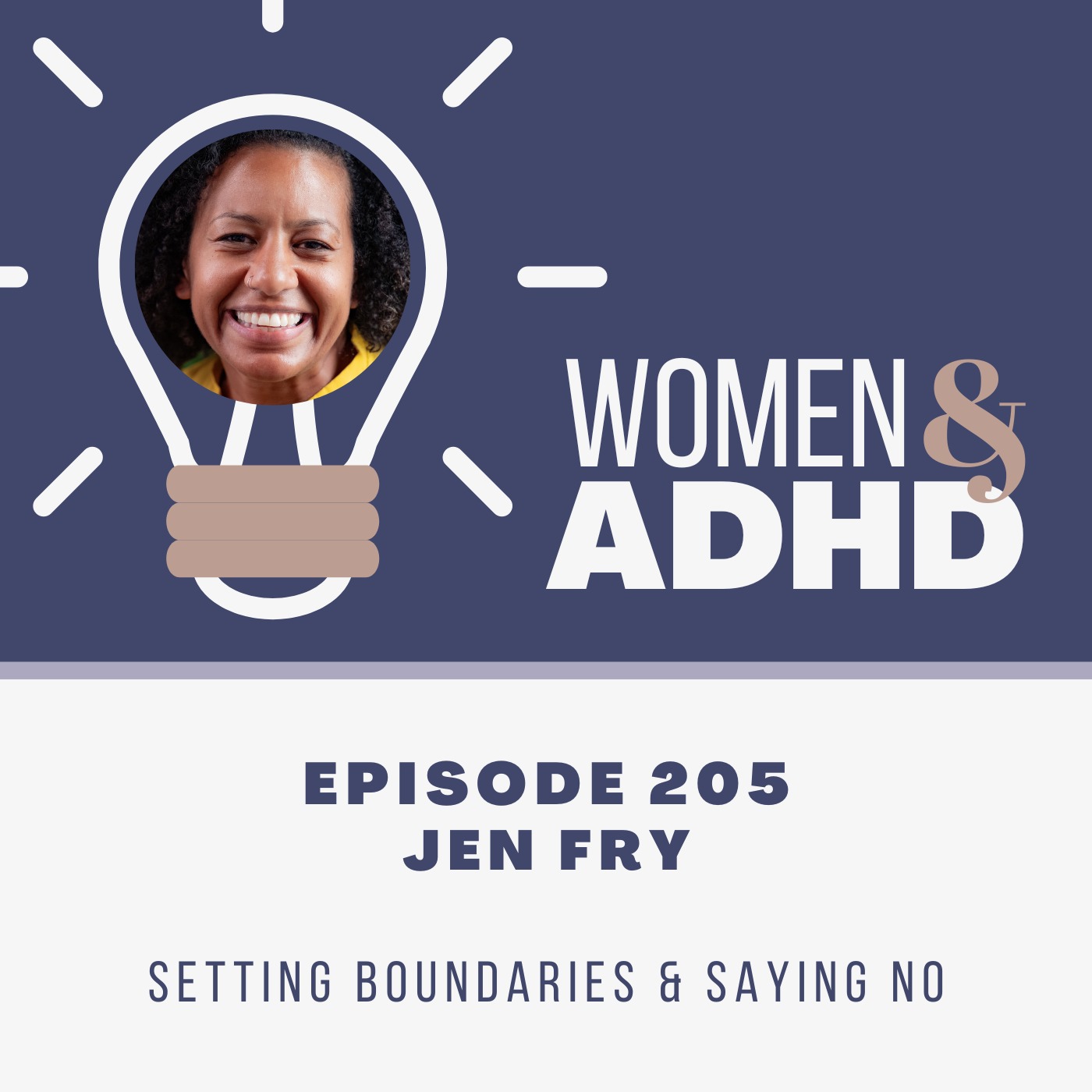
Jen Fry: Setting boundaries & saying no
About This Episode
Episode 205 with Jen Fry.
“I like to tell people that I’m not nice. I’m kind, but I’m not nice. I think niceness is weaponized way too much against people.”
Jen is an educator, speaker, and author of the book “I Said No: How to Have Boundaries and Backbone While Not Being a Jerk.”
Saying no is supposed to be simple — but for so many women with ADHD, it feels loaded with guilt, overthinking, and the fear of disappointing everyone around you.
Jen is a former college volleyball coach with a PhD in sports geography, and she now works at the intersection of conflict, culture, and sport, speaking to teams and organizations around the country.
We talk about the ADHD tendency to be a people-pleaser, and why Jen proudly says she’s kind, not nice. In this conversation, we talk about ADHD, hyperfocus, time blindness, imposter syndrome, and why so many high-achieving women end up chronically overcommitted, burnt out, and resentful.
We also explore what it really takes to say no — not just to other people, but to our own overexcited ADHD brains, our endless ideas, and our impulse to fill every spare moment.
If you’ve ever struggled with boundaries, overcommitting, or worrying that saying no makes you “difficult,” this episode is going to hit very close to home.
Website: jenfrytalks.com
Instagram: @jenfrytalks
Links & Resources:
I Said No: How to Have Boundaries and Backbone While Not Being a Jerk by Dr. Jen Fry
The Power of Likeability (Forbes)
- - - - -
Episode edited by E Podcast Productions
Find the transcript of this episode at www.womenandadhd.com/transcripts
- - - - -
Women & ADHD coaching: www.womenandadhd.com/coaching
- - - - -
Work 1-on-1 with Katy: www.womenandadhd.com/katy
- - - - -
Order the “Hey, it’s ADHD!” course: www.womenandadhd.com/adhdcourse
- - - - -
Did you love this episode? Click here to pledge a one-time donation to the podcast!
- - - - -
If you are a woman who was diagnosed with ADHD and you’d like to apply to be a guest on this podcast, visit womenandadhd.com/podcastguest.
Instagram: @womenandadhdpodcast
Tiktok: @womenandadhdpodcast
Twitter: @womenandadhd
Facebook: @womenandadhd
Advertising Inquiries: https://redcircle.com/brands
Privacy & Opt-Out: https://redcircle.com/privacy
[SPEAKER_01]: It takes a lot of a person to consistently say, no, when they're being badgered by one person or when it comes to family. [SPEAKER_01]: And so you're trying to say no to one person. [SPEAKER_01]: Now you have to say no to six people and text messages and emails. [SPEAKER_01]: And that's where people don't understand how hard it is to start setting boundaries because of all the other pressure and badgering in some aspects that occurs.
[SPEAKER_00]: Hello and welcome to the women and ADHD podcast. [SPEAKER_00]: I'm your host, Katie Weber. [SPEAKER_00]: I was diagnosed with ADHD at the age of 45, and it completely turned my world upside down. [SPEAKER_00]: I've been looking back at so much of my life. [SPEAKER_00]: School, jobs, my relationships, all of it with this new lens, and it has been nothing short of overwhelming. [SPEAKER_00]: I quickly discovered I was not the only woman to have this experience, and now I interview other women who like me discovered in adulthood they have ADHD, and are finally feeling like they understand who they are and how to best lean into their strengths, both professionally and personally.
[SPEAKER_00]: Hello and welcome back Happy New Year! [SPEAKER_00]: Alright, well here we are at episode 205 in which I interview Jen Fry. [SPEAKER_00]: Jen is an educator, a speaker, and the author of the book I said no, how to have boundaries and backbone while not being a jerk. [SPEAKER_00]: Saying no is supposed to be simple, but for so many women with ADHD, it feels loaded with guilt and overthinking and the fear of disappointing everyone around you. [SPEAKER_00]: Jen is a former college volleyball coach with a PhD in sports geography, and she now works at the intersection of conflict, culture and sport, speaking to teams and organizations around the country.
[SPEAKER_00]: Jen and I talk about the ADHD tendency to be a people pleaser, and why Jen proudly says she is kind, but not nice. [SPEAKER_00]: In this conversation, we talk about ADHD, hyperfocus, time blindness, imposter syndrome, and why so many high-achieving women end up chronically overcommitted, burnt out, and resentful. [SPEAKER_00]: We also talk about what it really takes to say no, not just other people, but to our own over excited ADHD brains. [SPEAKER_00]: So if you've ever struggled with boundaries, or you've worried that saying no will make you difficult, this episode is going to hit very close to home.
[SPEAKER_00]: Hello, Jen, welcome to the Women and ADHD podcast. [SPEAKER_00]: I'm so glad you could join me. [SPEAKER_01]: Hey, thank you very much for having me. [SPEAKER_01]: I'm so excited about this. [SPEAKER_00]: Well, congratulations on your book. [SPEAKER_00]: As soon as I saw the title, I knew I had to interview. [SPEAKER_00]: I think this is a topic we speak about a lot, especially as women with ADHD. [SPEAKER_00]: And so we will get to those millions of questions I have about that. [SPEAKER_00]: But first, I wanted to hear about your ADHD diagnosis.
[SPEAKER_00]: How long ago did you discover you had ADHD and kind of what were those signs for you, [SPEAKER_01]: You know, it's kind of funny because I didn't have an official diagnosis. [SPEAKER_01]: But I remember my coach, I was in junior college. [SPEAKER_01]: I was probably like, there was right before I started. [SPEAKER_01]: Probably like 16 or 17 and my coach was like, asking my mom, do you think you should have the gen test is for H, H, H, H, H, H, H, H, D, and my mom was like, no, she is just a really active girl.
[SPEAKER_01]: And I look back and I'm like, mom, bless your heart. [SPEAKER_01]: I appreciate your defending me. [SPEAKER_01]: And it's really evident by if you talk to me, if you interact with me that I have this. [SPEAKER_01]: Like it's not, and I think it was, you know, I'm 45. [SPEAKER_01]: And... [SPEAKER_01]: I think before it was kind of always like a secret, just put people on drugs and don't talk about it. [SPEAKER_01]: And now it's more widely talked about, but just the way I interact, the way I think through things, the way I jump to stuff, it's funny my chief of staff don't.
[SPEAKER_01]: She does time blocking. [SPEAKER_01]: And I'm like, you mean, you just stop when the time is done, but you just, I'm done, I'm like, I could never even envision that once I am down the rabbit hole, it will take going himself to pull me out, like the idea of just I did, okay, next task, I couldn't even fath of that at all. [SPEAKER_00]: I know, right. [SPEAKER_00]: Well, and even when I was first diagnosed, gosh, five years ago at this point, it was, that was one of my big fears about trying medication was the fact that I was like, I, that's kind of my best qualities are.
[SPEAKER_00]: that hyper focused that you're talking about. [SPEAKER_00]: I was really worried about losing that. [SPEAKER_00]: And so how long ago were you diagnosed? [SPEAKER_00]: Were you have you been officially diagnosed? [SPEAKER_00]: So you kind of self diagnosed? [SPEAKER_01]: I have not. [SPEAKER_01]: I have not been self diagnosed and it's at 45 it got to be the point of is what medication worth it. [SPEAKER_01]: You know, I'm a professional speaker and so being on stage. [SPEAKER_01]: I, my biggest fear with adding medication is I wouldn't have the opportunity to figure out how my brain works in front of a crowd of 1,000 people.
[SPEAKER_00]: I don't, it's a really complicated issue and, you know, I imagine even as an athlete too, I'm sure athletic departments and professional sports are filled. [SPEAKER_00]: I know the Olympics are their filled with, you know, ADHD kids had a lot of energy and their parents put them into sports and I think sports probably exercise structure, like I think it's probably really great for the [SPEAKER_00]: When I fell out you had your doctor at in sports geography. [SPEAKER_00]: I had to look it up.
[SPEAKER_00]: It's not a term. [SPEAKER_00]: I think I certainly have never heard of it. [SPEAKER_00]: I don't think it's a term a lot of people have heard of super fascinating though when I did look it up. [SPEAKER_00]: And so I'm kind of curious how you ended up going from being a professional volleyball coach to moving into the field of sports geography. [SPEAKER_00]: And then I want to ask you how you become a public speaker, but I feel like they're all connected, right, as that's the wonderful thing about ADHD, right?
[SPEAKER_00]: It's like all these seemingly random paths that all connect into this patchwork quilt of our life. [SPEAKER_01]: Yeah, so it does and I think kind of I have to jump around, but what happened was that I'm an educator at heart like I love to learn I am a person that I'm always taking webinars classes all of that stuff and I had gotten my second masters and that's time for story that ties. [SPEAKER_01]: Jason Lee to my professional speaking. [SPEAKER_01]: I got my second masters and I somehow was just talking to my friend of mine, probably about getting a third one.
[SPEAKER_01]: And she was like, Jen, you cannot get a third master. [SPEAKER_01]: You have to get PhD now, like you cannot be the collector of masters. [SPEAKER_01]: You have to get and my mom didn't graduate high school was [SPEAKER_01]: the librarian, I think one of the most academic minded people, but I didn't even have this understanding of Ph.D. of this graduate level degree of just really a knowledge-based. [SPEAKER_01]: I mean, we all know medical doctors or dentists, but didn't know about this.
[SPEAKER_01]: And I just, I've always kind of relied on [SPEAKER_01]: trusting my friends and what they see me. [SPEAKER_01]: And so I was like, okay, I did very nonchalot. [SPEAKER_01]: And then she said, you know, my mom got her, her bad choice of masters in geography at Michigan State. [SPEAKER_01]: They have this program you should look into it. [SPEAKER_01]: And I said, okay, and I looked into it and sport geography, interestingly enough, if you think about sports, sports is very geographical.
[SPEAKER_01]: playing styles is very geographical, just like if you if you take baseball for instance, someone's at baseball fan, how Asian countries, Japan, Korea, train their athletes compared to the maker of public, very different. [SPEAKER_01]: He was very different, training. [SPEAKER_01]: So sport is very geographical and that fandom is very geographical if you think about a fan and how they Patriots fan versus a Dallas Cowboys fan, right? [SPEAKER_01]: fandom is very geographical and so for me I was like, I want to talk more about kind of the experiences of black female volleyball players in Europe and look at that from a geographical land like idea and who would let me do it and so Michigan state [SPEAKER_01]: a class on like the geography of sport or geography of football and I was like, okay, why can go there and do it?
[SPEAKER_01]: And they let me. [SPEAKER_01]: And so that was, I think, one of the best parts about it is I was able to kind of make, like you said, patch work, this degree together. [SPEAKER_01]: And and that's all a PhD usually is a PhD is a patch work of a bunch of stuff to talk about, a really, really small topic. [SPEAKER_01]: And so Michigan state allowed me to do that. [SPEAKER_01]: And so, [SPEAKER_01]: became kind of probably one of the a handful of sports geographers. [SPEAKER_00]: Okay.
[SPEAKER_00]: And now, but I heard you mentioned, I think it was on another podcast. [SPEAKER_00]: You had mentioned that, you know, you ended up moving into public speaking. [SPEAKER_00]: After you were helping a lot of people with, like, advocating for themselves. [SPEAKER_00]: What was then the transition into public speaking? [SPEAKER_01]: Yeah, so what happened was was that I decided to leave coaching and I wasn't sure what I was going to do and I went and worked at Duke and I was I was working there in the Office of Undergraduate Scholars and Fellows and then I was blogging a lot about kind of intersection of race and sport and call athletics and then calling Kaepernick Neil probably like a month or two and to me working at Duke and then all of my friends.
[SPEAKER_01]: We're just very frantic, rightly so. [SPEAKER_01]: They're like, okay, my athletes want to kneel. [SPEAKER_01]: What do I do? [SPEAKER_01]: If I kneel, what do I do? [SPEAKER_01]: What is my first amendment? [SPEAKER_01]: Write for speech, public, private. [SPEAKER_01]: Like they just were kind of frantic about trying to figure out what to do and I became the go-to resource for them. [SPEAKER_01]: And then someone said, again, another friend said, you should look at becoming a professional speaker.
[SPEAKER_01]: And I had, like, you could tell me I was going to Mars. [SPEAKER_01]: I had no clue what that meant. [SPEAKER_01]: And so I was like, okay, let me look into that. [SPEAKER_01]: And I treated it like a skill. [SPEAKER_01]: I think a lot of people come to me and ask me about speaking. [SPEAKER_01]: And I think the problem is is that they lead with how do I get paid? [SPEAKER_01]: versus how do I get good at this skill? [SPEAKER_01]: And to me, that's always a conundrum because if you lead with what I want to get paid, how do I do it?
[SPEAKER_01]: You are going to risk your reputation for taking early check when you're not good. [SPEAKER_01]: And so for me, I was willing to do as much free work as possible because I knew like I had to learn that you, yes, you can speak in front of your team, but they kind of like, you're holding in postage. [SPEAKER_01]: Like they have to listen to, right? [SPEAKER_01]: They can't just get up and leave. [SPEAKER_01]: When you have a crowd of 500 people, they can get up and leave. [SPEAKER_01]: And so you have to learn a very different skill set.
[SPEAKER_01]: And so I took time to learn it as a skill, not just how do I get paid? [SPEAKER_00]: Yeah, I mean, honest on a smaller scale, I feel like I relate to that just as a podcast or where I feel like podcasting is one of those things, so like drumming or comedy where people are like, how hard can it be I'll do it. [SPEAKER_00]: And I'm so, you know, I have a journalism background, so I, you know, credit my own journalists skills and curiosity with podcasting and I'm like, I, you can't just show up and be like, all right, but I think a lot of podcasts are still.
[SPEAKER_00]: That's a little side now. [SPEAKER_01]: Well, I think it's also the idea that when you're good at something, you make it look really easy. [SPEAKER_01]: And since you make it look really easy, people ask how hard can it be? [SPEAKER_01]: Right? [SPEAKER_01]: Yeah. [SPEAKER_01]: Now, understanding the amount of time that you put in to make something look, if you can make a hard skill look easy, you've put a lot of time into it. [SPEAKER_01]: And people, a lot of them don't think of it in that aspect.
[SPEAKER_01]: They think of it in the other aspect of [SPEAKER_01]: you've made it look so easy, how hard could these things be? [SPEAKER_01]: And I think that's what concerns me, especially when it comes to speaking. [SPEAKER_00]: But I think there's something in there in terms of, that's going to segue us to the book, which is like, you know, you just said, I did a lot of stuff for free. [SPEAKER_00]: I sort of chase my own interests as I was building my skill. [SPEAKER_00]: And some might look at that as like saying, yes, or people pleasing.
[SPEAKER_00]: right in some weird way, which is like you're not knowing your worth doing things for free. [SPEAKER_00]: I think there's a real emphasis right now on like girl, you, you know, you've got to charge more and girl. [SPEAKER_00]: You've got to know your worth. [SPEAKER_00]: Like I feel like a lot of the time, it's almost like people, especially like younger generations, uh, like feel like they need to be paid before they have the experience of the scale. [SPEAKER_00]: And I'm kind of like, is that, are am I being a door mat?
[SPEAKER_00]: When I am not quote unquote charting what I'm worth, if I feel like I'm getting a lot out of the experience as well. [SPEAKER_00]: Like, I feel like that's a difficult line to balance. [SPEAKER_01]: I think, okay, that's such a good question. [SPEAKER_01]: And I think the first thing that a lot of people don't realize is that at in some cases, you don't get to decide what your worth, the market gets to decide what your worth. [SPEAKER_01]: and the market determines that, meaning you could say, you're gonna charge $30,000 for a keynote.
[SPEAKER_01]: You can say, I'm worth that. [SPEAKER_01]: The market will tell you, I'm only gonna pay 2,000. [SPEAKER_01]: Like the market tells you your worth when it comes to certain things. [SPEAKER_01]: I think the next thing is that, when it comes to professional speaking, once you take that check, you could get someone fired. [SPEAKER_01]: And I don't think people really realize that is you can get someone fired. [SPEAKER_01]: You take a check and like, oh, I can do this. [SPEAKER_01]: You don't know how I handle people.
[SPEAKER_01]: You don't know how to facilitate. [SPEAKER_01]: You don't know how I handle pushback. [SPEAKER_01]: You don't know how I handle conflict. [SPEAKER_01]: All these things you know how I handle, it becomes a mess. [SPEAKER_01]: And now the person that brought you in could be fired because you were completely ill-equipped for the situation. [SPEAKER_01]: Because you were worried about the check and not building the skill. [SPEAKER_01]: And so I think it's a few different things. [SPEAKER_01]: I think A, it's asked yourself, do I have the skill that's associated with receiving this check?
[SPEAKER_01]: And it's not that you have to be perfect, but I always like to think about like worst case scenarios. [SPEAKER_01]: What's worst case scenario? [SPEAKER_01]: A employee starts screaming at another employee, and I able to handle that. [SPEAKER_01]: As someone starts person, as someone starts saying something inappropriate. [SPEAKER_01]: Like am I able to handle these type of things? [SPEAKER_01]: And so that makes me think, okay, [SPEAKER_01]: can whoever hired me trust that they're going to keep their job.
[SPEAKER_01]: And I'm going to keep that. [SPEAKER_01]: That's all I always think about when people bring me on, I want to make sure that you are leaving keeping your job. [SPEAKER_01]: And that people still trust you for bringing me in. [SPEAKER_01]: I think the second thing that kind comes with the market value is so for instance, I was sent in at the intersection of race and sport for years. [SPEAKER_01]: If you mentioned race and call just like you mentioned gen fry in 23, I pivoted to conflict and culture.
[SPEAKER_01]: that hasn't means I have to introduce new information also to new audiences. [SPEAKER_01]: That being said, I can't charge my previous market value yet because I'm entering a whole new just information curriculum, identity, all these things, and to new industries. [SPEAKER_01]: So I my market value changes in some aspect. [SPEAKER_01]: Could I keep saying, yeah, I'm going to charge 20,000. [SPEAKER_01]: Yes, but the market at that time is not saying we don't think you're worth it. [SPEAKER_01]: And that's okay.
[SPEAKER_01]: And I have to build back up that market value. [SPEAKER_01]: And I think another component of it is that if you've been doing this for a while, if you have, you know, all the media, the videos, the testament, all that. [SPEAKER_01]: You can start raising your race and to see what the market believes in, but you have to the market tell you your value. [SPEAKER_01]: And that's a thing that many people don't realize and I've had people who [SPEAKER_01]: will come to me and be like, you know, I've done some panel discussions.
[SPEAKER_01]: I want to start getting paid and I'm like, have you had to command a crowd by yourself for 45 minutes? [SPEAKER_01]: No. [SPEAKER_01]: Okay. [SPEAKER_01]: Well, maybe you should do that a few times before you start getting paid. [SPEAKER_01]: You've been on a panel with four other people. [SPEAKER_01]: Me, you maybe talked a total of 10 minutes. [SPEAKER_01]: And you had other people to protect you, meaning, if I said something stupid, Katie could come around and be like, you know what?
[SPEAKER_01]: And then you could go into another pivot and then hold a smoke away from me. [SPEAKER_01]: If I say something stupid by myself, I'm up there by myself. [SPEAKER_01]: It's a very different experience. [SPEAKER_01]: And I think a lot of people think because they've been on stage. [SPEAKER_01]: that they get to charge them like no, you don't. [SPEAKER_01]: And so I've been doing a lot of work for free, but in that, I don't feel like as people pleasing, I'm deciding what work I'm doing, be I'm deciding what value, meaning if I do this, he knows for free, you are flying me out, you're paying for my hotel, you're giving me all the video that video could be worth $5,000, right?
[SPEAKER_01]: I'm saying what other things can I get with it versus just saying yes to everything. [SPEAKER_01]: I'm being very intentional about the free things I do and the industries I'm going into. [SPEAKER_00]: Yeah, I think there's also something there as you were talking, I was thinking about like imposter syndrome too, which maybe that's what it is. [SPEAKER_00]: Not so much people pleasing, but that feeling of like when do you believe you have the right to be on that stage and charge that money and I think that that's something, you know, there's a lot more kind of systemic stuff happening there, especially as women.
[SPEAKER_01]: That's a better question of the rate. [SPEAKER_01]: So I charge now that's where I've seen people who, I'm like, you're only charging how much? [SPEAKER_01]: Oh, I'm like, no, you need to raise that rate. [SPEAKER_01]: That I think is a different aspect because for some people, it's very hard to charge a lot. [SPEAKER_01]: It's hard. [SPEAKER_01]: And so what I tell folks is that it's their uncomfortable with that conversation. [SPEAKER_01]: It has a price sheet. [SPEAKER_01]: So when someone contacts you about rates, just send them a price sheet and say here here are my rates that way you don't have to talk and then you can start having a conversation but again you get to determine what the price is and if someone wants to come in a low ball you you get to decide yes or no because the one rule that I live by is once I accept a price I do not get to be mad about it.
[SPEAKER_01]: I've accepted that price and I see a lot of people, you know, taking you will contact me and be like, hey, will you do this keynote for $2,000? [SPEAKER_01]: And then I, you know, be grudgingly, I'm like, fine, I'll do it. [SPEAKER_01]: And then pistol time, I could be pissed. [SPEAKER_01]: I accepted, I could have said no. [SPEAKER_01]: And so that's why I tell people is whatever price you accept. [SPEAKER_01]: If you accept a card of eggs and some cheese, as your price, then you have to be happy with that.
[SPEAKER_01]: You do not get to be upset with the price that you accept it. [SPEAKER_01]: You don't. [SPEAKER_01]: If you feel it's below your worth, you don't get to accept it and then be pissed off saying that they're paying you below your worth. [SPEAKER_01]: That's not the way it works. [SPEAKER_00]: Yeah, I love when you talk about that in the book too about just like [SPEAKER_00]: the existence of resentment because I feel like I talk about that with my family too when it comes to doing things and making decisions, you know, where I'm like, if there's resentment in any of this, then the your people pleasing.
[SPEAKER_00]: And so like, look for the resentment. [SPEAKER_00]: And that's like a flag for you to see like, okay, what am I expecting that I'm not getting? [SPEAKER_00]: And why did I expect that? [SPEAKER_00]: And like, you know, a lot of sort of working backwards from the resentment. [SPEAKER_00]: Um, which I find is very helpful for me because a lot of the time I don't realize I'm people pleasing until it's too late. [SPEAKER_00]: Which is another question I will have for you, but going back to I said no, which is just a fantastic title for a book.
[SPEAKER_00]: I love it. [SPEAKER_00]: Thank you. [SPEAKER_00]: How to have boundaries in back vote while not being a jerk. [SPEAKER_00]: Like I said, as soon as I saw the title, I was like, I have to read this was fantastic book. [SPEAKER_00]: I really love, I mean, I think a lot of what you say. [SPEAKER_00]: I wouldn't say I've heard it before, but it's like, I feel like there's so much that makes sense. [SPEAKER_00]: I'm also just like, what is the disconnect between being able to hear it and be like, you know, what other people's opinions of me?
[SPEAKER_00]: Don't they're not on my business? [SPEAKER_00]: Like, I've heard all of that stuff so many times, but I was so curious to know from your point of view, like, why [SPEAKER_00]: I guess even from an ADHD point of view, why do you think so many ADHD people specifically have such a hard time with boundaries and saying, no? [SPEAKER_01]: I think in some aspects it's because they want to be the end all be all to everyone to prove that they can do it all. [SPEAKER_01]: And so what better way to prove you can do it all is by saying yes to everything.
[SPEAKER_01]: And then to me, like you said, it falls absolutely within the people pleasing aspect because when you say yes to everyone now everyone has a lot of these expectations on you that you feel like you have to do and the second you say no. [SPEAKER_01]: What, what, what's wrong? [SPEAKER_01]: And now it becomes the cycle. [SPEAKER_01]: You know, I think also a hard part about that is that when you teach people that you're always saying yes, and you don't have boundaries, then what happens is that when you do set a boundary and you're like, okay, I'm just set a boundary with this thing, people don't know how to handle it.
[SPEAKER_01]: Like I say, people are habitual line steppers. [SPEAKER_01]: they will consistently step over the mind and if you are people please or you might say okay no I can't do it and then the first time they push back or step over the boundary okay yes I can do it and you would rather wear yourself thin than the thought of saying consistently saying no to people because the reality of situations that the first [SPEAKER_01]: when you are consistently saying no, people will keep bad dream you and that's where folks get exhausted.
[SPEAKER_01]: Is that they will just say yes, it means a lot to you. [SPEAKER_01]: Obviously, could you keep asking so I'll say yes versus it takes a lot of a person to consistently say no when they're being bad driven by one person or when it comes to family. [SPEAKER_01]: How the whole family will start doing it, right? [SPEAKER_01]: So I'm just doing it for Katie, you know, she's exhausted. [SPEAKER_01]: And right now you have your cousin, your sister, your uncle, just do it. [SPEAKER_01]: It's not a big deal.
[SPEAKER_01]: And so you're trying to say no to one person. [SPEAKER_01]: Now you have to say no to six people and text messages and emails and and that's where people don't understand how hard it is to start setting boundaries because of all the other pressure and baddrian some aspects that occurs. [SPEAKER_00]: Hmm. [SPEAKER_00]: Oh my goodness. [SPEAKER_00]: I just had such a visceral reaction to that one. [SPEAKER_00]: I thought of my family. [SPEAKER_00]: Um, and that like it's not a big deal.
[SPEAKER_00]: Just do it. [SPEAKER_00]: You know, oh my goodness. [SPEAKER_00]: Oh, all right. [SPEAKER_00]: I needed to like recover from that one. [SPEAKER_01]: But can I go back to that Katie real quick? [SPEAKER_01]: Is that people don't understand how hard that family pressure is to break? [SPEAKER_01]: Like they don't. [SPEAKER_01]: And so it becomes the [SPEAKER_01]: Like you said, sitting in the resentment, I'll just do it, even though I don't have time to drive 45 minutes across town to grab something for you.
[SPEAKER_01]: I don't have time. [SPEAKER_01]: It breaks at my whole day because now I have five people on my butt about it. [SPEAKER_01]: I will just do it to get everyone off my butt. [SPEAKER_01]: And the setting of the first boundary. [SPEAKER_01]: It's hard, but it's not going to be the hardest one. [SPEAKER_01]: It's a consistent, bad dream to get you to break down. [SPEAKER_01]: And in a way for you to never set a boundary again. [SPEAKER_01]: Because I'm going to, if I keep, if we all keep bad dream, you learn really quickly.
[SPEAKER_01]: If you set a boundary, we are going to just literally, everyone's going to keep attacking and to finally stop doing it. [SPEAKER_01]: And then you learn not to set any boundaries again.
[SPEAKER_00]: One of the things that happened to me, and I've talked about this on the podcast before, like, you know, during the pandemic and locked down, it was, I mean, it was, I think it was the first time in my life I felt regulated. [SPEAKER_00]: It was a really amazing experience. [SPEAKER_00]: I think I'm not the only one who just really benefited from having the rug pulled out from all of the things I was in the middle of doing. [SPEAKER_00]: And it really made me look at how much I had overcommited myself.
[SPEAKER_00]: I would a chronic volunteer, [SPEAKER_00]: And I would always complain about the fact that I would like join a board, and then I'd have my hand up, and then next thing, you know, I'm the president of the board, and I was always just perpetually overwhelmed, I still am, but like, I sort of felt like, like you said that first no had to be much further. [SPEAKER_00]: further ahead. [SPEAKER_00]: So I just was like, I decided during the pandemic that I was not going to volunteer for anything until I could figure out how to have a better balance.
[SPEAKER_00]: And it really helped me to sort of say, like, nope, that's just a solid no. [SPEAKER_00]: And then like you talk about in the book, it's like, like you liken it to like reps at a gym, right? [SPEAKER_00]: It's like it's a muscle that you build. [SPEAKER_00]: The the no is a muscle in terms of, it just got easier from there to say no to [SPEAKER_00]: important it was to not say no to myself and that's what I was doing and I feel like you know that that idea of like what is the cost of saying yes is so important.
[SPEAKER_00]: But one of the things I find that I relate very much to in terms of ADHD. [SPEAKER_00]: is like, how do I say no to myself? [SPEAKER_00]: I say that sometimes to people and they look at me like, what are you talking about, but I feel like that's very common with ADHD is the overexcipement. [SPEAKER_00]: I think there's a combination there of like time blindness maybe like sure I have time to do this and a little bit of. [SPEAKER_00]: what you said earlier about like wanting to prove to everyone that I can do it because there's like a lot of childhood stuff around that right and like living up to your potential and be proving I'm good at things but I also just have like like this past weekend alone.
[SPEAKER_00]: I was like I really want to take voice lessons. [SPEAKER_00]: I really want to volunteer at the library. [SPEAKER_00]: I want to do you know [SPEAKER_00]: Right? [SPEAKER_00]: And then it's also like impulsive shopping, right? [SPEAKER_00]: Like I look at all of these things that are very much ADHD related and I have to just be like, like, it's a full time job pulling back in terms of my own enthusiasm and my own desire and my own ideas and I feel like that is like a very unique. [SPEAKER_00]: no.
[SPEAKER_00]: I don't have as much of a problem of modeling boundaries and saying no to other people but what I really struggle with is I feel perpetually just overstretched and like every time there's like something free and in my calendar it gets filled up like this with something I've said yes to because I really wanted to and I feel like I have a hard time distinguishing between like [SPEAKER_01]: you know that I feel like of like just because you can doesn't mean you shouldn't and it's like just because you want to doesn't mean you can look for me when I look at walks on my calendar I'm like whales can I do what can I fill it with and I agree with you on kind of this over extended though the way I think I can get through these lists I'm like girl I know way but I will make these lists and thinking I can do that you know [SPEAKER_01]: I will all of some be like, I wonder if I can, on a set, I just paint my living room walls, like I just 100% instead of saying like, just rest.
[SPEAKER_01]: It's okay if you have two hours or three hours or an afternoon, you can just rest and it's completely okay. [SPEAKER_01]: Everything doesn't have to be filled, like you said, just because the opportunity is there. [SPEAKER_01]: And [SPEAKER_01]: you don't have to pick up a new hobby because you have a weekend free. [SPEAKER_01]: Like I literally was looking at slime lessons. [SPEAKER_01]: I was like, how long would it take for me getting my private pilot license? [SPEAKER_01]: Jen, you do not.
[SPEAKER_01]: But I told my chief of staff she would murder me. [SPEAKER_01]: I think why am I looking at private lessons for being a pilot? [SPEAKER_01]: I do not need to be that, but like you said, I go down this rabbit hole. [SPEAKER_01]: I'm like, how hard could it be? [SPEAKER_01]: How long would it [SPEAKER_01]: I do not have the time to learn how to be a downpilet and that's the problem is that we think we have the time and then we put ourselves in it and then it just keeps going downhill that way.
[SPEAKER_00]: Yeah. [SPEAKER_00]: Right? [SPEAKER_00]: And that's where I end up in a lot of situations where I have said yes to people and then I either disappoint them or I disappoint myself because I am run ragged and I'm kind of like I don't even know where to put the boundary in. [SPEAKER_00]: I guess it's like you said it's sort of like [SPEAKER_00]: look at some point I have to just be like you can't like that's it. [SPEAKER_00]: It's a hard no in terms of just like do not agree to things and so I do find that there are times where I'm just like no I'm shutting down my calendar it's off limits nothing more like but it does feel like a full time job kind of pulling back from a lot of that stuff.
[SPEAKER_01]: Well, I think the problem also with ADHD is that we go through rabbit holes so quickly and we find stuff so interesting and we find something so interesting. [SPEAKER_01]: We are just diving down the rabbit hole. [SPEAKER_01]: It's hours into it. [SPEAKER_01]: And then it's like, yeah, I think I could do that. [SPEAKER_01]: I think I could learn Chinese in two weeks. [SPEAKER_01]: Right. [SPEAKER_01]: Like the stuff that. [SPEAKER_01]: We think about, it's like, no, you can't, no, you can't.
[SPEAKER_01]: You can't do all this. [SPEAKER_01]: And so for me, I am a rabbit whole person. [SPEAKER_01]: If I find something interesting, good luck, because kids, you're not pulling me out from that. [SPEAKER_01]: And if it means, if there's something now, I have to buy to do it. [SPEAKER_01]: Like, I have a love of legos now. [SPEAKER_01]: And the amount of legos, because my friend bought me this cat up there. [SPEAKER_01]: Oh, yeah. [SPEAKER_01]: And that was my downhill. [SPEAKER_01]: And now I research all the little, and then it goes like, right, like, the rabbit holes I go down because of my interest level.
[SPEAKER_01]: Like I said, my chief of staff can time block. [SPEAKER_01]: She is very much like the, and I am all over the place. [SPEAKER_01]: But also, you know, one of the things I've learned that I have five degrees, I have two businesses. [SPEAKER_01]: I figured out how do I under this umbrella of ADHD? [SPEAKER_01]: How do I, [SPEAKER_01]: be Jen, how do I get stuff done? [SPEAKER_01]: How do I figure out my life? [SPEAKER_01]: And the part of getting stuff done, because like you said the timeline is, I'll look at 7pm and be like, oh, I still got like five hours, I'm good.
[SPEAKER_01]: And then one AM hits and I'm like, what just happened? [SPEAKER_01]: And so it really is figuring out how do I continue to work within the parameters of ADHD, do we what I need to do? [SPEAKER_01]: Like I said, when my hesitancy is taking medicine is I don't know what it will do to my mind when I'm on stage because I've been able to figure it out. [SPEAKER_01]: I can be on stage talking to a crowd of 500 people. [SPEAKER_01]: I can look through slides to figure out what my next slide will be, what topic I want to connect it to, what thing I want to transition it will all at the same time.
[SPEAKER_01]: I am worried that it will be able to have those ways to do it because the only way you have to figure out if you can still do it is if you're doing it in the moment. [SPEAKER_01]: And then I don't want to audience to be my guinea pigs. [SPEAKER_01]: And so for me, it's how do I figure out under this ADHD umbrella doing the things I need to do in a way that also is healthy, meaning I'm not saying it to for you and doing stuff because I've gone down a rabbit hole, I'm able to say, okay, get your butt to bed now, there's no point of staying up.
[SPEAKER_00]: Well, and it also sounds like your chief of staff is a very helpful accountability partner, which I think, oh my gosh. [SPEAKER_01]: So you will be like, we are shutting down your account, your calendar, do not book anything on these days. [SPEAKER_01]: I mean, like, okay, you sure. [SPEAKER_01]: So she's great with that. [SPEAKER_01]: And my friends is funny, because my friends all go to sleep early in my best friend. [SPEAKER_01]: He doesn't have a cooking show, go sleep at like 830.
[SPEAKER_01]: And she'd be like, okay, you're going to try and go sleep early today. [SPEAKER_01]: I'm like, yeah, okay, Sarah, I'll try it. [SPEAKER_01]: But I feel like I get my best work done once it hits like 11 o'clock. [SPEAKER_01]: And I'm just like, now I can do everything. [SPEAKER_00]: Well, and even with spending money too, I mean, thankfully, I'm married to somebody who is much better with money than I am. [SPEAKER_00]: And I kind of... [SPEAKER_00]: Elected him as the budget person when we got married and I I said like put me on a very strict budget because I will keep spending money until I until it's gone So if you keep me on a very very strict budget then you know then what I'm done I'm done and people used to look at me like what are you like they were like blink twice if you need help like they would always think I was in this terrible [SPEAKER_00]: Dominated marriage, but I was like, no, I instilled that.
[SPEAKER_00]: This was long before I even knew about ADHD. [SPEAKER_00]: But I was like, that did that for my own good. [SPEAKER_00]: And I think it's the same idea of like looking about these ways in which we intuitively set boundaries ahead of time knowing that it might be difficult in the moment to set those boundaries. [SPEAKER_01]: Yeah, I mean, it's funny because again, like I am this big idea person I want to do it all and the way Don handles that now is she like I'm not doing it. [SPEAKER_01]: Do you have time in your schedule to do it.
[SPEAKER_01]: and I'll be like, oh, never mind, no. [SPEAKER_01]: And that way, right, she's like, I'm not doing this stuff. [SPEAKER_01]: And so that's helped out a lot of like, do you have time on your schedule to do this project? [SPEAKER_01]: And I'll be like, nope, I don't. [SPEAKER_01]: And so having people around that can help in that way, I think is so important because [SPEAKER_01]: I have so much going on on a consistent basis and there you need people in your life that can kind of put their foot down and say you're not doing that like no and so that's why I tell Dawn like you some of this stuff just say yes or no it doesn't bother me because you you see my calendar you know it's like you're like okay these days you're closed work you're not doing anything else but you need people to put parameters around you for you if it's your partner saying like okay here's your budget and that's what works for you then that's what works for you keeps you and your relationship healthy.
[SPEAKER_00]: Yeah, I work with a lot of business owners who have that I that micro management I wouldn't say it's like nefarious, but there's that like you were saying like that that feeling like if we have an idea it's up to me to do it because I'm the one in charge. [SPEAKER_00]: I don't know we kind of have to unravel that that micro management. [SPEAKER_00]: I think there's a perfectionism element there too of just like if I want to done, I'll do it myself kind of feeling that a lot of us have when we're, you know, really that feeling of like, oh, I wish I could clone myself a lot of those statements that you hear from perfectionists who, but I work with a lot of business owners who then feel like they have to do everything and it's and it's very similar.
[SPEAKER_00]: But to what you were saying with your teeth of staff, which is like, you don't do anything. [SPEAKER_00]: You generate ideas and you delegate and that's it, right? [SPEAKER_00]: But it's like starting from the beginning, just making sure that like if you need somebody else to do it for you in order to give you the time to do the things that you actually want to do. [SPEAKER_01]: Not really, I think for me, what it is is that it's this idea of, do you have time on your schedule to do it, meaning like if if we're going to take on because I hate to say that's most of my ideas are not small, most of my, I mean, I started a tech company like my ideas are not small and so it's this idea of everything that it entails, do you have the bandwidth to also do it and manage it.
[SPEAKER_01]: because there's so much that is involved with it. [SPEAKER_01]: Yes, you can say I have this idea and then delegate, but there's so much of it that you have to be involved in to get off the ground. [SPEAKER_01]: You have to get off, if I were to say, I mean, just a very big picture of, [SPEAKER_01]: want to start a shirt company. [SPEAKER_01]: Well, I can tell someone I want to start a shirt company, but then I have to be the one to talk about what type of shirt will color shirts. [SPEAKER_01]: You know what size and do I want, what type of material.
[SPEAKER_01]: I have to have all of those things to be able for them to do their job well. [SPEAKER_01]: And if I don't have all that information, they can't do their job well. [SPEAKER_01]: And so that's what Dom means is like, do you have this on your schedule or give the billion on your schedule? [SPEAKER_01]: Because if you can't do the stuff to get off the ground, you're going to make everyone else's jobs a lot harder. [SPEAKER_01]: Yeah. [SPEAKER_01]: And I know where my perfectionist for me, my PhD was B's get PhDs.
[SPEAKER_01]: Like I am a solid B-level, I've had to tell Don, we are not perfectionists. [SPEAKER_01]: We can't move fast with perfection. [SPEAKER_01]: So that is one thing I can pride myself on is that there is no perfectionism here. [SPEAKER_01]: B's get PhDs. [SPEAKER_00]: Was there anything specific that led to the creation of the book or the Genesis? [SPEAKER_01]: You know, so I think the first thing is, [SPEAKER_01]: I got done with my dissertation. [SPEAKER_01]: Everyone just kept asking, so you can write a book.
[SPEAKER_01]: And I'm like, I just got done with the 403 page dissertation, and you give me, like, 0.2 seconds to breathe. [SPEAKER_01]: And then a book has always been my mind. [SPEAKER_01]: But I didn't know, like, what that even entailed. [SPEAKER_01]: And most of the big projects I take on, I don't realize that until I'm in the middle of it. [SPEAKER_01]: And so when I move topics to conflict and culture, the idea is if you want to get on bigger stages, you have to have a book. [SPEAKER_01]: Unless you are like a celebrity or have some type of disability or you're missing a limb, you have to have a book.
[SPEAKER_01]: And so once I knew that, okay, if I want to get to the next level, I want to have a book. [SPEAKER_01]: Why had to think about, what is this book going to be? [SPEAKER_01]: And one of the things I think when you're writing a book, that is nonfiction that involves parts of your lives. [SPEAKER_01]: you don't realize like how personal it actually is to write and then understanding that the stories you tell about people in your life that that's going to be the readers only image of them.
[SPEAKER_01]: So you have to be a little bit more thoughtful about it. [SPEAKER_01]: So in it there's there's a story about my mom and my family members and it's like, okay, now do I want this person who's going to read this book who has never met them, what image do I want to leave them with about my mom? [SPEAKER_01]: And so for me, just starting to think about writing this book was like, okay, there's going to be a personal element to it. [SPEAKER_01]: What do I want to lead people with? [SPEAKER_01]: And the first title is actually called Kind Asshole, out of the back bone boundaries that be a jerk.
[SPEAKER_01]: But then people were just kind of pushed back to like, if you want to go into colleges, you can't have a customer and all that. [SPEAKER_01]: And so the next title that came up to me was this idea, I say no. [SPEAKER_01]: because that tends to be one of the biggest problems that people have is that ability to say it. [SPEAKER_01]: And so it was like, if I want to get on some big stages, I want to have a book and but then also what do I want this book to be about? [SPEAKER_01]: And so I would say that for the first time writing, it was a really cool experience to do this.
[SPEAKER_01]: I self-published. [SPEAKER_01]: I didn't go through to traditional publishing. [SPEAKER_01]: Again, the ADHD I'm got time. [SPEAKER_01]: Like y'all are supposed to release this [SPEAKER_01]: No, I'm going to be on book number three by then, baby. [SPEAKER_01]: Like, I ain't got time to wait this time, and when I want to do something, I want it done immediately. [SPEAKER_01]: Like, there's no waiting. [SPEAKER_01]: And so for me, once I started seeing that with traditional publishing, you have to do proposals and you have to farm it out.
[SPEAKER_01]: I said, I'm doing it myself. [SPEAKER_01]: And so I was able all in to do my book from beginning to end was $2,500. [SPEAKER_01]: And I went out five or five found some phenomenal editors. [SPEAKER_01]: I did, so this footprint has a company that's a offshoot called 99 Designs, which designed my whole cover and this phenomenal job. [SPEAKER_01]: You send in all your information and they do a contest. [SPEAKER_01]: So I had over 100 people put in design. [SPEAKER_01]: for it. [SPEAKER_01]: And so it was just such a great experience from beginning to end.
[SPEAKER_01]: So now I know exactly what's a part of it. [SPEAKER_01]: So for my next book, I already have an idea that if I do do vibrator-traditional publishing, I have an idea of what the process is and where my involvement needs to be. [SPEAKER_00]: Yeah, that was great. [SPEAKER_00]: Yeah, I had a similar experience. [SPEAKER_00]: Again, I didn't know I had a HD at the time, but I saw publish my first book and it was very similar. [SPEAKER_00]: It was like it was all done very quickly and and I wrote the hyper focus wave and I don't I can't imagine having to sit and wait for for two years.
[SPEAKER_01]: Girl, I literally, like, I said I wanted to have my book written the first draft by the end of 2024. [SPEAKER_01]: And so, you know, a lot of people when they are talking about writing books are like, okay, clear your desk, set your intentions, you know, put your candles on. [SPEAKER_01]: And I was like, I got time for that. [SPEAKER_01]: So it would literally be me in the car like this dictating to notes. [SPEAKER_01]: Yeah, that's how I wrote my whole book with like this talking to it.
[SPEAKER_01]: Well, I'm driving and for me, my best ideas are in the shower when I'm driving long distances. [SPEAKER_01]: So I would just keep reading and saying everything. [SPEAKER_01]: And then from that point to the editing and line by line, but that's how I wrote the book. [SPEAKER_01]: But when people are like, yeah, I'm looking at my book come out in 2026, 2027. [SPEAKER_01]: Oh, what? [SPEAKER_01]: That's in two. [SPEAKER_01]: I'm going to be on book three by 27. [SPEAKER_01]: Like I couldn't even fathom sitting there and just waiting for X a year or two.
[SPEAKER_01]: Absolutely not. [SPEAKER_01]: No way, no how. [SPEAKER_00]: I love the fact that your initial title was kind of asshole because you do talk about the difference between being nice and being kind and a lot you know how so many of us feel like if we have boundaries if we say no it means we're not being nice and you know that doesn't happen in a vacuum a lot of the time it is we're told straight out right oh how do you present uh so so explain in your own words them now like what is the difference between [SPEAKER_01]: I think a lot of it, niceness gets weaponized to us to keep us to miss it.
[SPEAKER_01]: You know, you're not being nice, Katie. [SPEAKER_01]: It means to me that you're willing to do whatever for anybody just to make sure that you don't rock the boat. [SPEAKER_01]: How many times when it's like, just be a nice girl, just be nice. [SPEAKER_01]: You know, I know he said something mean to you, but but be nice. [SPEAKER_01]: And to me, it just means being completely walked over kind means you you self advocate. [SPEAKER_01]: You have boundaries. [SPEAKER_01]: You stand up for yourselves.
[SPEAKER_01]: You understand that part of that is that people will be upset with you and you're okay with that. [SPEAKER_01]: I think so many people, especially women in society, the fear of not being thought as nice will have them doing and being in horrendous positions. [SPEAKER_01]: I mean, from working in college athletics, the amount of young ladies that put themselves in horrible positions because they didn't want to seem like they were mean, that they didn't want to seem like they weren't nice.
[SPEAKER_01]: They would be in place and we're like, you saw them. [SPEAKER_01]: They're doing drugs. [SPEAKER_01]: These things are happening. [SPEAKER_01]: Why didn't you want to leave? [SPEAKER_01]: Well, I just, people wouldn't think I was nice if I did that. [SPEAKER_01]: Go on. [SPEAKER_01]: And so they leave themselves in horrible predicaments. [SPEAKER_01]: And so for me, we have to disseminate the kind of dispelous idea that be nice is good. [SPEAKER_01]: I think, like I tell people, I am not nice.
[SPEAKER_01]: I'm kind, I am not nice. [SPEAKER_01]: I do not want people to weaponize that against me. [SPEAKER_01]: Because if I say no, I want people to be like, no, just be nice, absolutely not. [SPEAKER_01]: Absolutely not. [SPEAKER_01]: My no, like I tell people, I go and try to tell someone else to do stuff because you're not going to tell me. [SPEAKER_01]: Like, I do not fall to peer pressure at all. [SPEAKER_01]: Like, I'm the worst person to try that with. [SPEAKER_01]: And so I wish you may women would stop worrying about being nice, that they would just have that out of their vocabulary.
[SPEAKER_01]: They'd stop telling their daughters to be nice. [SPEAKER_01]: and telling them to be kind and the things that come with being kind being you hold people accountable. [SPEAKER_01]: You push back on things that people say they're problematic. [SPEAKER_01]: You hold yourself to a different standard. [SPEAKER_01]: And being nice none of that occurs. [SPEAKER_01]: I just think niceness is weaponized way too much against people. [SPEAKER_00]: Yeah, well, I mean, in hindsight, like when I met my husband, we were, I'm actually four years older than he is, so I had four more years experience in the field we were both met at the same job as journalists, the same newspaper and, you know, those like in our 20s and I watched him a white guy.
[SPEAKER_00]: get promoted over and over and over again and make more money than me. [SPEAKER_00]: And often times the reason was never, oh, well, you know, there's misogyny and sexism in the workplace, which is what should have been said, but often times I was told it was because I [SPEAKER_00]: wasn't likable, you know, or I needed to be nicer because I wasn't, you know, I was very blunt and I was very like roll-up shirt sleeves and I never took bullshit and I kind of that was like, I couldn't be any other way, but it was often told that the reason why I wasn't getting promoted was because I had this like, you know, bristly personality and [SPEAKER_00]: Yeah, and so I feel like there is like that's what I mean.
[SPEAKER_00]: It doesn't happen in a vacuum. [SPEAKER_00]: I think there are a lot of women who, you know, we, we prove our worth by how many plates we can span and how much we can do and how many people we can appeal to and be likable to and. [SPEAKER_00]: And, you know, and with an ADHD diagnosis in adulthood, like I think a lot of the time, one of the things I love about getting older is the fact that I give less of a shit every year what people think about me. [SPEAKER_00]: And so I think a lot of women get diagnosed with ADHD in their 30s and 40s because they get to that point where they're like, I'm sorry, like I'm done with this house of cards and I'm not doing it anymore and I'm not going to be like, [SPEAKER_00]: and that's kind of where they start to see the ADHD elements come through.
[SPEAKER_00]: And so, you know, I know you talk about like aggressiveness versus aggressiveness and like a lot of the way, but I feel like it's really easy to say, like, don't worry about how you're being perceived. [SPEAKER_00]: But it's also a reality too. [SPEAKER_00]: And how do you what kind of advice do you give to [SPEAKER_00]: you know, they may have gone further in life or in their career if they were nicer. [SPEAKER_01]: They think it's always very easy to romanticize. [SPEAKER_01]: And to romanticize, had I been nicer?
[SPEAKER_01]: Had I kept quiet, I would have gotten further. [SPEAKER_01]: But you don't really know that. [SPEAKER_01]: What in reality can happen is that you got 10 more duties under the same title with the same pay. [SPEAKER_01]: That's more than likely what would happen is that you'd be a nice living like, okay, Katie, can you take on John's work? [SPEAKER_01]: John's not feeling well. [SPEAKER_01]: Can you also take on Steve's this? [SPEAKER_01]: And now you're carrying everyone's work because you're so nice.
[SPEAKER_01]: You're leaving at 8 p.m. because you have all this stuff to do. [SPEAKER_01]: Right, like, I think we romanticized the promotions we would have gotten if we were just an nicer. [SPEAKER_01]: And I just push back on that, nightness has not gotten woman of promotion. [SPEAKER_01]: Nightness has got a woman way more work with no title upgrade and no salary increase. [SPEAKER_01]: It hasn't gotten anything. [SPEAKER_01]: And I think the thing about it is that you have to be ready with the consequences of not being thought of as nice.
[SPEAKER_01]: And if someone tells me you're not being nice, I'm like, okay, Anne, like what's your point? [SPEAKER_01]: Okay, I get it doesn't bother me and I think like I said niceness is weaponized if I can say Katie you're just not being nice I can get your head to think you to have you think okay, well, I'll just be nice this time. [SPEAKER_01]: I don't want to be the obvious me and all that and that's just not true women in the whole like just work harder you'll get the promotion we don't get that we just get more duties we get more put on us.
[SPEAKER_01]: And so I want if women are sitting there saying like my career could have gone XYZ if I just would have been nice. [SPEAKER_01]: No, it wouldn't have. [SPEAKER_01]: You're just romanticizing that they wouldn't have given you the promotion and all that. [SPEAKER_01]: No, they would just give you more work. [SPEAKER_01]: That's all it is. [SPEAKER_00]: Yeah, I mean, I remember when Hillary Clinton lost a Trump in 2016, right? [SPEAKER_00]: I mean, even my own mother at the time, she's passed now.
[SPEAKER_00]: But I remember her saying like, I'm not against a woman as president. [SPEAKER_00]: It's just they didn't like that woman. [SPEAKER_00]: You know, it was just like, I don't know. [SPEAKER_00]: There was just something about her. [SPEAKER_00]: And I was like, what are you talking about? [SPEAKER_00]: She's literally the most qualified female politician ever. [SPEAKER_00]: Nobody is more qualified than her. [SPEAKER_00]: And then with Kamala, it was a lot of the same stuff, right? [SPEAKER_00]: Which is like, oh, she's just, I don't know.
[SPEAKER_00]: She's not like friendly enough, right? [SPEAKER_00]: Like, it's just like, and I don't think the answer is we need friendly or women, right? [SPEAKER_00]: But like, I also feel like, you know, it's this different, I guess the glass ceiling, right? [SPEAKER_00]: Of like, at some point, [SPEAKER_00]: I think there's just a limit to where you get in certain arenas as a woman, whether you're nicer or not. [SPEAKER_01]: Well, I think it's funny because it's like, Kamala, like, you know, they need to be nicer and then you have Trump who's like, hey, immigrants, it was like, yeah, right, exactly.
[SPEAKER_01]: It's like, what, but like, you, you can't have a person running the country and all your focus on is niceness. [SPEAKER_01]: like they're responsible for millions of people. [SPEAKER_01]: There's not enough for this whole country. [SPEAKER_01]: Yes, there has to be a level of kindness with them being nice is what you're centering you're looking at the wrong thing. [SPEAKER_01]: And I mean, the reality of it is that is it going to be that people look at women differently because we are not nice.
[SPEAKER_01]: And I want women to sleep well knowing that they didn't have people just running a buck on them because they let them. [SPEAKER_01]: I want women to be able to say, someone didn't like this, but I'm also going to sleep well because I wasn't their pack meal, right? [SPEAKER_00]: Yeah, absolutely. [SPEAKER_00]: And I agree with you, like I don't think the idea is to be nicer, but I do think that there's, [SPEAKER_00]: formula, I guess, to likeability that a sort of women, usually, especially a sort of women who are marginalized, right?
[SPEAKER_00]: I mean, you talk about the Black Angry Black Woman trope in the book too. [SPEAKER_00]: It's very real, but like I feel like there's there's a difference there in terms of like ability and marketability and having a backbone. [SPEAKER_01]: Yeah, there was some articles on that, like what you were talking about was like ability. [SPEAKER_01]: There's a Forbes article, I just looked up about the power of likeability. [SPEAKER_01]: And so 100% that is a big thing with women is the power of like there's so much stuff on like like ability tests, there's so much on that.
[SPEAKER_01]: of a likable person is going to go farther than some of who gets shit done, right? [SPEAKER_01]: Like, let's be honest, if you're like, you will go farther. [SPEAKER_01]: And I think there's also a part of it. [SPEAKER_01]: Oh, far women get if they act like men. [SPEAKER_01]: If we just, we sit on this, it's not only a tight rope kitty, it is a piece of dental floss. [SPEAKER_01]: Like we sit on a piece of some dental floss, trying to massage both sides at all times. [SPEAKER_01]: And it's exhausting.
[SPEAKER_01]: And the only person that loses in that is us. [SPEAKER_00]: I agree. [SPEAKER_00]: I'm not saying because of you, I'm just saying because of [SPEAKER_00]: Society right now and it's a lot it's a lot and I think you know what I think I took from your book [SPEAKER_00]: to heart was at the end of the day when there are so many things that feel out of your control. [SPEAKER_00]: The most important thing for us and our mental health and our spiritual and physical health is like living authentically and saying at the end of the day that like I was true to myself and I think that that's something that a lot of us and I actually feel like an ADHD diagnosis for me really helped me get to that point [SPEAKER_00]: I read that realization of how much I wasn't living authentically, how much I was masking, how much I felt like I was trying to control how people viewed me or you know environments and there was like a letting go in a lot of ways in terms of like I need to focus on my own boundaries, I need to focus on my own like I said not saying no to me, you know, really like I can't just point myself, so I'm going to have to live.
[SPEAKER_00]: as authentically as possible. [SPEAKER_00]: And I really, I really appreciate it that part of the book. [SPEAKER_00]: I guess what do you hope most people get from reading the book? [SPEAKER_01]: that you're worth it, that it's hard, let me preface is hard as hell to set boundaries to say no to self advocate, especially if you've never been trained that, like many women have not been trained in those skills. [SPEAKER_01]: So it's really hard at the beginning to start do it, but you're worth it.
[SPEAKER_01]: You are worth learning how they handle people pushing back and being habitual line [SPEAKER_01]: just say no, and even if it's you just sit in your office and do nothing rather than do that thing. [SPEAKER_01]: Like you are worth it, and I think so many women are taught that they're not worth it, and that's what hurts my heart. [SPEAKER_01]: It's like you are worth saying no in sending boundaries. [SPEAKER_01]: For any other reason, but just for yourself. [SPEAKER_00]: Well, this has been wonderful.
[SPEAKER_00]: Thank you so much. [SPEAKER_00]: What's next for you? [SPEAKER_00]: I know you do a lot of speaking engagements and you're promoting the book and Once you're next book That's a joke because I like I know people say that immediately like you don't get time to rest, but [SPEAKER_01]: The funny part is I told my chief of staff whenever I'm like so there's this thing I'm doing she's like what now Yeah, so I'm actually in the process of writing two books at the same time So one of them is I come from college athletics and [SPEAKER_01]: You sports right now, so I come from college ethics.
[SPEAKER_01]: I coach you, it's volleyball, but in youth sports right now, there's so much conflict. [SPEAKER_01]: Parents don't have any skills, kids don't have skills, coaches, and no one. [SPEAKER_01]: So I'm writing a book for parents on the navigating conflict of being in these Facebook groups and seeing whether they're big problems that parents keep coming up with. [SPEAKER_01]: So I think that's one of the books I'm doing simultaneously and the other one is called The Courage of the Pivot.
[SPEAKER_01]: I think in my life there have been a several points where I've pivoted. [SPEAKER_01]: Folks talk about pivoting, but they aren't talking about the mouth courage it you need to leave the thing you know to go to the thing you don't know and you have no clue how it's going to work out. [SPEAKER_01]: And so for me, those are two books I'm kind of writing at the same time, which is all ADHD. [SPEAKER_01]: Right, that's a pity of the ADHD. [SPEAKER_01]: Oh, my god. [SPEAKER_01]: Let me write two books at the same time.
[SPEAKER_01]: So in my notes, I just am speaking the different chapters. [SPEAKER_01]: And so that's what I'm doing right now is these two books. [SPEAKER_01]: That's what I said. [SPEAKER_01]: By 2027, baby, I'm going to be three books in. [SPEAKER_01]: Yeah. [SPEAKER_01]: And so I got stuff to do. [SPEAKER_01]: Now that I know the way to do it, like you couldn't have given me the keys to the kingdom. [SPEAKER_01]: Now I understand, so yeah, so that's what I'm doing right now is writing those two books because I think parents need to think about conflict and their kids in a different way.
[SPEAKER_01]: And I think I have the skills that I know is to help them with that. [SPEAKER_00]: Yeah, right, and I think, you know, something touching that you said about your mom too in the book that like that desire to kind of keep the peace but also the conflict of avoidance is very different than conflict resolution. [SPEAKER_01]: 100% you can't have harmony without conflict and people just don't realize that. [SPEAKER_01]: Like, whenever people will be like, I'm dating and we've never had a fight and I'm like, oh, good luck.
[SPEAKER_01]: It's about to be World War III. [SPEAKER_01]: It's not rational. [SPEAKER_01]: I think you can date this person that's totally different from you and there's no arguing. [SPEAKER_01]: That's just not rational. [SPEAKER_00]: And even the courage to pivot, I mean, that's, I don't even know if it's courage for me or if it's just lack of interest when I just like, you know, suddenly move into a new field and a completely new, I mean, I've had so many different jobs that I used it. [SPEAKER_00]: have a lot of shame around, right?
[SPEAKER_00]: Where I was like, oh, I can't hold down the job. [SPEAKER_00]: I'm always doing this. [SPEAKER_00]: I'm like, you know, I can't finish things. [SPEAKER_00]: I sold a lot of shame around that. [SPEAKER_00]: I think a lot of women do, especially ADHD women. [SPEAKER_00]: But now I'm kind of like, oh, no, this is just like I'm moving where my, I'm following the dopamine, right? [SPEAKER_00]: And I never really think about the courage. [SPEAKER_00]: It takes to do that. [SPEAKER_00]: And so I like that reframe, you know, that yeah, there is really courage there and not just kind of [SPEAKER_01]: Well, I think there's two things.
[SPEAKER_01]: First, I think that college volleyball gave me the ability to talk about changing jobs because I have like four different jobs of four different years because that's just called volleyball. [SPEAKER_01]: You go, you're someone gets hired and they want you or your whole staff gets fired. [SPEAKER_01]: Like, college volleyball is a very different beast when it comes to hiring and firing than other people. [SPEAKER_01]: And so, because of that, [SPEAKER_01]: going to jobs. [SPEAKER_01]: I can talk about that really well.
[SPEAKER_01]: I think that when it comes to pivoting, I don't think people realize how much courage it takes. [SPEAKER_01]: It's really easy to sit in a job you hate because you don't want to leave it. [SPEAKER_01]: It's very easy. [SPEAKER_01]: And I think we can talk, we can think about people who have been in jobs for 10, 20, 30, 40 years, who they hate because they didn't want to leave. [SPEAKER_01]: And so for me, it takes all courage to say, I hate this job more than I hate what could potentially be on [SPEAKER_00]: Yeah, awesome.
[SPEAKER_00]: Well, thank you so much. [SPEAKER_00]: It's been a delightful to talk to you. [SPEAKER_00]: I will Jen Fry Talks.com is the website. [SPEAKER_00]: That's where people can find you and I'll have links to all of your social accounts to in the show notes as well as a link to I said no. [SPEAKER_00]: I'll probably even put a link to the Forbes article on like ability. [SPEAKER_00]: in the show notes there. [SPEAKER_00]: But yeah, thank you so much for your time. [SPEAKER_00]: This has been really great and really appreciate this conversation.
[SPEAKER_01]: I just appreciate you for having me on here and having this podcast and talking about things that women tend to not think it's acceptable to talk about. [SPEAKER_01]: So I appreciate you, friend. [SPEAKER_00]: Oh, thanks.
[SPEAKER_00]: There you have it! [SPEAKER_00]: Thank you for listening and I really hope you enjoyed this episode of the Women and ADHD podcast. [SPEAKER_00]: If you'd like to find out more about me and my coaching programs, head over to women and ADHD.com. [SPEAKER_00]: If you're a woman who was diagnosed with ADHD and you'd like to apply to be a guest on this podcast, visit women and ADHD.com slash podcast guest and you can find that link in the episode's showdowns. [SPEAKER_00]: Also you know we ADHD are brave feedback.
[SPEAKER_00]: And I would really appreciate hearing from you, the listener. [SPEAKER_00]: Please take a moment to leave me a review on Apple podcasts or audible. [SPEAKER_00]: And if that feels like too much and I totally get it, please just take a few seconds right now to give me a five-star rating. [SPEAKER_00]: Or share this episode on your own social media to help reach more women who maybe have yet to discover and lean into this gift of neurodivergency. [SPEAKER_00]: And they may be struggling and they don't even know why.
[SPEAKER_00]: I'll see you next time when I interview another amazing woman who discovered she's not lazy or crazy or broken but she has ADHD and she's now on the path to understanding her neurodivergent mind and finally using this gift to her advantage. [SPEAKER_00]: Take care till then!
 Apple Podcasts
 Castbox
 Castro
 Goodpods
 Moon FM
 Overcast
 Pocket Casts
 Podbean
 Podcast Addict
 Podcast Republic
 Spotify